Stephen Gandel believes that stablecoins rewards will not endanger the banking system and that estimates of deposit flight are excessive. Nonetheless, he acknowledged that the equity returns of banking institutions might be affected, as banks will be forced to pay higher interest rates.
Analyst: Bank’s Stablecoin Reward-Tied Deposit Flight Numbers Are Flawed
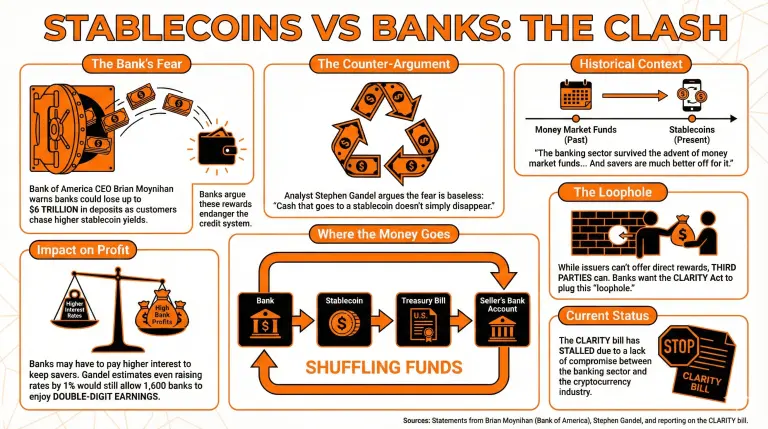
The discussion of stablecoin rewards in the CLARITY bill has prompted concerns from banks, which claim these rewards might endanger the credit system.
According to Bank of America’s CEO Brian Moynihan, banks could lose up to $6 trillion in deposits, as customers seek higher yields by holding stablecoins under the custody of cryptocurrency exchanges.
Stephen Gandel, a seasoned financial analyst and journalist, claims that the banks’ arguments are baseless, as there is no way to pull deposits from the system completely.
He explained:
“Cash that goes to a stablecoin doesn’t simply disappear – it goes into the reserve assets like Treasury bills or bank accounts.”
This means that whenever stablecoin issuers buy U.S. Treasuries to support their issuance, the party selling the debt instruments would have extra cash in their account. In this way, funds would just be shuffled around.
Gandel acknowledges that individual banks will have to pay more to keep savers’ cash under their control, potentially affecting their business model profitability. He alleges that raising interest levels by 1% would still allow 1,600 national banks to enjoy double-digit earnings, with the U.S. remaining the nation with the most banks even after this shift.
“The banking sector survived the advent of money market funds, even if many smaller regional lenders didn’t. And savers are much better off for it. The same may be true if stablecoins take off,” he concluded.
While stablecoins issuers have been banned from offering direct rewards to holders, third parties can still do it. Banks have qualified this as a loophole and are actively trying to plug it by including this consideration in the CLARITY Act.
Nonetheless, the bill has stalled due to a lack of compromise on this subject from both banks and the cryptocurrency industry.
FAQ
- What concerns have banks raised regarding stablecoin rewards in the CLARITY bill?
Banks argue that allowing stablecoin rewards could lead to a loss of up to $6 trillion in deposits as customers seek higher yields from cryptocurrency exchanges.
- How does financial analyst Stephen Gandel view the banks’ concerns?
Gandel claims the banks’ fears are unfounded, noting that cash moving to stablecoins does not disappear but is reallocated into assets like Treasury bills or bank accounts.
- What impact might the shift to stablecoins have on individual banks?
While banks may need to increase interest rates to retain customers, Gandel believes many national banks can still thrive, even with a 1% increase in rates.
- What is the current status of the CLARITY Act concerning stablecoin rewards?
The bill has stalled due to disagreements between banks and the cryptocurrency industry over how to manage stablecoin rewards and related loopholes.
Disclaimer: The information on this page may come from third parties and does not represent the views or opinions of Gate. The content displayed on this page is for reference only and does not constitute any financial, investment, or legal advice. Gate does not guarantee the accuracy or completeness of the information and shall not be liable for any losses arising from the use of this information. Virtual asset investments carry high risks and are subject to significant price volatility. You may lose all of your invested principal. Please fully understand the relevant risks and make prudent decisions based on your own financial situation and risk tolerance. For details, please refer to
Disclaimer.
Related Articles
Philippines Declares National Energy Emergency Due to Iran War, Global Energy Supply Under Pressure
Philippine President Ferdinand Marcos announced that the nation has entered an energy emergency state to address threats to energy supply from Middle East conflicts. Multiple countries globally that rely on imported energy have also implemented austerity measures, reflecting the fragility of energy supply chains and the impact of conflicts on international markets.
GateNews2h ago
International Energy Agency Director: Prepared to Release More Oil Reserves, Still Has 80% Inventory
International Energy Agency Director Birol stated in Tokyo that in response to surging global energy prices, it will prepare to release additional oil reserves. Previously, Japan's Prime Minister requested preparations for a second emergency release. The IEA has announced the release of 400 million barrels of oil and warned that global energy security faces severe threats.
GateNews2h ago
Deutsche Bank Report: Petrodollar System Faced Triple Pressure Before the War
Deutsche Bank report analyzes the current state of the petrodollar system, pointing out that it faced pressure before the war. Factors such as U.S. energy independence, the trend of oil currency localization, and shaken trust in the Gulf region pose challenges to the system, resulting in increased Middle Eastern oil flows to Asia and more non-dollar transactions.
GateNews3h ago
BlackRock CEO: If Oil Prices Reach $150 Per Barrel, It Will Trigger Global Economic Recession
BlackRock CEO Larry Fink stated in an interview that if oil prices reach $150 per barrel, it could trigger a global economic recession. He pointed out that the outcome of conflicts could lead to either a decline or sustained high oil prices, affecting the economic situation.
GateNews3h ago
UK Inflation Stays at Critical 3% Level: Energy Shock Incoming, Rate Cut Expectations May Be Disrupted
Data from the UK Office for National Statistics shows that the Consumer Price Index rose 3% year-over-year in February, with core inflation reaching 3.2%. The market expects inflation to remain elevated due to Middle East conflicts and rising energy prices, which will impact monetary policy. The pound weakened slightly against the dollar, with analysts predicting the Bank of England may maintain high interest rates to counter the "second-round inflation effects."
GateNews3h ago
Morgan Stanley Raises 2027 Brent Crude Oil Price Forecast to $80 per Barrel
Gate News reported that on March 25, Morgan Stanley raised its 2027 Brent crude oil (one of the global crude oil price benchmarks) price forecast to $80 per barrel.
GateNews4h ago


