Trade
Basic
Futures
Futures
Hundreds of contracts settled in USDT or BTC
TradFi
Gold
Trade global traditional assets with USDT in one place
Options
Hot
Trade European-style vanilla options
Unified Account
Maximize your capital efficiency
Demo Trading
Futures Kickoff
Get prepared for your futures trading
Futures Events
Participate in events to win generous rewards
Demo Trading
Use virtual funds to experience risk-free trading
Earn
Launch
CandyDrop
Collect candies to earn airdrops
Launchpool
Quick staking, earn potential new tokens
HODLer Airdrop
Hold GT and get massive airdrops for free
Launchpad
Be early to the next big token project
Alpha Points
Trade on-chain assets and enjoy airdrop rewards!
Futures Points
Earn futures points and claim airdrop rewards
Investment
Simple Earn
Earn interests with idle tokens
Auto-Invest
Auto-invest on a regular basis
Dual Investment
Buy low and sell high to take profits from price fluctuations
Soft Staking
Earn rewards with flexible staking
Crypto Loan
0 Fees
Pledge one crypto to borrow another
Lending Center
One-stop lending hub
VIP Wealth Hub
Customized wealth management empowers your assets growth
Private Wealth Management
Customized asset management to grow your digital assets
Quant Fund
Top asset management team helps you profit without hassle
Staking
Stake cryptos to earn in PoS products
Smart Leverage
New
No forced liquidation before maturity, worry-free leveraged gains
GUSD Minting
Use USDT/USDC to mint GUSD for treasury-level yields

More


Featured Courses
More
Advanced
Tools That Help You Trade Better: Moving Averages, Trend Lines, and Indicators
There are no trading rules that are applicable to any scenario. These courses will help you establish your own trading strategy, then test it and improve on it in practice
Advanced
Introduction to Shared Sequencer Networks & Atomic Composability
Shared sequencer networks and atomic composability are emerging as core innovations in modular blockchain ecosystems. They address fundamental challenges caused by the proliferation of rollups, particularly the fragmentation of liquidity and the loss of synchronous transaction ordering that previously defined monolithic chains. This course introduces these concepts from first principles and explores their role in enabling scalable, secure, and composable multi-rollup environments.

Intermediate
Introduction to Flare (FLR)
This course provides a structured overview of the Flare Network (FLR), a Layer 1 blockchain designed to support smart contracts, decentralized data access, and cross-chain interoperability. Through technical modules, learners will understand how Flare integrates external data into on-chain applications, supports non-smart contract assets, and maintains network security and governance. The course is intended for those seeking practical knowledge of Flare’s architecture, tokenomics, protocol features, and governance systems.
Learn by Topic
Topics
Altcoins
Bitcoin
Blockchain
DeFi
Ethereum
Metaverse
NFT
Trading
Tutorial
Futures
Quant Trading
BRC-20
GameFi
DAO
Macro Trends
Wallets
Inscription
Technology
Meme
AI
SocialFi
DePin
StableCoin
Liquid Staking
Finance
RWA
Modular Blockchains
Zero-Knowledge Proof
Restaking
Crypto Tools
Airdrop
Gate Products
Security
Project Analysis
CryptoPulse
Research
TON Ecosystem
Layer 2
Solana
Payments
Mining
Hot Topics
Sui Ecosystem
Chain Abstraction
Options
Quick Reads
Video
Daily Report
Market Forecast
Trading Bots
VIP Weekly Industry Report
ETF
Top Stories
XRP
Pi Network
VIP Daily Industry Report
In-Depth Research
Gate Ventures
Weekly Report
Investment News
Perpetual DEX
Web3 For Beginners
Base
Protocols
DApp
Gate Private Wealth Management
Platform Highlights
The Latest News
TradFi
Difficulty
Beginner
Intermediate
Advanced
Latest Courses
More
Intermediate
Introduction to Zero‑Knowledge Coprocessors
Zero‑Knowledge Coprocessors (ZK Coprocessors) are a new advancement in blockchain technology that combine off‑chain computation with on‑chain verification. They allow blockchains to process complex or data‑heavy tasks without compromising security or decentralization. By generating cryptographic proofs, ZK Coprocessors ensure that off‑chain computations can be trusted without having to repeat them on‑chain.
This course provides a comprehensive understanding of ZK Coprocessors, from basic concepts and cryptographic foundations to real‑world applications and future research directions. It is designed to bridge the knowledge gap for both beginners and experienced blockchain developers seeking to explore this emerging field.

Advanced
Introduction to Stateless Ethereum & Verkle Trees
Ethereum’s roadmap toward stateless clients represents one of the most significant protocol shifts since its inception. As state size continues to grow, full nodes face increasing storage and synchronization burdens, threatening decentralization and accessibility. Stateless Ethereum proposes a new validation model where nodes verify blocks using compact cryptographic proofs instead of maintaining the entire state. At the center of this approach are Verkle Trees, a data structure that drastically reduces proof sizes and enables efficient stateless validation. This course provides a comprehensive understanding of this transformation, covering both theoretical foundations and real-world implementations.
00:10:27
Beginner
Bitcoin Fundamental (Video)
Bitcoin is the most representative cryptocurrency, which represents the rise and fall of the cryptocurrency market and has witnessed history. A deep understanding of all aspects of Bitcoin is the first step into the cryptocurrency market
Latest Articles
More
Intermediate
2026 Robotics Track Practice: Who's Building Roads, Who's Mining, and Who's Creating Systems?
This article employs a data-driven approach to compare FDV risks, highlighting DePIN's shift from speculative hype to practical implementation through a positive feedback cycle. It offers investors a thorough analysis of the machine economy's complete ecosystem.
2026-02-25 10:10:47

Beginner
What Is Dogecoin (DOGE)? A Complete Beginner's Guide
Dogecoin is an open source cryptocurrency designed for peer to peer value transfer and small tips. As decentralized payments have evolved, Dogecoin has been widely used in social media tipping, charitable donations, and online retail payments.
2026-02-25 10:08:02

Beginner
What Is Chainlink? A Comprehensive Guide to the Principles, Mechanisms, and Application Ecosystem of Web3 Oracles
Chainlink is a decentralized oracle network that brings real-world off-chain data, secure computation results, and external system states onto blockchains.
2026-02-25 10:06:13
Latest Research
More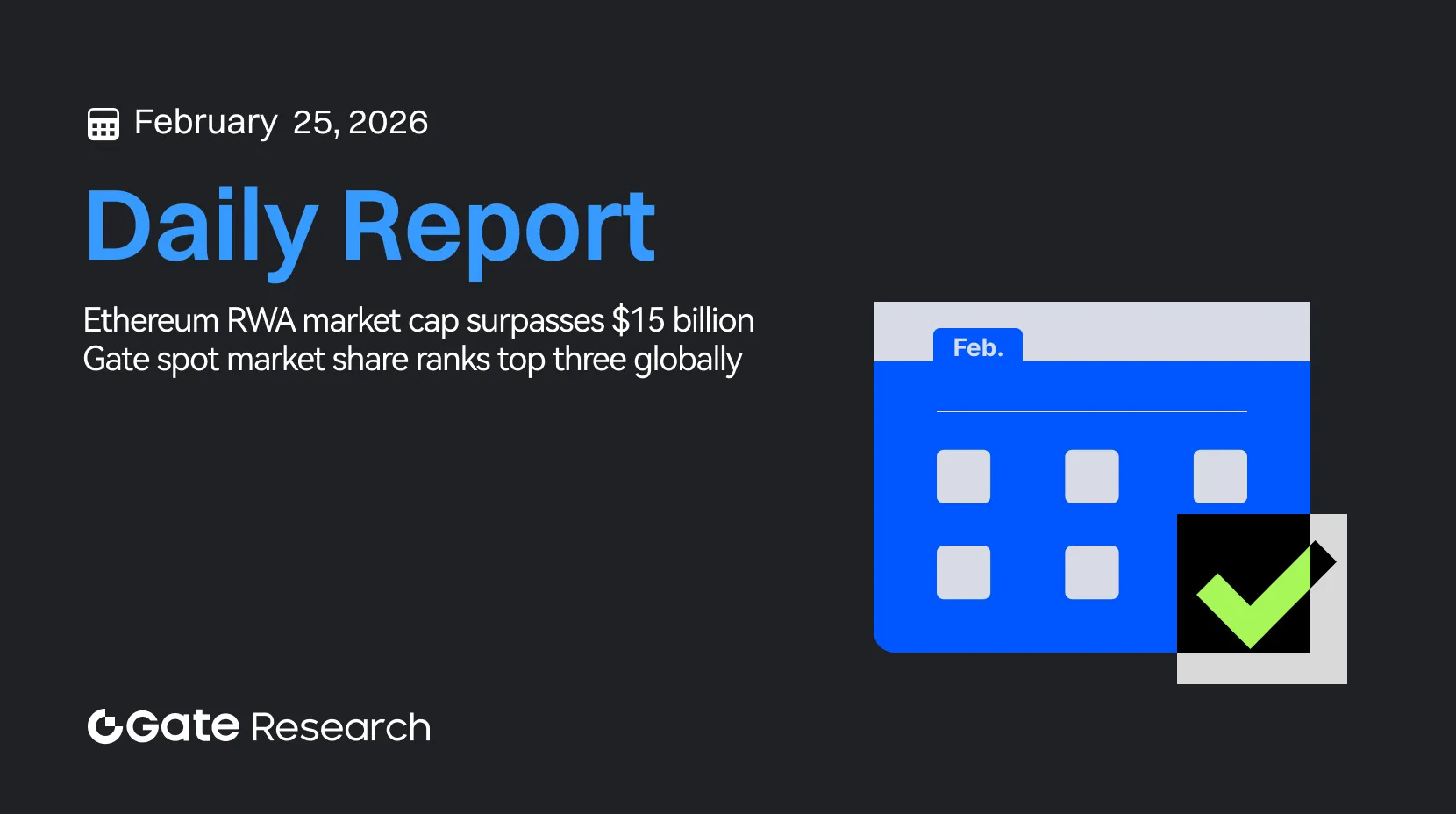
Advanced
Gate Research: Ethereum RWA Market Cap Surpasses $15 Billion | Gate Spot Market Share Ranks Top Three Globally
Gate Research Daily Report: On February 25, the crypto market saw a technical rebound, but overall conditions remain range-bound and largely driven by market sentiment, with BTC and ETH showing short-term recovery while medium-term direction remains unclear. Capital continues to rotate into high-narrative assets, with ENSO, ESP, and POWER strengthening on catalysts tied to cross-chain execution infrastructure, unified interaction layers, and funding tailwinds, respectively. Structurally, Ethereum RWA market capitalization has surpassed $15 billion, signaling accelerating real-world asset tokenization, while Gate continues to укрепen its spot and derivatives market share and advance TradFi and AI trading features—highlighting infrastructure build-out and compliance as key medium- to long-term themes.
2026-02-25 07:56:56
Advanced
Gate Research: Vitalik Sold 10,700 ETH This Month | IBM Plunges 11% as AI Disrupts Traditional Business Models
Gate Research Daily Report: Affected by factors including Trump’s proposed 15% global tariffs, Bitcoin lacks strong upward momentum. Ethereum continues to consolidate near its 20-day low, with multiple momentum indicators still pointing to a weak market structure. PIPPIN rose 16.62%, mainly driven by strong speculative buying and community momentum. POWER gained 12.05%, largely fueled by leveraged trading activity. Anthropic’s announcement on automating COBOL system modernization triggered an 11% drop in IBM’s share price. ZachXBT is set to release a major investigation, with prediction markets and Trump-related projects expected to face scrutiny. Vitalik sold 10,700 ETH this month at an average price of $2,027, drawing market attention.
2026-02-24 06:03:24
Advanced
Gate Research: January 2026 Crypto Market Review
In January, BTC and ETH trading volumes generally fluctuated at elevated levels. Market sentiment shifted from a recovery phase toward caution, with limited trend persistence. Stablecoin market capitalization across major blockchains remained highly concentrated, with Ethereum accounting for more than half of the total. Gold and silver prices reached record highs, while the market cap of tokenized commodities surpassed $5 billion. Prediction markets recorded a new monthly high of $12 billion in trading volume, with both activity and fees expanding in tandem. The Web3 industry completed 53 funding rounds in January, with capital primarily flowing into blockchain services and the CeFi sector. Smart contract vulnerabilities continued to be the leading source of Web3 security risks.
2026-02-24 02:39:35
Glossary
Moreapr
Annual Percentage Rate (APR) represents the yearly yield or cost as a simple interest rate, excluding the effects of compounding interest. You will commonly see the APR label on exchange savings products, DeFi lending platforms, and staking pages. Understanding APR helps you estimate returns based on the number of days held, compare different products, and determine whether compound interest or lock-up rules apply.
fomo
Fear of Missing Out (FOMO) refers to the psychological phenomenon where individuals, upon witnessing others profit or seeing a sudden surge in market trends, become anxious about being left behind and rush to participate. This behavior is common in crypto trading, Initial Exchange Offerings (IEOs), NFT minting, and airdrop claims. FOMO can drive up trading volume and market volatility, while also amplifying the risk of losses. Understanding and managing FOMO is essential for beginners to avoid impulsive buying during price surges and panic selling during downturns.
nft
An NFT (Non-Fungible Token) is a unique certificate recorded on the blockchain that represents ownership and attributes of a specific digital work or on-chain asset. NFTs are minted by smart contracts, which also store their metadata. Unlike fungible tokens, NFTs are indivisible and cannot be exchanged on a one-to-one basis. They are commonly used in digital art, in-game items, event tickets, and membership passes, enabling proof of ownership, provenance tracking, and trading. Some platforms also support creator royalties and cross-chain display of NFTs.
leverage
Leverage refers to the practice of using a small amount of personal capital as margin to amplify your available trading or investment funds. This allows you to take larger positions with limited initial capital. In the crypto market, leverage is commonly seen in perpetual contracts, leveraged tokens, and DeFi collateralized lending. It can enhance capital efficiency and improve hedging strategies, but also introduces risks such as forced liquidation, funding rates, and increased price volatility. Proper risk management and stop-loss mechanisms are essential when using leverage.



Your Gateway to Crypto World, Subscribe to Gate for a New Perspective