
Bitcoin (BTC) continues its weak decline from the weekend, currently around $66,380 as of March 30, with the U.S.-Iran war still unresolved. Kalshi faces another lawsuit in Washington State, signaling an escalation in market regulation storms. Canada plans to ban cryptocurrency political donations, with related legislation entering its first reading.
Macro Events & Crypto Highlights
- According to CoinDesk, Washington State Attorney General Nick Brown has filed a civil lawsuit against prediction market platform Kalshi, accusing it of violating state gambling and consumer protection laws by offering betting services on sports, elections, and war events. The lawsuit has been submitted to the King County Superior Court, seeking to ban Kalshi from operating locally, recover residents’ lost funds, and impose civil fines. This is another regulatory action the company is facing, currently involved in over 20 civil lawsuits. Previously, Arizona prosecutors had filed criminal charges against it, considered the first criminal case targeting prediction markets.
The complaint states that Kalshi’s advertisements implied users could bypass local laws to participate in NFL betting, indicating they “knowingly violated regulations.” Kalshi responded that it is a federally regulated compliant trading platform, denying offering war-related markets, and expressed confidence in winning the legal case.
- Although Canada has permitted crypto donations since 2019, they have been rarely used in the 2021 and 2025 federal elections. Regulators believe that the “pseudo-anonymity” of crypto assets and the difficulty in tracing funds pose potential risks to election transparency, leading to a move toward a full ban. Reports indicate that the Canadian government proposed the “Strong and Free Elections Act” (C-25) on March 26, aiming to ban the use of cryptocurrencies like Bitcoin for political donations, classifying them alongside money orders and prepaid payment tools as “difficult to trace” funding methods. The ban covers registered parties, candidates, campaign teams, and third-party campaign advertisers, meaning crypto assets will be fully excluded from federal election financing. This follows the UK’s recent temporary ban on crypto political donations, showing a clear trend toward stricter regulation.
According to the bill, any improperly received crypto donations must be returned or disposed of and remitted to the treasury within 30 days, with fines up to twice the amount of the violation and an additional maximum of $100,000. The bill has now entered its first reading stage in Parliament.
News Updates
p, li { white-space: pre-wrap; } hr { height: 1px; border-width: 0; } li.unchecked::marker { content: “\2610”; } li.checked::marker { content: “\2612”; }
-
Willy Woo: Traditional on-chain models suggest Bitcoin’s bottom may be between $46,000 and $54,000.
-
Walmart-backed OnePay has added over ten tokens to its crypto services.
-
Huang Licheng has increased positions after partial liquidation, with total losses reaching $31.3 million.
-
Iranian Parliament Speaker: The so-called “news” before the market is just a trap set for profit-taking.
-
Iranian Foreign Ministry spokesperson: The proposals from the U.S. via intermediaries are very unreasonable.
-
Sources: Senate hearings for Fed Chair nominee Waller may be held as early as the week of April 13.
-
Gnosis and Zisk launched the “Ethereum Economic Zone” Rollup framework funded by the Ethereum Foundation.
-
CoinList will support OneFootball’s token TGE on April 9.
-
Data shows tokens like SUI, EIGEN, OPN, etc., will undergo large unlocks this week, with SUI unlocking approximately $37.2 million worth.
Market Trends
-
Latest Bitcoin news: $BTC continues its weak weekend decline, around $66,380, with $120 million liquidated in the past 24 hours, mostly long positions.
-
U.S. stocks plummeted on March 27, with the Dow Jones Industrial Average dropping over 10% from its February peak, following the Nasdaq Composite into correction territory. As the U.S.-Iran war enters its fifth week, the S&P 500 may soon follow. The Dow fell 793 points, down 1.7%, and the Nasdaq, which had already entered correction on the 26th, declined 2.1%, with a weekly drop of 3.2%, the largest since April last year. Meta and Micron fell over 15% and 11%, respectively, while Alphabet and Microsoft declined nearly 9% and 7%. The S&P 500 fell 2.1% last week, marking five consecutive weeks of decline—the longest in nearly four years—and has dropped 7.4% since March, heading toward its worst monthly performance since 2022.
 (Source: Bitcoin Counter Flow)
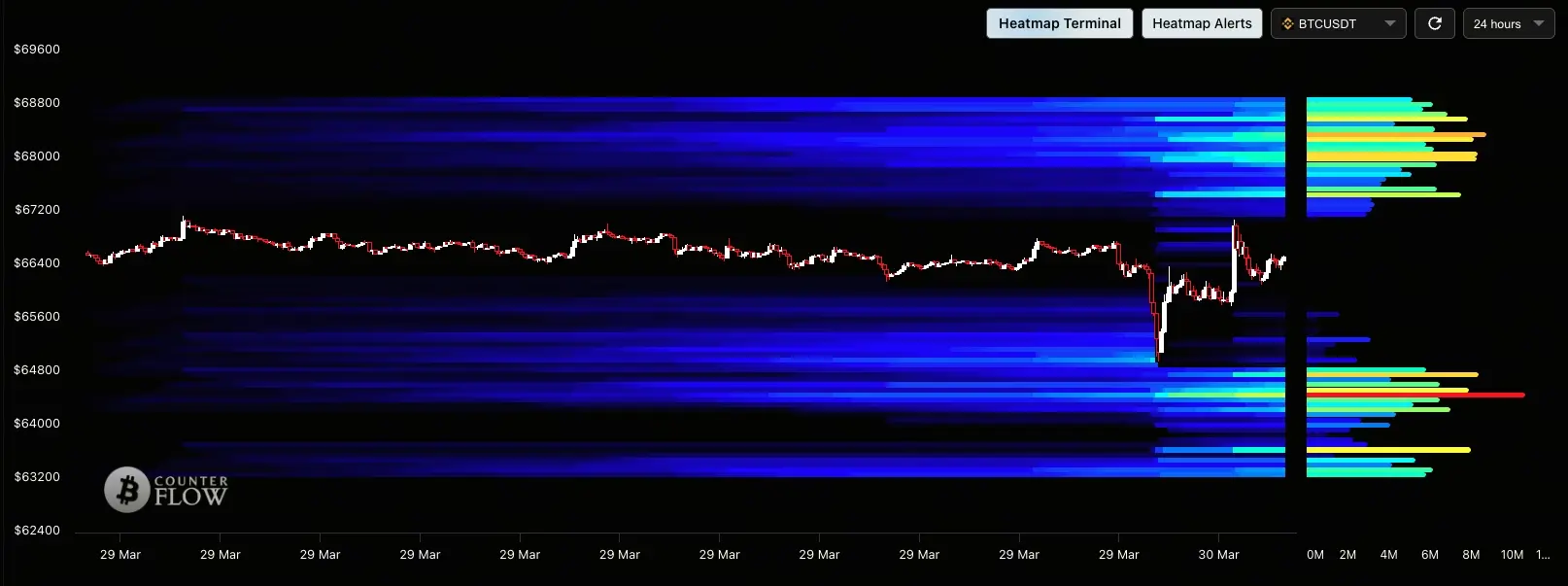
- In the Gate BTC/USDT liquidation map, based on the current price of 64,425 USDT, if it drops to around $63,600, the total long liquidation will exceed $8 million; if it rises to about $68,325, the short liquidation will exceed $9 million. Short positions have higher liquidation amounts than longs, so traders should control leverage carefully to avoid large-scale liquidations during market swings.
 (Source: Coinglass)
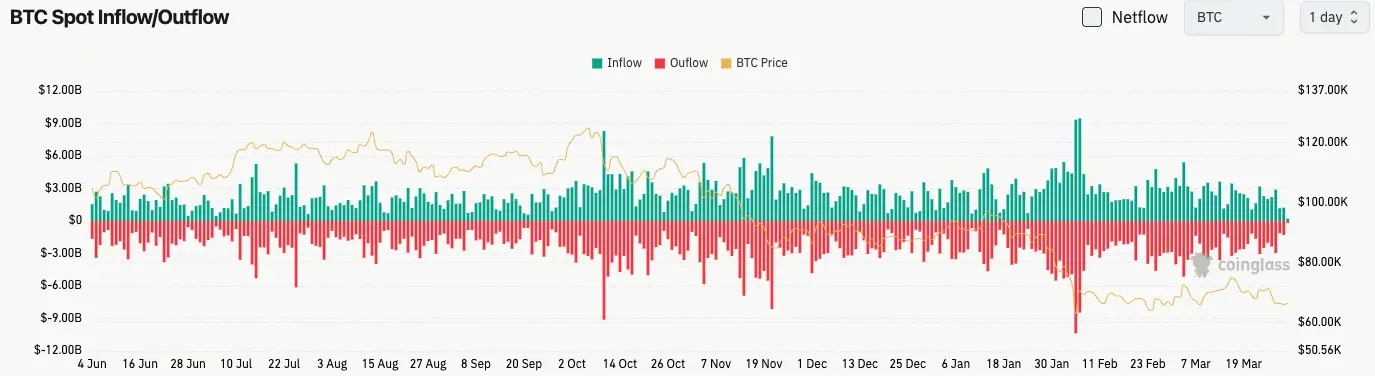
- In the past 24 hours, Bitcoin saw inflows of $1.23 billion and outflows of $1.29 billion, resulting in a net outflow of $60 million.
 (Source: Coinglass)
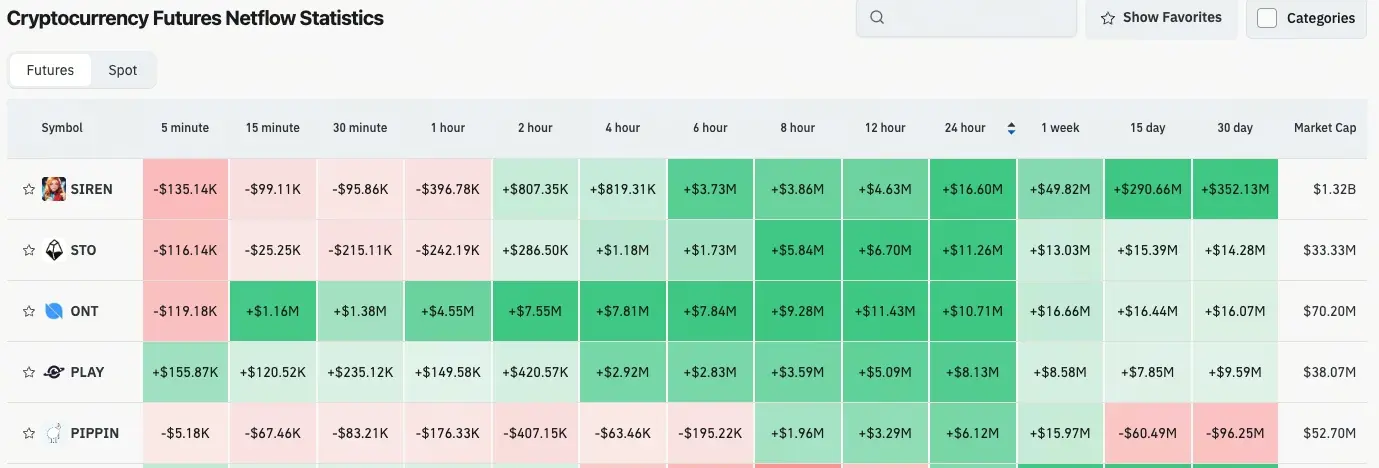
- Over the last 24 hours, contracts such as $SIREN, $STO, $ONT, $PLAY, and $PIPPIN led net outflows, indicating trading opportunities.
KOLs’ Selected Insights
Phyrex Ni (@Phyrex_Ni): “Today was relatively uneventful, a weekend without much fuss. Bitcoin’s price only fluctuated slightly over the weekend, and although there’s a sense of escalation in the war, it didn’t translate into Bitcoin’s price over the weekend. This suggests that outside institutional investors, real retail investors are not paying much attention to the current market behavior. The focus might still be on how Asian traders react after the CME opens on Monday and how U.S. investors respond after the U.S. stock market opens in the evening.”
“The impact of the war on oil prices is becoming uncontrollable. Today, many global analysts believe Brent crude could surge to $200. I initially thought $150 was hard enough, but if it hits $200, we’ll have to consider rate hikes and recession risks; inflation could rebound significantly. We’re probably just three weeks away from the depletion of the strategic reserves released by the IEA.”
“Not only are there no signs of a ceasefire, but the war’s development is becoming more severe. The Houthis have officially entered the conflict, and how long it will take to blockade the Red Sea remains uncertain. The Middle East is heavily impacted, and the U.S. has dispatched large troop numbers. If I were Trump, I’d be very worried. After the war, tariffs, the Fed, and midterm elections will still be waiting.”
“Looking at Bitcoin data, the weekend’s turnover rate continues to decline, and trading volume is decreasing. This indicates that even with escalating war tensions, investors show little interest in trading and no panic. The overall holdings structure remains normal; the key is to watch U.S. stock investor behavior after Monday’s opening.”
Today’s Outlook
- No major economic data releases.
Disclaimer: The information on this page may come from third parties and does not represent the views or opinions of Gate. The content displayed on this page is for reference only and does not constitute any financial, investment, or legal advice. Gate does not guarantee the accuracy or completeness of the information and shall not be liable for any losses arising from the use of this information. Virtual asset investments carry high risks and are subject to significant price volatility. You may lose all of your invested principal. Please fully understand the relevant risks and make prudent decisions based on your own financial situation and risk tolerance. For details, please refer to
Disclaimer.


