On Threads, there’s a rumor that someone who claims to be an accountant will have Taiwan’s special act to ban USDT. In reality, it’s fear-based marketing. The draft clearly states that offshore stablecoins can be traded after obtaining approval from the competent authority. People are urged not to believe the rumor and to turn away from illegal underground coin traders, and to choose legitimate trading platforms to avoid scams.
Someone claiming to be an accountant spreads a rumor: USDT will be banned after the special act is passed
Yesterday (4/8), an anonymous user on Threads who claims to hold a CPA accounting license posted sensational remarks about the draft of the “Virtual Asset Services Act” that the Executive Yuan recently passed.
The user claimed that Articles 34 and 35 of the new law explicitly provide that stablecoins must be approved by the competent authority and consulted with the Central Bank, and further stated that the conservative Central Bank would never allow Tether ( $USDT ) to legally circulate in Taiwan. Once the regulations take effect, all Taiwan exchanges will全面禁止 to provide trading services, and $USDT will soon become an unqualified “black account.” At present, the post has already received 20k views.
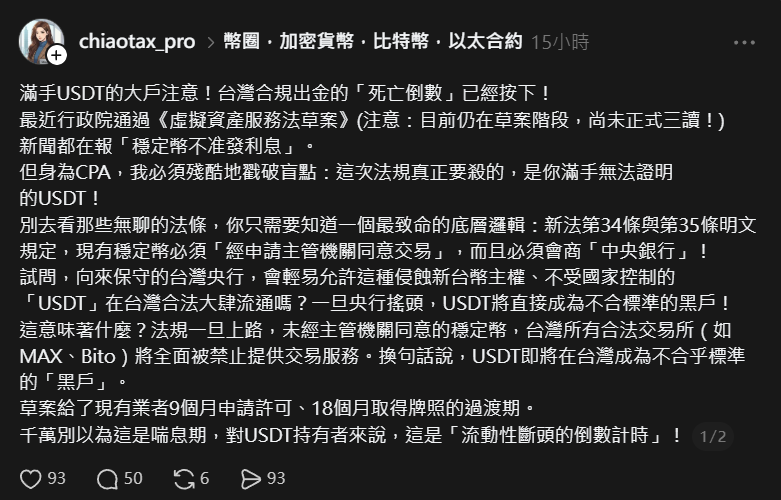
Image source: Threads
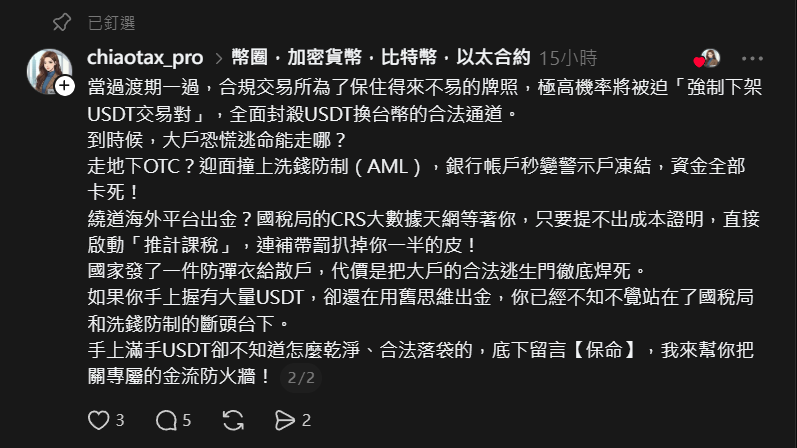
Image source: Threads
《Crypto City》editor-in-chief Max responded to this. The fear-marketing in this article is pretty good, but the interpretation of the regulations is excessively misguided. The value of compliant expertise lies in helping funds find legal, viable paths. By amplifying the blurred area of the draft and describing it as an escape door that has been completely welded shut, it completely departs from the essence of professional analysis.
Max emphasized that the core of the draft is the market entry qualification and risk-control mechanisms for virtual asset service providers. The asset itself is not directly the regulatory target. The reasoning that turns potentially delisted trading pairs into a “liquidity breakdown” is too linear, and the draft’s legal text is packaged in a doomsday narrative style—highly irresponsible and unprofessional.
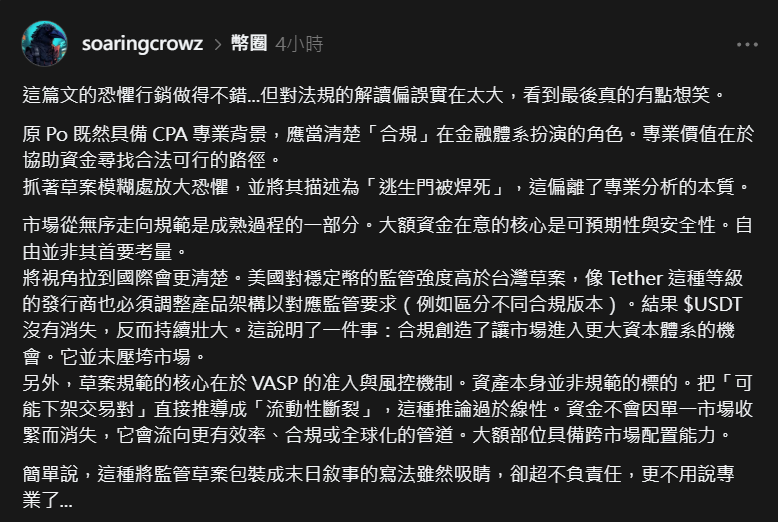
Image source: Threads
In addition, judging from this account’s pinned post, it seems they’ve been presenting themselves as an accountant for some time. However, the accountant certificate names have been redacted and the profile picture is also AI-generated. It’s only natural to wonder: if they’re trying to build a brand as a real-life accountant, would they really hide their identity like this?

Review Article 35 of the special-act draft and puncture the user’s fallacy
If you actually look at Article 35 of the Executive Yuan’s passed “Virtual Asset Services Act” draft, it’s easy to dismantle the absurd conclusion made by that user.
In the “Explanation” section of the draft’s Article 35, it is written in black and white:
When a virtual asset service provider provides services involving stablecoins, it is limited to stablecoins issued in our country with the permission of the competent authority, or—although not issued in our country—stablecoins for which the competent authority has consented to trading in our country.
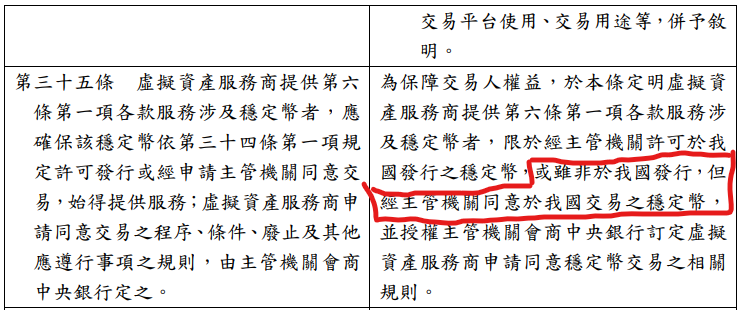
Image source: Legal provisions of the draft “Virtual Asset Services Act”
This provision clearly indicates that for offshore stablecoins that are not issued in Taiwan, the regulation has already established a mechanism for applying for and obtaining consent to trade.
The logic error of this Threads user is that without any basis, they pre-assume that after the special act is passed, the Central Bank will necessarily reject all offshore stablecoins across the board, and treat this invented assumption as an established fact to frighten people.
In practice, the purpose of the regulation is to bring the market under governance, requiring platform operators—before offering relevant trading pairs—to have robust assessment and application procedures. Sliding “establishing review and compliance mechanisms” directly into “a blanket crackdown on USDT” does not hold up logically at all.
Breaking down the community rumor playbook: shoot first, then draw the target
Looking back at recent panic posts on social media about Taiwan exchange deposits and withdrawals, you can find that rumors of this kind usually follow very similar writing structures and tactics. Most of them have a strong “AI vibe,” and they also explicitly or implicitly tell you at the end of the post that you need to find other withdrawal channels.
The author breaks down the structure of posts like this:
- First, the post uses extremely sensational headlines to create panic like Taiwan’s crypto deposits and withdrawals are being cut off.
- Then, it magnifies recent risk-control upgrades, hacker incidents, or wording from the draft at legitimate exchanges, completely denying the official deposit/withdrawal route.
- Finally, at the end of the article, it guides readers to DM, or asks them to leave specific words to obtain an exclusive “lifesaving” channel.
The core purpose of posts like this is simply to destroy the public’s trust in legitimate platforms, and then convert traffic and funds into underground exchange and remittance groups privately run by the person who posted.
Related coverage:
Is TWD deposits/withdrawals out of control? Beware—they tell you not to use exchanges, but it’s actually promoting their own personal coin dealer
Threads explodes with massive AI matrix accounts! They funnel people to illegal coin dealers—watching the chain of clues; Binance also responded
Don’t panic when regulation goes live—stay away from illegal underground coin dealers
Currently, the government has clearly stated that virtual asset service providers must complete anti-money-laundering measures and service energy registration. Any personal coin dealers that operate without registering according to law are engaging in illegal operations and face the harshest penalty of imprisonment of up to 2 years or fines of up to 5 million New Taiwan Dollars.
The draft “Virtual Asset Services Act” also provides that operating without permission or offering stablecoins will be punished with imprisonment of up to 7 years, and may be accompanied by fines of up to 100 million New Taiwan Dollars.
According to information from the Criminal Investigation Bureau, since new rules took effect at the end of 2024, police have been carrying out crackdowns and arrests targeting illegal street coin dealers, and have also seized large sums of money.
- **Related coverage:**Taipei: crypto currency hand-to-hand robbery in 3 cases in 4 days! A “no fees” script scam tricks the public; police urge people to use legitimate exchanges
Use legitimate coin dealers to avoid ending up with a black U or a scam
Although there are posts like this on Threads from time to time, this time it directly claims the person has an accountant identity, which is relatively rare.
When facing community panic posts like this, stay rational. If the article affects you and you end up DMing the anonymous user, you could be lured into using illegal coin dealers, or fall into scams with unclear origins.
If you want to trade cryptocurrencies, you must choose legitimate providers announced by the Financial Supervisory Commission and use normal channels that can leave transaction records, such as bank transfers. Do not let your funds be exposed to extremely high risks in underground markets, just because you want convenience for a moment or trust internet rumors.
Below are the currently legitimate virtual asset service providers (VASP) in Taiwan, listed in order by stroke count:
- 禾亞數位科技(HOYA BIT)
- 拓荒數碼科技(ZONE Wallet)
- 現代財富科技(MaiCoin、MAX 交易所)
- 重量科技(KryptoGO)
- 富昇數位科技(TWEX)
- 跨鏈科技(Chainss)
- 幣託科技(BitoPro)
- 鏈科股份有限公司(XREX 交易所)
Disclaimer: The information on this page may come from third parties and does not represent the views or opinions of Gate. The content displayed on this page is for reference only and does not constitute any financial, investment, or legal advice. Gate does not guarantee the accuracy or completeness of the information and shall not be liable for any losses arising from the use of this information. Virtual asset investments carry high risks and are subject to significant price volatility. You may lose all of your invested principal. Please fully understand the relevant risks and make prudent decisions based on your own financial situation and risk tolerance. For details, please refer to
Disclaimer.
Related Articles
IMF's Former Chief Economist Warns Double Deregulation Could Trigger Systemic Financial Crisis
Gate News message, April 27 — Kenneth Rogoff, former chief economist of the International Monetary Fund, has warned that the Trump administration's push for financial deregulation—particularly loosening bank capital requirements and regulatory transparency—is significantly raising the risk of a
GateNews30m ago
Mike Novogratz: The 《CLARITY Act》 was submitted to the committee for review in May, with an estimated approval rate of 50%
Galaxy Digital CEO Mike Novogratz said in a podcast episode he posted on YouTube on April 25 that the U.S. “CLARITY Act” will be submitted to a Senate committee for review during the first week of May, and it is expected that Trump will complete the signing in June. Alex Thorn, head of research at the firm, estimates the probability that the bill will pass in 2026 at 50%.
MarketWhisper1h ago
Japan's FSA Outlines Dual-Track Strategy for Digital Assets: Investor Protection and Financial Infrastructure
Gate News message, April 26 — Japan's Financial Services Agency is pursuing a two-pronged approach to digital asset regulation, balancing investor protection with infrastructure innovation, according to remarks by Shigeru Shimizu, Head of Risk Analysis at the FSA, delivered April 21 at a
GateNews3h ago
Tennessee Becomes Second U.S. State to Ban Crypto ATMs Statewide
Gate News message, April 26 — Tennessee has become the second U.S. state to outright ban cryptocurrency ATMs, with Gov. Bill Lee signing House Bill 2505 into law on April 13 after unanimous passage in both chambers. The law will take effect on July 1 and makes it a misdemeanor to operate or host
GateNews3h ago
Study Finds Only 3% of Polymarket Traders Are Skilled, Capturing Over 30% of Gains
Gate News message, April 26 — A new academic paper analyzing Polymarket transactions from 2023 through 2025 concludes that the platform's accuracy reflects "the wisdom of an informed minority, not the wisdom of the crowd." The research, revised April 25 by scholars from London Business School and
GateNews3h ago
DOJ Drops Probe into Powell, Clearing Path for Crypto-Friendly Kevin Warsh to Lead Fed
Gate News message, April 26 — The U.S. Department of Justice has dropped its criminal investigation into Federal Reserve Chair Jerome Powell, clearing the way for the Senate to confirm Kevin Warsh as the next Fed chair. U.S. Attorney for the District of Columbia Jeanine Pirro announced the
GateNews4h ago


