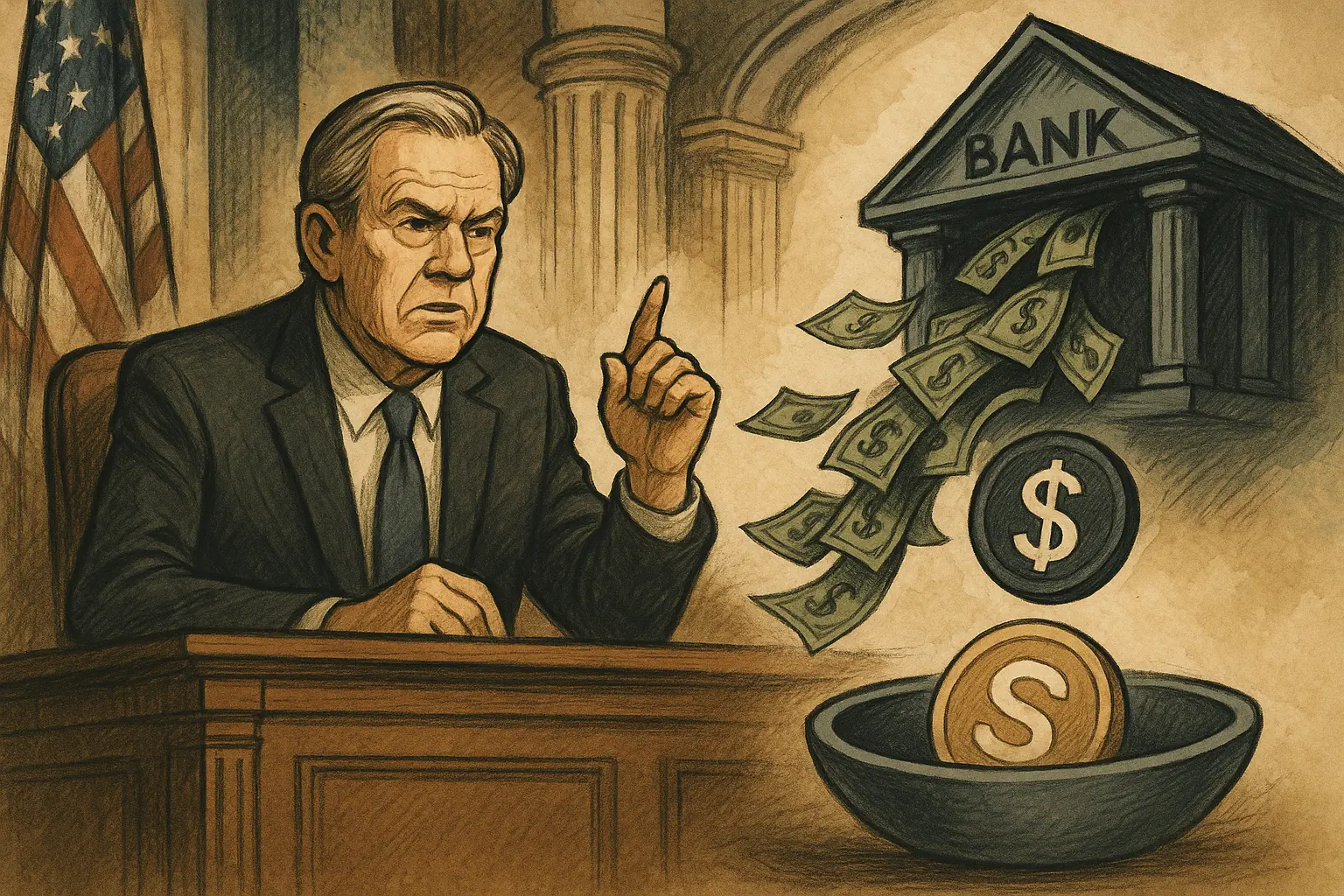
The U.S. Senate Banking Committee held a hearing on February 27, where banking regulators gathered to testify on the topic of stablecoin yields. Democratic Senator Angela Alsobrooks expressed concerns that some stablecoin reward mechanisms could blur the line between crypto products and bank deposits without regulatory protections, potentially leading to bank deposit outflows.
Hearing Focus: The Legislative Gap on Yields Post-GENIUS Act
The core of the hearing centered on how the GENIUS Act (passed in July 2026) addresses stablecoin yield issues. The GENIUS Act explicitly bans stablecoin issuers from paying interest directly to holders but does not prohibit third-party platforms like Coinbase from offering rewards to users. This legislative gap became the main point of debate.
Alsobrooks stated, “What we’re worried about is products that resemble bank deposits but lack any protections or regulation, and what this could mean for future deposit outflows.”
North Carolina Republican Senator Tom Tillis said he plans to submit an independent assessment request to regulators on deposit outflow risks: “I need some independent evaluation reports so we can move forward with this.”
However, Ohio Republican Senator Bernie Moreno, a supporter of cryptocurrency, asked whether all regulators have “seen large-scale deposit outflows from banks,” to which all four regulators responded no. FDIC Chair Travis Hill replied, “Banks are still performing quite well.”
Banking vs. Crypto Industry: Divergent Perspectives
Behind this debate lies a fundamental conflict of interest between the banking industry and the cryptocurrency sector, each offering contrasting analytical frameworks.
The Independent Community Bankers of America (ICBA) research indicates that allowing platforms to pay yields on stablecoin holdings could lead to a $1.3 trillion decrease in community bank deposits, reducing their lending capacity by $850 billion. Coinbase policy chief Faryar Shirzad countered, “There’s no substantial link between the proliferation of stablecoins and deposit outflows from community banks.”
Tim Scott cited studies during the hearing, noting that deposits actually increased after the passage of the GENIUS Act, and said, “Concerns about deposit outflows seem to have been completely unfounded.”
Summary of Positions
Banking Industry (ICBA): Allowing yields would cause $1.3 trillion in deposit outflows, shrinking community bank lending by $850 billion.
Coinbase (Faryar Shirzad): The spread of stablecoins is not materially linked to bank deposit outflows; restricting yields stifles innovation.
Federal Regulators (FDIC, etc.): No signs of large-scale deposit outflows so far; bank performance remains solid.
White House: Actively mediating, organizing meetings between crypto firms and banks, with a deadline at the end of the month to reach a resolution.
The OCC released a proposal for implementing the GENIUS Act the night before the hearing, clarifying its regulatory authority over certain issuers. Federal Reserve Vice Chair Michelle Bowman stated that they will clarify how digital assets are handled to ensure the banking system can “better support digital asset activities.”
Frequently Asked Questions
What are the regulations on stablecoin yields under the GENIUS Act, and what is the core controversy?
The GENIUS Act bans stablecoin issuers from paying interest directly to holders but does not restrict third-party platforms like Coinbase from offering rewards. Opponents argue that such rewards effectively replicate bank deposit interest without regulatory protections; supporters see this as legitimate platform competition that does not threaten the banking system.
Is there actual data supporting concerns about deposit outflows from banks?
Currently, there is no concrete data indicating large-scale deposit outflows. FDIC Chair mentioned that bank performance remains “quite good,” and Tim Scott’s cited research shows deposits increased after the GENIUS Act’s passage. The main argument from banks is based on predictive estimates (ICBA’s $1.3 trillion outflow estimate), not on actual observed shifts, leading to fundamental disagreements.
How will the OCC’s proposed regulatory framework for stablecoins impact the market?
The OCC’s proposal clarifies its regulatory jurisdiction over national bank subsidiaries and federally qualified payment stablecoin issuers. This framework aims to provide clearer compliance pathways for regulated stablecoin issuers and signifies active regulatory engagement in building a stablecoin market infrastructure.
Disclaimer: The information on this page may come from third parties and does not represent the views or opinions of Gate. The content displayed on this page is for reference only and does not constitute any financial, investment, or legal advice. Gate does not guarantee the accuracy or completeness of the information and shall not be liable for any losses arising from the use of this information. Virtual asset investments carry high risks and are subject to significant price volatility. You may lose all of your invested principal. Please fully understand the relevant risks and make prudent decisions based on your own financial situation and risk tolerance. For details, please refer to
Disclaimer.
Related Articles
Federal Reserve Board Member Mullan: Interest rates should be lowered to a neutral level of 2.5%-2.75%
Gate News reports that on March 6th, Federal Reserve Board Member Milan expressed his views on interest rate policy, stating that the neutral interest rate is approximately 2.5% to 2.75%. Milan pointed out that if the Federal Reserve does not cut interest rates this month, he will oppose it, believing that the Fed should lower rates to the neutral level and then reassess the policy direction.
GateNews6h ago
Federal Reserve Board Member Mullan: The Federal Reserve usually does not respond to oil prices
Gate News Report, March 6 - Federal Reserve Board Member Michelle Bowman stated that the Federal Reserve generally does not respond to oil prices. She pointed out that if there is any impact, oil price fluctuations tend to push the Fed toward a more dovish policy stance, as oil shocks could dampen core inflation by hurting demand.
GateNews6h ago
Federal Reserve's Goolsbee: Expect interest rate cuts to begin before the end of this year
Gate News Report, on March 6th, Federal Reserve official Goolsby stated that rate cuts could begin before the end of this year. He pointed out that the timing for taking prudent action has been continuously delayed.
GateNews8h ago
Schroders Chief Economist: U.S. Non-Farm Payrolls Data Below Expectations, but Recent Factors May Weaken the Need for Rate Cuts
Gate News Report, March 6 — Schroders Global Chief Economist David Rees commented on the U.S. non-farm payroll data. Rees pointed out that the non-farm employment figures were significantly below expectations, providing a basis for dovish discussions within the Federal Reserve. He stated that at least part of the deviation below expectations was due to strikes in the healthcare industry, which are expected to be reversed. Additionally, despite the soft employment report, the continued growth in labor demand persists amid the ongoing strong U.S. economic expansion. Rees mentioned that Kevin Woor, who is about to become the Federal Reserve Chair, previously expressed the view that the application of artificial intelligence would greatly enhance U.S. productivity and create room for rate cuts. However, he also noted that the recovery of the labor market and inflation risks from Middle Eastern events would weaken the need for rate cuts in the short term.
GateNews8h ago
Institutional analyst: Poor February employment data does not change the Federal Reserve's expectation of rate cuts this year; the market expects only one rate cut this year.
Carson Group analyst Sonu Varghese stated that despite poor employment data in February, the Federal Reserve's interest rate cut expectations for this year remain unchanged, and risks in the labor market still exist. Meanwhile, energy prices and artificial intelligence bottlenecks will keep the Federal Reserve cautious on rate cuts, and the market may only expect one rate cut.
GateNews8h ago
U.S. non-farm employment data fell short of expectations, unemployment rate rose, and oil prices surged significantly
Gate News Announcement, March 6 — Annex Wealth Management Chief Economist Brian Jacobsen stated that the latest non-farm employment data deviates from expectations, with the unemployment rate rising and oil prices surging. The Federal Reserve is currently facing policy choices: whether to take measures to support the labor market or to maintain the current stance to curb inflation expectations.
GateNews8h ago


