SEC explicitly allows broker-dealers to hold US dollar stablecoins with only a 2% capital discount, equivalent to being integrated into mainstream asset frameworks, strengthening the on-chain US dollar position.
SEC relaxes capital calculation rules, stablecoins only require a 2% discount
Last week, the U.S. Securities and Exchange Commission (SEC) issued a Frequently Asked Questions (FAQ) document through its Trading and Markets division, clearly stating that broker-dealers can apply a 2% “haircut” to their holdings of US dollar-pegged stablecoins.
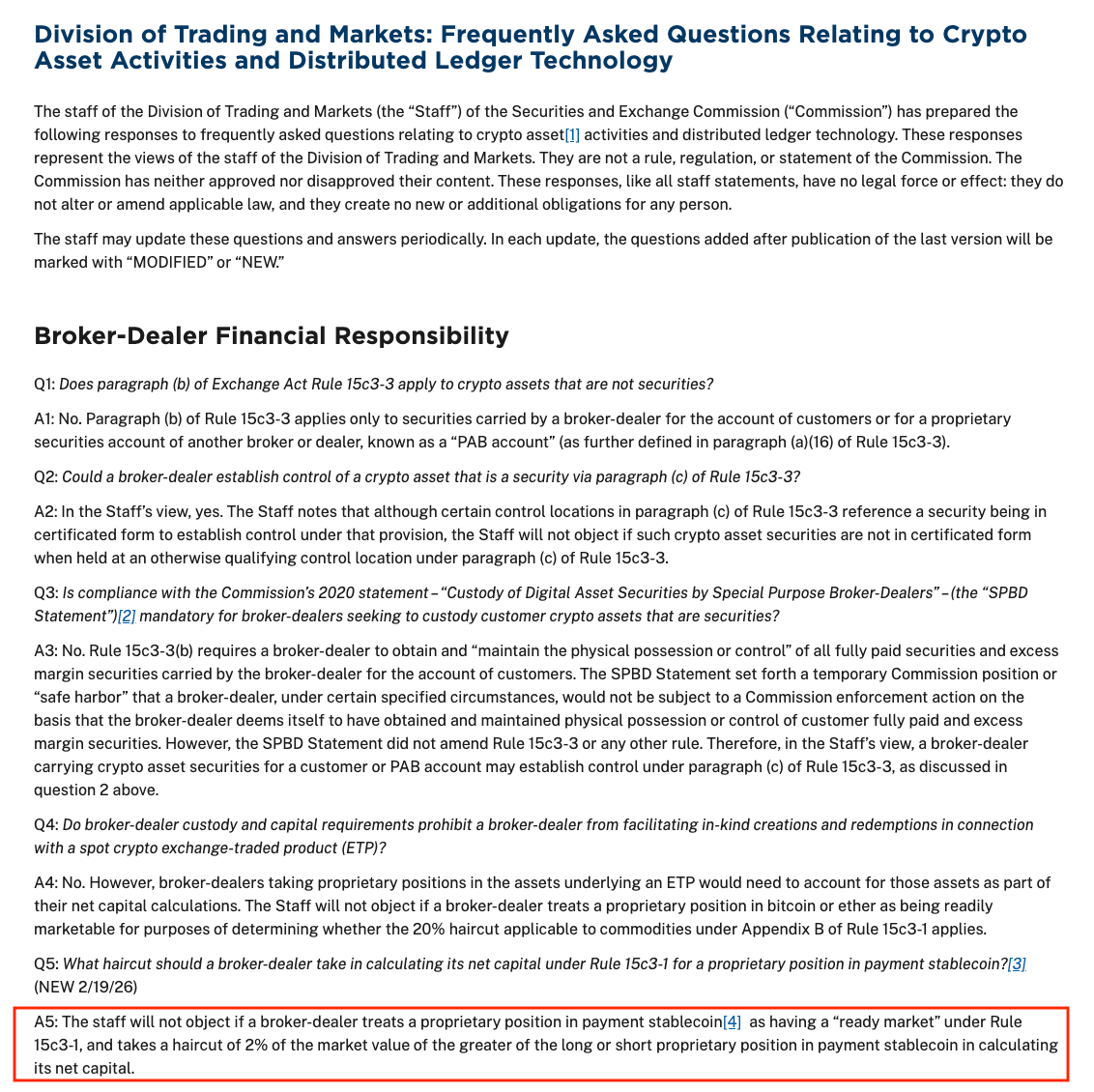
Image source: SEC SEC issues FAQ document, clearly stating that broker-dealers can apply a 2% “haircut” to their holdings of US dollar-pegged stablecoins
Previously, the market was uncertain whether broker-dealers had to apply a 100% discount to stablecoins, meaning they would be completely excluded from net capital calculations. Now, the explanation at the SEC staff level signals a loosening, allowing stablecoins to receive treatment similar to money market funds within the regulatory capital framework. For example, holding $100 million in stablecoins with a 2% discount would only deduct $2 million, leaving $98 million countable toward net capital, significantly less restrictive than the extreme 100% discount approach.
SEC Commissioner Hester Peirce also publicly stated that applying a 100% discount to payment stablecoins is too harsh and does not reflect the nature of their backing reserves.
Wall Street capital pressure eases, stablecoins incorporated into mainstream assets
SEC regulations require broker-dealers to maintain minimum net capital levels to withstand market volatility and potential losses. The new guidance means broker-dealers can hold stablecoins without significantly increasing capital costs and incorporate them into daily operations.
Marc Baumann, CEO of crypto intelligence firm 51, said on LinkedIn that this is a major turning point—Wall Street can finally hold and use stablecoins without disrupting capital ratios.
Market interpretation suggests this will help broker-dealers participate more in tokenized securities and on-chain financial activities, reducing regulatory hurdles for stablecoins within traditional finance. Following the establishment of a federal stablecoin regulatory framework under the GENIUS Act, SEC’s clarifications are seen as concrete progress on implementation.
Stablecoin market cap reaches $295 billion, policy benefits continue to unfold
According to RWA.xyz data, the total market cap of stablecoins is currently about $296.1 billion. Although slightly below the peak of over $300 billion in December 2025, it has shown steady growth since 2023.
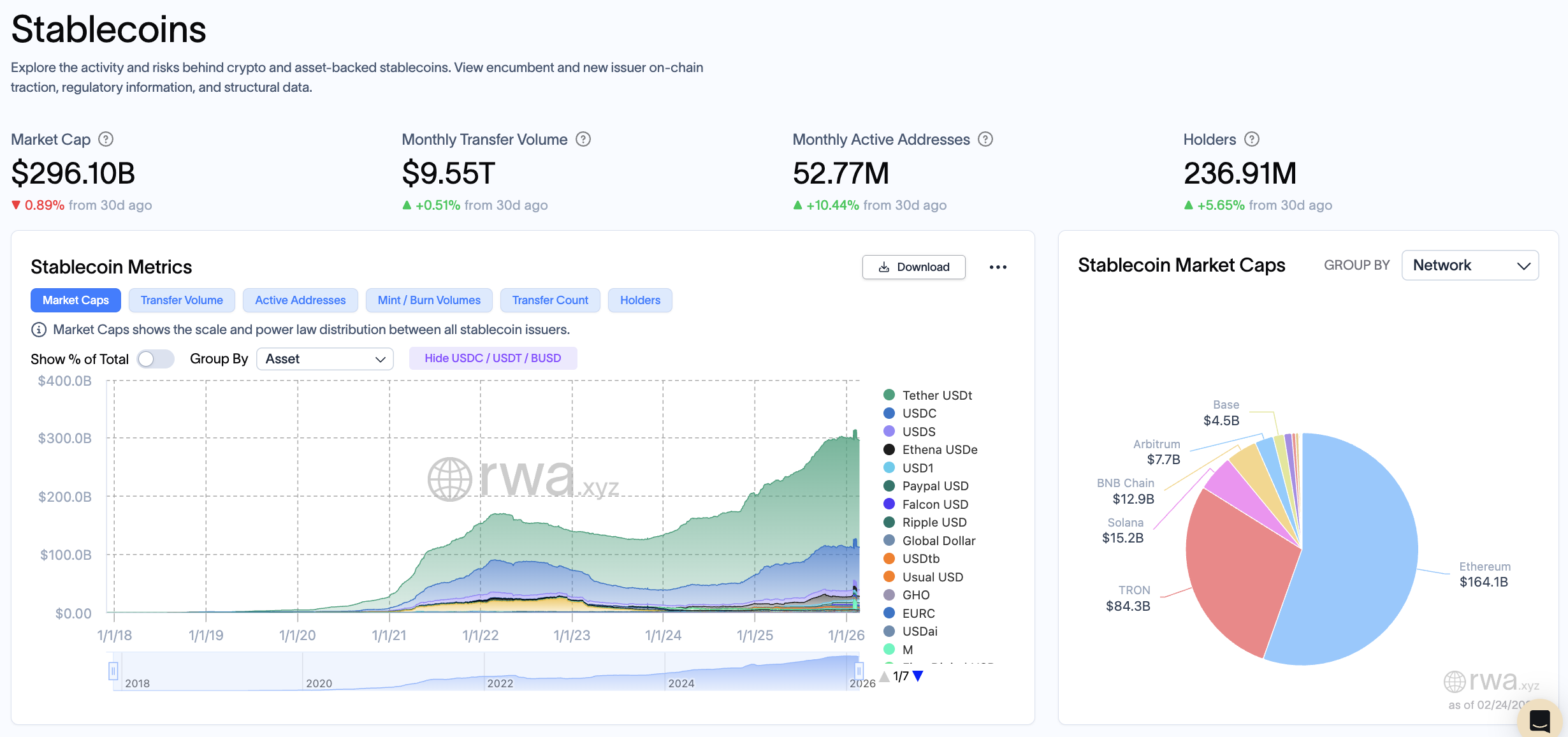
Image source: RWA.xyz The total market cap of stablecoins is currently about $296.1 billion
When President Trump signed the GENIUS Act in July 2025, the stablecoin market cap was approximately $252 billion. After the bill’s passage, capital inflows accelerated significantly. The market generally views stablecoins as an important on-chain extension of the US dollar, supporting crypto trading and reinforcing the dollar’s dominant position in the global digital asset market.
Federal Reserve officials remain skeptical, policy disagreements emerge
Despite the gradually clarifying regulatory environment, some officials remain cautious about the practical use of stablecoins. Neel Kashkari, President of the Minneapolis Federal Reserve, recently questioned publicly whether existing payment tools like Venmo, PayPal, or Zelle already fulfill transfer functions, and what actual innovation stablecoins bring.
Further reading
Federal Reserve officials criticize: Stablecoins’ advantages do not surpass existing systems; crypto applications are nonsense
This commentary reflects ongoing policy disagreements about the role of stablecoins. On one hand, regulators are gradually integrating stablecoins into the mainstream financial system through capital rules and legislation; on the other hand, some central bank officials remain cautious about their use cases and risks. Under the dual influence of regulatory easing and market expansion, stablecoins have shifted from being a side player in crypto to an essential part of financial infrastructure.
Disclaimer: The information on this page may come from third parties and does not represent the views or opinions of Gate. The content displayed on this page is for reference only and does not constitute any financial, investment, or legal advice. Gate does not guarantee the accuracy or completeness of the information and shall not be liable for any losses arising from the use of this information. Virtual asset investments carry high risks and are subject to significant price volatility. You may lose all of your invested principal. Please fully understand the relevant risks and make prudent decisions based on your own financial situation and risk tolerance. For details, please refer to
Disclaimer.
Related Articles
Bitunix Analyst: Margin reduction combined with oil price shocks shifts market pricing towards "higher interest rates for a longer period"
CME lowers precious metals futures margin requirements, signaling increased market liquidity. The Middle East conflict has driven up energy prices, leading to a reassessment of inflation risks. The interest rate market pricing has shifted, with easing expectations cooling down, and funds focusing on U.S. non-farm payroll data, affecting economic and liquidity trends. The crypto market is also impacted, with short-term volatility rising.
GateNews1h ago
The Federal Reserve emphasizes technological neutrality! The capital accounting method for tokenized securities should be in line with traditional securities.
The Federal Reserve, FDIC, and OCC jointly issued guidelines, clearly stating that tokenized securities should follow the same capital requirements as traditional securities, emphasizing neutrality regarding technological forms to promote the development of blockchain assets, reduce regulatory concerns, and enhance the business flexibility of financial institutions.
CryptoCity3h ago
ETH short-term upward movement of 0.99%: Driven by whale inflows and external capital transfers, a structural rebound
From 01:30 to 01:45 (UTC) on March 6, 2026, ETH achieved a return of +0.99% within 15 minutes, with a price range of 2065.42 to 2088.57 USDT, and an amplitude of 1.12%. The volatility during this window was significantly higher than the daily average, increasing short-term market attention. Liquidity was relatively low, and some large transactions drove the trading volume upward.
The main driver of this abnormal movement was the concentrated inflow of whale funds into decentralized exchanges and large transfers. On-chain monitoring detected multiple large ETH fund inflows into DeFi protocols and trading platforms, effectively pushing
GateNews4h ago
The Federal Reserve announces "technological neutrality," aligning tokenized securities capital rules with traditional securities
The Federal Reserve has issued guidelines stipulating that banks should treat tokenized securities equally with traditional securities when calculating regulatory capital, emphasizing the principle of technological neutrality. No special legislation is required; banks can operate under the existing framework. This move provides a stable policy foundation for tokenization businesses, promotes market growth, and reduces compliance costs.
MarketWhisper4h ago
The flow of money into stablecoins recovers to $1.7 billion as Washington debates interest rate regulations
The weekly net inflow into stablecoins has seen a strong rebound over the past week, as on-chain activity increased despite ongoing debates between U.S. lawmakers and banking groups about whether third parties should be allowed to pay interest on stablecoins. This is the information
TapChiBitcoin5h ago
U.S. Treasury yields rise across the board, with market expectations for fewer interest rate cuts
Influenced by Middle East conflicts and inflation concerns, U.S. Treasury yields continue to rise. Initial jobless claims remain at 213,000, and the January import price index growth was below expectations. The market expects non-farm employment to decline, while the futures market anticipates the Federal Reserve will cut interest rates only once by 2026. The 10-year U.S. Treasury yield rose to 4.134%.
GateNews15h ago


