


Central Bank of Brazil to Advance Institutional VASP Regulation by 2027
The central bank will focus on designing a regulatory framework for the so-called institutional VASPs, defined as organizations that operate infrastructure and provide crypto services to other institutions. The move would bring clarity to companies like Fireblock, Ripple, and Bitgo in the Brazilian market.
Brazil to Regulate Institutional VASPs by 2027
Brazil is advancing fast to bring clarity to all sectors of the crypto market, including Business-to-Business (B2B) interactions.
Local reports indicate that the Central Bank of Brazil will advance regulations regarding the operation of institutional virtual asset service providers (VASPs) in the country before 2027.
Institutional VASPs are defined as companies that construct, provide, and operate crypto infrastructure to serve other institutions, focusing their action on serving other businesses rather than end users.
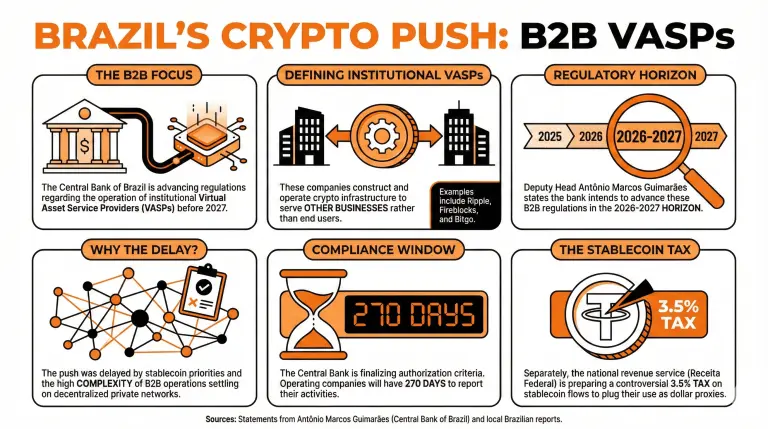
Companies like Ripple, which operates crypto-based payment networks; Fireblocks, which provides various crypto infrastructure products and services; and Bitgo, a custody provider, would fall under this classification.
During a live transmission, Antônio Marcos Guimarães, deputy head of the bank’s Regulation Department, stated that the bank would “intend to advance in the regulation of institutional VASPs (B2B)” in the 2026-2027 horizon.
Furthermore, he stated that the proposal to regulate these institutions’ activities was born of the bank’s public consultations. Nonetheless, other regulatory activities involving stablecoins and more pressing matters took the bank’s attention before this.
An element that has taken this regulatory push aback is the complexity of these businesses’ activities, as there is no brokerage between them, and transactions or deals are settled using decentralized private networks.
In addition, Guimarães added that the bank is finalizing the authorization criteria for companies operating in the country, which will have 270 days to report their activities.
Brazil has been hard at work regarding crypto regulation in 2026, having already streamlined new rules for banks entering the crypto market.
In addition, the national revenue service (Receita Federal) is reportedly preparing a controversial measure that would tax stablecoin flows with 3.5%, aiming to plug a loophole that allowed users and institutions to benefit from using these solutions as dollar proxies for payments and remittances.
FAQ
- What steps is Brazil taking towards crypto regulation?
Brazil is advancing regulations for institutional virtual asset service providers (VASPs) to clarify operations in the B2B sector before 2027. - What defines an institutional VASP in Brazil?
Institutional VASPs are companies that provide and manage crypto infrastructure specifically to serve other businesses rather than individual users. - What is the Central Bank’s timeline for these regulations?
Deputy head Antônio Marcos Guimarães indicated that the regulation of institutional VASPs is expected to progress during the 2026-2027 timeframe. - Are there additional regulatory measures related to stablecoins?
Yes, Brazil’s national revenue service is preparing to implement a 3.5% tax on stablecoin flows to close a loophole in their use as dollar proxies for payments.
Related Articles
Kalshi removes the badge indicating association with the X platform due to stricter promotion rules on the platform
Arizona State Senate Rules Committee passes the Digital Asset Reserve Fund Bill, which will be submitted for full Senate vote.
Federal Reserve plans to eliminate the "Reputation Risk" rule: restrictions on bank accounts for crypto companies may see significant easing
SEC Crypto Task Force Welcomes Key Personnel Change: Chainlink Executive Taylor Lindman Appointed as Chief Legal Officer
CLARITY bill approval rate drops to 44%, White House stablecoin compromise plan announced