The measure, described last week, would be submitted by Brazil’s Revenue Service for public consultation and would impose a 3.5% tax on both stablecoin purchases and remittances, treating them as foreign currency exchanges subject to the existing Tax on Financial Transactions (IOF).
Brazil Prepares For Issuing Decree Taxing Stablecoin Purchases and Remittances
The Brazilian crypto industry is on the verge of changing due to a new tax measure expected to be presented in the next few days.
According to Valor Econômico, the Brazilian government is preparing to close what many considered a gray area by classifying stablecoins as digital assets subject to taxation (IOF). The proposal will come from the Federal Revenue Service (Receita Federal), which will specify that both stablecoin purchases and remittances will be taxed with 3.5% on their operations.
Nonetheless, individuals will be exempt from paying this percentage if they don’t transact over 10,000 Brazilian reais (nearly $1,910) monthly. Companies leveraging stablecoins will not enjoy this benefit.
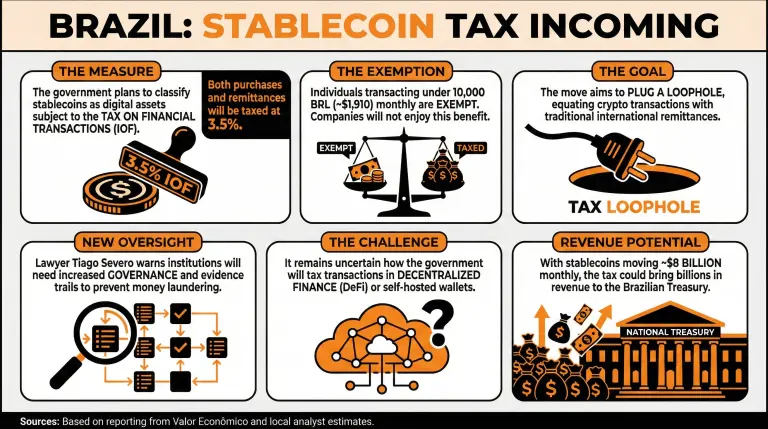
This move would equate cryptocurrency transactions and traditional remittances, plugging a loophole that allowed both individuals and companies to sidestep taxation in these operations.
Local analysts explain that the proposal will also include a new level of oversight on institutions handling stablecoins. Tiago Severo, a crypto-specialized lawyer, highlighted that anyone who operates crypto for payments or international remittances “will need to raise governance, evidence trails, and controls to prevent money laundering to a level closer to the regulated exchange rate.”
Nonetheless, the measure is expected to face significant opposition from the crypto industry, as it will surely affect their operations as customers abandon these local businesses for decentralized finance alternatives.
It is uncertain how or even if the government plans to apply this tax to transactions outside the centralized exchange sector, as Brazilians will also be able to manage stablecoins through decentralized finance options and move them using self-hosted wallets.
According to estimates, if applied, the tax would bring billions in revenue to the Brazilian Treasury, as stablecoins move up to $8 billion each month in the country.
FAQ
- What significant tax measure is Brazil expected to introduce for the crypto industry?
The Brazilian government plans to classify stablecoins as digital assets, subjecting them to a 3.5% Tax on Financial Transactions (IOF).
- How will this tax affect individual and corporate stablecoin transactions?
Individuals will be exempt from the tax if their transactions do not exceed 10,000 Brazilian reais monthly, while companies will not receive this exemption.
- What additional regulations are expected alongside this tax proposal?
The proposal will introduce increased oversight on institutions handling stablecoins, requiring enhanced governance and control measures to combat money laundering.
- What impact is this measure predicted to have on the Brazilian crypto industry?
Local analysts anticipate significant opposition from the crypto sector, as this tax may drive customers to decentralized finance alternatives and impact local business operations.
Disclaimer: The information on this page may come from third parties and does not represent the views or opinions of Gate. The content displayed on this page is for reference only and does not constitute any financial, investment, or legal advice. Gate does not guarantee the accuracy or completeness of the information and shall not be liable for any losses arising from the use of this information. Virtual asset investments carry high risks and are subject to significant price volatility. You may lose all of your invested principal. Please fully understand the relevant risks and make prudent decisions based on your own financial situation and risk tolerance. For details, please refer to
Disclaimer.
Related Articles
U.S. stocks are close to recouping their losses from the Iran war, while oil remains elevated due to continued risk in the Strait of Hormuz.
U.S. stocks rebounded after the ceasefire agreement was announced, nearing a full recovery of the losses caused by the Iran war, but the oil market remained cautious, with prices holding at elevated levels. Investors’ confidence in future economic and political developments increased, and they may continue to add to their positions.
GateNews1m ago
Hassett: The Strait of Hormuz could be opened within two months, and the Federal Reserve still has room to cut rates
Gate News message: On April 10, U.S. National Economic Council Director of the White House, Hassett, said the Strait of Hormuz could be reopened within two months. In addition, Hassett said the Federal Reserve still has room to cut interest rates, and this outlook will be very solid.
GateNews5m ago
A certain CEX offers temporary relocation options for employees in the United Arab Emirates to deal with regional conflict
Amid the impact of the Iran war, a certain CEX offered about 1,000 temporary relocation options for its employees in the UAE, including to places such as Hong Kong. Its UAE operations remain normal, and global user services are unaffected. This move is intended to address disruptions to cryptocurrency activities caused by regional conflicts.
GateNews27m ago
U.S. Vice President Vance: Trump provides clear guidelines for U.S.-Iran negotiations
Gate News message: On April 10, U.S. Vice President Vance said that Trump has provided very clear guidance for the negotiations, is looking forward to talks with Iran, and believes that the negotiations with Iran will be positive.
GateNews30m ago
The U.S. Dollar Spot Index is down about 1.4% this week, marking its largest weekly drop since January.
Gate News message: On April 10, the U.S. dollar spot index has fallen cumulatively by about 1.4% this week, marking the largest weekly drop since January. After the CPI data was released, market trading strategies focused on buying the U.S. dollar and oil. The foreign exchange market has now entered a news-headline-driven trading phase, and progress in the Iran-U.S. negotiations amid a fragile ceasefire is becoming the new focal point.
GateNews30m ago
Crypto Sector Wavers As Geopolitical Tensions Influence Market Performance
The crypto market has seen a 1.14% decline, with Bitcoin and Ethereum experiencing slight gains. Top gainers include PEPE and IRISnet. DeFi TVL increased, while NFT sales dropped. Notable events include xAI suing Colorado and South Korea tightening crypto regulations.
BlockChainReporter45m ago


