Who Are Gate ETF Leveraged Tokens For? A Practical Guide from Market Assessment to Capital Management

Last Updated 2026-03-25 13:54:19
Reading Time: 1m
Gate ETF leveraged tokens are built for trending markets, boosting returns via automatic rebalancing and compounding. This article explores how to use Gate ETF leveraged tokens more effectively, focusing on use cases, market analysis, and capital management strategies.


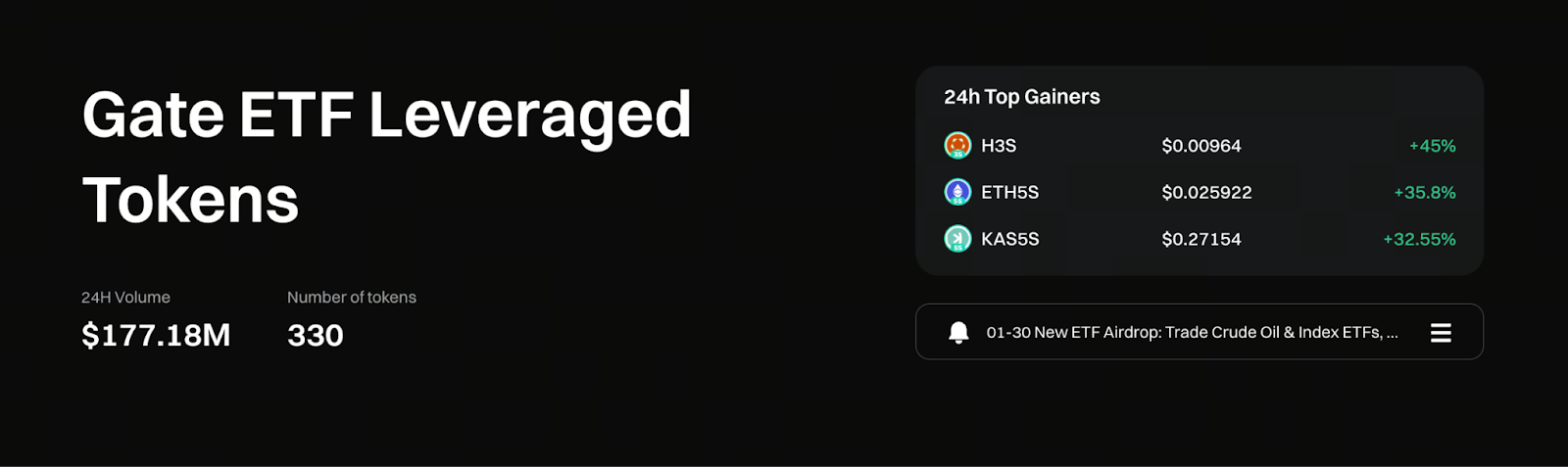
Image: https://www.gate.com/leveraged-etf

Gate ETF Leveraged Tokens: Product Positioning

Gate ETF leveraged tokens are purpose-built to offer streamlined leveraged exposure for trending markets. Unlike traditional contracts, which prioritize flexibility and higher risk, ETF leveraged tokens function as structured products. The system automatically adjusts leverage, making user operations significantly simpler.

On Gate, ETF leveraged tokens trade as spot instruments—there are no margin calls and no liquidation events. This positions them as leveraged tools with controlled risk, rather than high-frequency speculative vehicles.

Optimal Market Conditions for Gate ETF Leveraged Tokens

The deciding factor for using ETF leveraged tokens isn’t market volatility, but the presence of a sustained directional trend.

Gate ETF leveraged tokens excel when the market exhibits the following:

  • Price breaks key ranges and enters a trend;
  • Trading volume expands consistently in a single direction;
  • Macro, policy, or fundamental drivers create a one-sided market.

In such scenarios, the auto-rebalancing mechanism reinforces prevailing trends, and the compounding effect becomes increasingly evident. Conversely, in markets without clear direction and frequent swings, the net asset value of ETF leveraged tokens may be repeatedly diminished—leading to divergent user experiences.

Core Differences: Gate ETF Leveraged Tokens vs. Contract Trading

Many investors compare ETF leveraged tokens to perpetual contracts, but their foundational logic differs.

Contract trading requires active management—monitoring margin ratios, liquidation prices, and funding rates. Gate ETF leveraged tokens, however, encapsulate risk within the product through system-level mechanisms.

As a result, ETF leveraged tokens are best suited for:

  • Users who prefer not to monitor markets constantly;
  • Investors seeking trend exposure while avoiding liquidation risk;
  • Those favoring medium- to short-term holding over ultra-short-term trading.

Recognizing this distinction helps prevent the misuse of ETF leveraged tokens as contract substitutes.

Fund Management and Position Control Strategies

While liquidation risk is absent, Gate ETF leveraged tokens remain high-volatility instruments, making disciplined fund management essential.

Sound strategies include:

  • Avoiding heavy, single-entry positions;
  • Gradually building positions at the start of a trend rather than chasing highs;
  • Reducing exposure or taking profits in stages when volatility spikes.

ETF leveraged tokens are designed to boost capital efficiency—not to promote aggressive trading. Treating them as an “enhancement module” within a portfolio is generally more prudent than taking an all-or-nothing approach.

A Rational Approach to ETF Leveraged Token Returns and Risks

Gate ETF leveraged tokens can deliver amplified returns in trending markets, but any tool that increases returns also increases volatility.

Rational investors should keep in mind:

  • ETF leveraged tokens are not for long-term passive holding;
  • Returns are driven by trends, not by time held;
  • Understanding the product mechanism is more important than market prediction.

When product logic, market assessment, and risk awareness align, ETF leveraged tokens can enhance trading efficiency rather than magnify emotional trading.

Author: Max
Disclaimer
* The information is not intended to be and does not constitute financial advice or any other recommendation of any sort offered or endorsed by Gate.
* This article may not be reproduced, transmitted or copied without referencing Gate. Contravention is an infringement of Copyright Act and may be subject to legal action.

Related Articles

AI-Native Settlement Layers: How United Stables Is Building the Next Financial Rail
Beginner

AI-Native Settlement Layers: How United Stables Is Building the Next Financial Rail

Stablecoins were originally designed as dollar substitutes within exchanges, primarily used for asset pricing and trade settlement. As on-chain financial ecosystems have matured, their role has expanded beyond simple payments to include collateral assets, cross-chain liquidity mediums, and unified settlement units. In particular, as AI systems and automated agents begin to participate directly in economic activity, demand has risen sharply for programmable value units capable of instant settlement. This shift is pushing stablecoins toward the role of foundational financial infrastructure.
2026-03-25 03:16:17
DePIN Identity Network and Real World Applications: How Humanity Protocol Brings on-chain Identity Into the Physical World
Beginner

DePIN Identity Network and Real World Applications: How Humanity Protocol Brings on-chain Identity Into the Physical World

Most Web3 identity systems remain confined to on-chain environments and struggle to achieve meaningful adoption in real world settings. Through a DePIN architecture and physical verification hardware, Humanity Protocol aims to bring decentralized identity into access control systems, hospitality, public services, and offline events, allowing on-chain identity to function not just as a digital credential, but as foundational infrastructure for real world access.
2026-03-25 07:40:53
The ve(3,3) Flywheel Explained: How AERO Tokenomics Powers Aerodrome’s DeFi Economy
Beginner

The ve(3,3) Flywheel Explained: How AERO Tokenomics Powers Aerodrome’s DeFi Economy

In the competition for DeFi liquidity, high-inflation mining alone is no longer enough to build lasting advantages. Aerodrome applies the ve(3,3) economic model to redesign token emissions, voting mechanisms, and revenue distribution, creating a liquidity flywheel centered on governance and cash flow. This article examines AERO tokenomics, the veAERO locking mechanism, and protocol revenue models to explain how Aerodrome builds a sustainable DeFi economic system.
2026-03-25 06:41:58
Aerodrome Tokenomics: How ve(3,3) Powers Base's Most Profitable DEX
Beginner

Aerodrome Tokenomics: How ve(3,3) Powers Base's Most Profitable DEX

AERO is the native token of Aerodrome Finance, a core decentralized exchange and liquidity protocol in the Base ecosystem. It is primarily used for liquidity incentives and ecosystem operations. veAERO is a governance NFT that users receive by locking AERO, representing both voting power and the right to share protocol revenue. Through a dual track structure of AERO as a utility token and veAERO as a governance credential, Aerodrome separates liquidity usage value from long term governance power, allowing participants to act as liquidity providers, governance decision makers, and revenue sharers within the same system.
2026-03-25 06:40:31
Aster vs Hyperliquid: Which Perp DEX Will Prevail?
Beginner

Aster vs Hyperliquid: Which Perp DEX Will Prevail?

Aster and Hyperliquid are the two representative protocols of the "purpose-built L1 path" within the current decentralized perpetual exchange (Perp DEX) sector. As a pioneer in the field, Hyperliquid has built a deep liquidity moat through its highly mature order book architecture and strong community consensus. Conversely, Aster, as a rising challenger, seeks to leapfrog the competition in high-performance trading through more aggressive multi-chain aggregation logic, private transaction modules, and an underlying execution environment optimized for 2026 market demands.
2026-03-24 11:58:33
Gold Price Forecast for the Next Five Years: 2026–2030 Trend Outlook and Investment Implications, Could It Reach $6,000?
Beginner

Gold Price Forecast for the Next Five Years: 2026–2030 Trend Outlook and Investment Implications, Could It Reach $6,000?

Analyze current gold price trends alongside authoritative five-year forecasts, integrating an evaluation of market risks and opportunities. This gives investors insight into the potential trajectory of gold prices and the main drivers expected to shape the market over the next five years.
2026-03-25 18:13:30





