Aerodrome is a decentralized liquidity protocol built on Base and represents an engineered implementation of the ve(3,3) economic model in a Layer 2 environment. Compared with earlier DeFi models that relied on high-inflation liquidity mining to attract capital, Aerodrome links liquidity incentives, governance rights, and protocol cash flow through the AERO and veAERO mechanisms. This design allows participants to gain voting power and revenue distribution rights while providing liquidity, shifting incentives away from short-term subsidies toward governance-led and long-term value creation.
As DeFi enters a phase focused on efficiency, liquidity quality and capital utilization have become critical to protocol sustainability. Through the ve(3,3) flywheel, Aerodrome connects token locking, voting, incentive allocation, trading activity, and fee generation into a positive feedback loop. Combined with Base’s low gas costs and high throughput, the protocol optimizes AMM design and trade routing, enabling more market-driven and dynamic liquidity allocation. This governance-coordinated liquidity engine not only improves capital efficiency but also offers a sustainable infrastructure model for DeFi.
This article outlines the evolution of liquidity efficiency in DeFi and the core logic of the ve(3,3) model. It explains how Aerodrome implements the liquidity flywheel on Base, analyzes AERO token design and veAERO locking mechanics, and examines cash-flow distribution alongside key operating data and risk considerations. Together, these elements provide a comprehensive view of Aerodrome’s structure, potential advantages, and strategic role in the future of DeFi liquidity infrastructure.
Aerodrome Overview
(Source: AerodromeFi)
Aerodrome operates within the Base ecosystem as a decentralized trading platform, but its role extends far beyond that of a typical DEX. It is designed as a liquidity hub for the on-chain financial system, responsible for coordinating capital allocation, trading depth, and market pricing efficiency.
Officially positioned as a MetaDEX, Aerodrome is not limited to a single market-making model. Instead, it integrates multiple AMM architectures, a ve(3,3) governance framework, and fully immutable smart contracts. Guided by principles of community governance, on-chain decision making, and revenue distribution back to users, the protocol is gradually forming a self-sustaining liquidity infrastructure.
The Evolution of DeFi Liquidity Efficiency
Early DeFi ecosystems relied heavily on high-inflation liquidity mining to attract capital. While effective in the short term, this approach often resulted in temporary liquidity and long-term value leakage.
Aerodrome adopts the ve(3,3) model to align liquidity incentives with governance participation, allowing long-term contributors to gain greater rewards and influence. At its core, this shift represents a transition from subsidy-driven liquidity toward a governance-driven economic system.
The Core Logic of the ve(3,3) Flywheel
The ve(3,3) flywheel is fundamentally a mechanism that tightly binds liquidity, governance rights, and incentive distribution. Its goal is to ensure that protocol growth is driven by long-term participant alignment rather than short-term mining rewards.
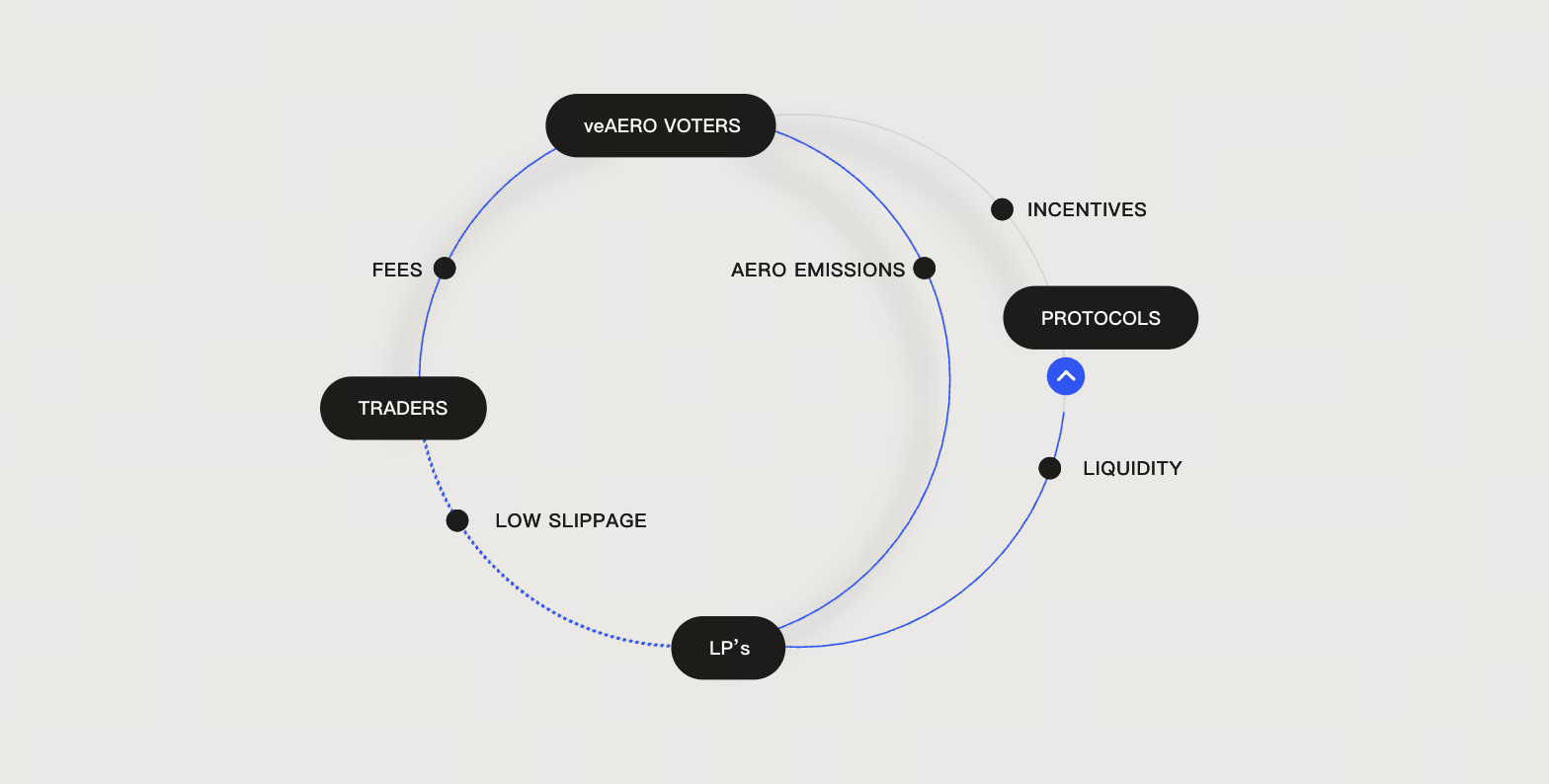
In this model, users lock tokens to obtain veTokens, granting them voting power to determine how rewards are allocated across liquidity pools. Protocols and projects actively compete for voting support, often through incentive mechanisms, in order to attract liquidity into their target pools.
As trading volume increases, fee generation rises, benefiting both lockers and liquidity providers. This encourages additional token locking and liquidity provision, forming a positive cycle of locking → voting → incentives → liquidity → trading volume → revenue growth → renewed locking. Compared with traditional liquidity mining, the ve(3,3) flywheel emphasizes long-term capital commitment and governance participation, resulting in a more stable and sustainable liquidity structure.
Aerodrome: Engineering ve(3,3) on Base
Aerodrome can be viewed as an engineered implementation of the ve(3,3) model on the Base network. Its value lies not in simply replicating the economic logic, but in deeply integrating liquidity incentives, governance voting, and trade routing within a Layer 2 execution environment.
Users lock AERO to obtain veAERO, enabling them to vote on emission allocation across liquidity pools. Protocols compete for these votes through incentives to attract liquidity to specific trading pairs. At the same time, Aerodrome optimizes its AMM architecture for Base’s low gas costs and high throughput, supporting both stable and volatile pools while introducing automated reward distribution and aggregated routing logic. In Aerodrome, ve(3,3) evolves from a pure incentive mechanism into a liquidity coordination system, forming a self-reinforcing on-chain flywheel among users, LPs, voters, and protocols.
(Source: AerodromeFi)
Operational Analysis of Aerodrome’s Liquidity Engine
The health of Aerodrome’s liquidity engine can be assessed through key indicators such as TVL trends, trading volume composition, fee generation, and the distribution of voting incentives. In practice, liquidity tends to concentrate around core Base ecosystem assets and stablecoin pairs, highlighting Aerodrome’s role in price discovery and capital routing.
When pools receiving higher voting weight also see growth in trading volume and fees, it signals positive alignment between incentives and real demand. Conversely, pools with strong incentives but weak depth may reflect short-term subsidy behavior rather than organic liquidity. By tracking fee yields, liquidity retention, and voting concentration, observers can better assess whether Aerodrome’s flywheel remains healthy and capital efficient.
AERO Token Design: A Low-Inflation, Emission-Directed Model
AERO maintains an annual inflation rate of approximately 1% and uses a dynamic emission system. Emissions are not distributed automatically but are directed through veAERO voting, meaning liquidity allocation is determined by the market rather than centralized decisions.
High-demand trading pairs naturally attract more emissions, while low-usage pools see incentives decline. This structure reduces inefficient subsidies and improves overall capital efficiency.
veAERO Locking Mechanism: Time in Exchange for Power and Cash Flow
Users can lock AERO for up to four years to receive veAERO NFTs. Longer lock durations grant greater governance influence and a higher share of revenue distribution. This time-weighted design favors long-term participants over short-term arbitrage behavior.
veAERO is transferable, allowing governance power itself to become a liquid asset and further increasing market flexibility.
veAERO as a Claim on Protocol Cash Flow
All trading fees and incentive revenues generated by Aerodrome are distributed to veAERO holders, making veAERO a direct representation of protocol cash flow. As trading activity increases, the value of governance participation rises accordingly, creating a tightly aligned relationship between token holders and protocol growth.
Risk Considerations and Structural Limitations
Despite the coordination benefits of the ve(3,3) model, Aerodrome still faces structural risks. Voting power and locked capital may concentrate among large holders or protocols, potentially skewing incentive allocation. Incentive competition and vote buying can drive liquidity growth, but may also introduce short-term capital migration and inflated depth.
Long lock periods help stabilize liquidity but reduce flexibility during volatile market conditions. In addition, Aerodrome’s close dependency on Base means its performance is sensitive to overall network activity. Ongoing monitoring of real trading demand, voting concentration, and liquidity retention is essential to assess long-term flywheel health.
Conclusion
Aerodrome’s ve(3,3) economic model reflects DeFi’s shift from subsidy-driven growth toward governance- and cash-flow-based sustainability. Through low-inflation AERO design, veAERO locking, and vote-directed emissions, the protocol establishes a self-reinforcing liquidity flywheel.
Rather than competing on headline APR alone, Aerodrome focuses on stability, capital efficiency, and long-term alignment. In an increasingly competitive DEX landscape, sustainable liquidity models like this are more likely to define the next generation of DeFi infrastructure.