At the level of technical and financial infrastructure, next-generation stablecoins increasingly emphasize liquidity-first architectures, cross-chain liquidity pools, and gasless payment designs to support high-frequency trading and automated payments in machine economies. United Stables, for example, seeks to integrate liquidity aggregation, AI payment workflows, and programmable finance within a single framework. This enables support for micropayments, enterprise-grade settlement, and global fund orchestration, while lowering barriers to use through technologies such as EIP-3009. The result is a Web3 payment experience that more closely resembles traditional internet services, while significantly improving capital efficiency and payment scalability.
This article examines the shift of stablecoins from payment tools toward financial infrastructure, explains how liquidity-first design supports large-scale settlement, analyzes the impact of AI agent payment protocols and gasless transactions on enterprises and machine economies, and explores real-world applications in travel payments, cross-border settlement, and institutional treasury management. Together, these perspectives help clarify how stablecoins are becoming a core value layer for future digital finance and global commerce.
Stablecoin Trends: From Payment Tools to Financial Infrastructure
Stablecoins initially functioned as dollar substitutes within exchanges. As on-chain financial ecosystems matured, they gradually assumed additional roles, including collateral assets, settlement units, and cross-chain liquidity mediums. When AI and automated systems begin participating in financial activity, the market requires programmable value units capable of instant settlement, a role stablecoins are well positioned to fill.
In the future, payments will no longer be executed solely by humans. AI agents may autonomously purchase data, pay for API usage, or rent computing power. This transition elevates stablecoins from trading instruments to foundational financial infrastructure.
United Stables: A Liquidity-First Architecture for Large-Scale Payment Systems

(Source: UTechStables)
For a stablecoin to function as a true settlement layer, price stability alone is insufficient. What matters equally is the depth and sustainability of liquidity. When market depth is shallow, large transactions can generate significant slippage or even disrupt pricing, undermining the reliability and predictability required of payment instruments. United Stables therefore treats liquidity as the cornerstone of its architecture rather than a secondary feature, using a liquidity-first design to support high-frequency and large-scale capital flows.
In practice, the system aggregates multiple stable assets and establishes cross-chain liquidity pools, enabling funds to be rapidly allocated and rebalanced across chains. This ensures low slippage and near-instant settlement even under high transaction pressure. Liquidity is sourced from multiple environments rather than a single market, improving resilience to volatility and enhancing capital efficiency. This structure supports not only everyday retail payments but also enterprise-grade settlement, cross-border transfers, and high-frequency commercial transactions, giving stablecoins the structural capacity to function as global payment layers.
AI Agent Payment Protocols and Automated Financial Processes
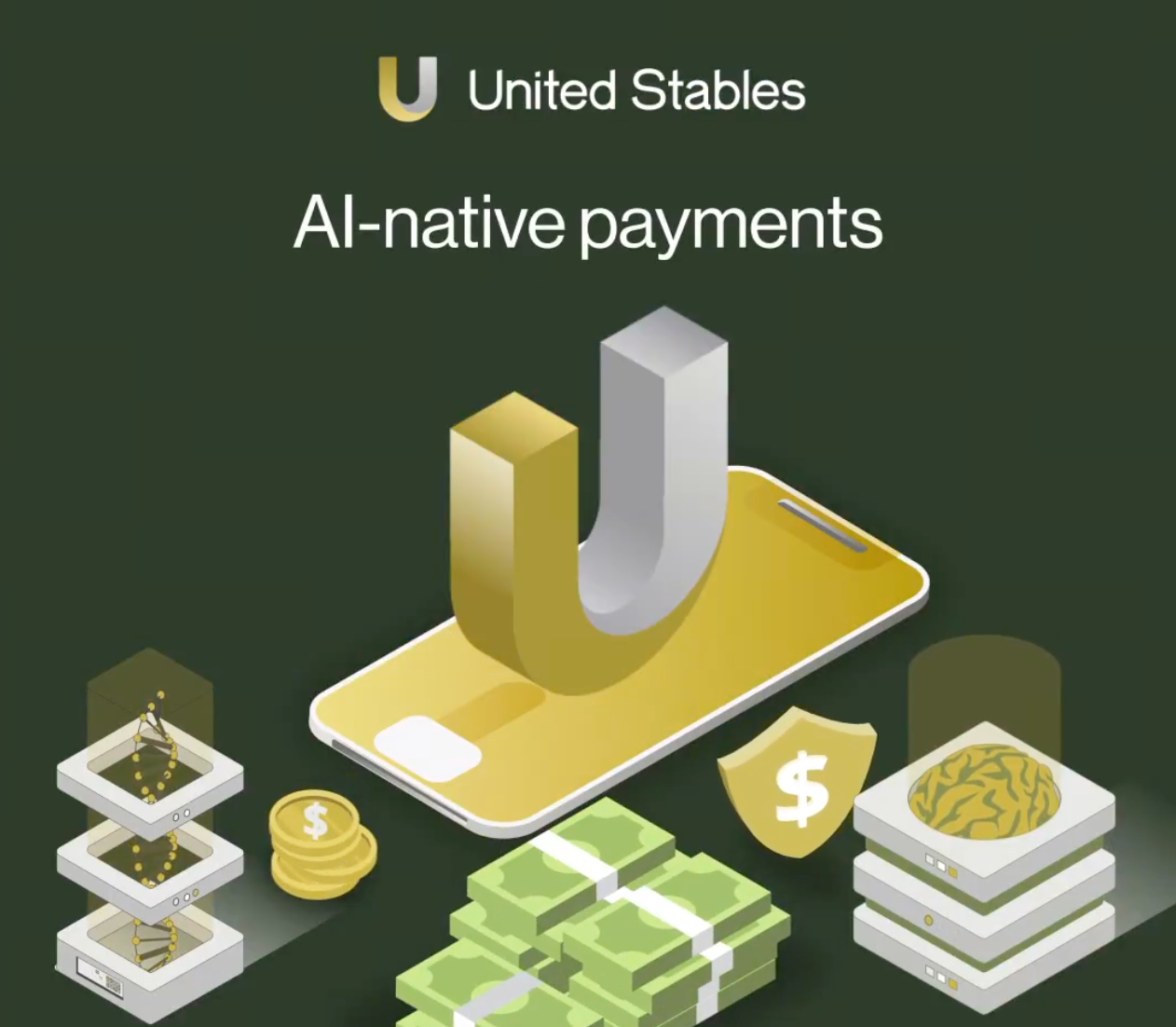
The rapid rise of AI agents is driving financial logic away from manual execution toward automated decision-making. Future AI systems may independently procure services, pay subscription fees, and even allocate assets or settle trades based on real-time data, allowing capital flows and commercial activity to operate continuously without human intervention. In such an environment, stablecoins that integrate seamlessly into AI decision and payment workflows have the potential to become core value mediums of the machine economy, serving simultaneously as settlement layers and transactional fuel.
(Source: UTechStables)
As AI becomes a primary participant in economic activity, payment behavior shifts from discrete transactions to continuous, high-frequency, and automated data exchanges. Examples include per-second API billing, dynamic subscription models, and real-time task compensation. To support these scenarios, stablecoins must be highly programmable, low-latency, and scalable, capable of handling large volumes of micropayments and instant settlement. On-chain payment infrastructure must also ensure predictable costs and fast confirmation to function reliably as a value transfer mechanism within AI-driven economies.
The Significance of EIP-3009 and Gasless Payments for Enterprises
Gasless payments allow enterprises to absorb transaction costs on behalf of users, enabling transfers and interactions without requiring users to hold native blockchain tokens. This significantly lowers the entry barrier to Web3 and aligns product experiences more closely with traditional internet services. For companies seeking mass adoption, this design represents a critical step toward mainstream usability. It also enables firms to manage transaction fees as operating expenses, optimizing business models and improving conversion rates.
Through EIP-3009-supported signature-based transactions, payment flows can be integrated directly into existing backend systems and automated workflows, such as SaaS subscription billing, platform revenue distribution, internal treasury transfers, and AI-driven micropayments. Users authorize once, after which transactions can be executed and settled automatically. This reduces friction, improves efficiency, and allows Web3 products to adopt familiar financial service patterns, providing enterprises with more stable, scalable, and commercially aligned payment infrastructure.
From Travel Payments to Global Settlement Networks
Stablecoin applications are expanding beyond crypto-native finance into everyday consumer and service contexts, including travel booking platforms, cross-border e-commerce settlement, digital content subscriptions, and online service payments. With instant settlement and low fees, enterprises can collect and settle payments globally without relying on layered banking channels or expensive international payment networks. For startups and digitally native brands, lightweight financial infrastructure enables rapid international expansion, faster capital turnover, and improved operational efficiency.
Once payment and settlement processes move fully on-chain, capital flows are no longer constrained by banking hours or cross-border clearing delays. Enterprises can dynamically allocate funds across markets, managing inventory, advertising spend, and supply-chain expenses in real time. Stablecoins reduce foreign exchange spreads and intermediary fees, making cross-border transaction costs more transparent and controllable. As payments, finance, and digital services converge, stablecoins are evolving from crypto-native tools into increasingly important universal settlement layers for global digital commerce.
How Institutions Use a Unified Dollar Layer
For enterprises and institutions, a unified on-chain dollar asset simplifies treasury management by enabling a single settlement unit and consistent accounting standards. Rather than frequently converting between multiple stablecoins or international bank accounts, organizations can orchestrate global funds more efficiently. Such assets can also connect directly to DeFi markets and on-chain liquidity pools, allowing idle capital to participate instantly in lending, market-making, or yield strategies. Treasury operations thus evolve from cost centers into active components of liquidity and return management.
In practical terms, a unified dollar layer allows enterprises to monitor cash flow in real time, execute cross-border payments, settle with suppliers, and reallocate internal funds without dependence on banking schedules or regional clearing systems. As more institutions move capital on-chain, unified dollar assets may become core settlement infrastructure for on-chain finance, supporting cross-market flows, instant settlement, and global capital operations, ultimately reshaping enterprise financial management and allocation models.
Conclusion
As AI and automated finance continue to advance, stablecoins are transitioning from transactional instruments into core settlement layers of the digital economy. United Stables aims to integrate liquidity, gasless payments, and programmable finance within a single architecture, providing foundational support for machine economies and institutional finance. If these designs continue to mature, stablecoins will no longer function merely as payment tools, but as operational foundations for the entire digital financial system.