In an environment where DeFi liquidity competition continues to intensify, the ability to build long term capital commitment and stable governance has become a central challenge. Aerodrome combines a vote escrow locking model, a ve(3,3) incentive mechanism, and a Gauge voting allocation system to bind trading volume, emissions incentives, and governance power together. It also integrates an emissions curve, rebase based supply adjustment, and an Aero Fed monetary policy framework. These components align token value, liquidity demand, and protocol governance into a sustainable economic loop, positioning Aerodrome as an important liquidity and value distribution layer within the Base ecosystem.
This article explains Aerodrome’s dual track token structure through AERO and veAERO. It examines veAERO locking and voting weight mechanics, token supply and emissions policy, rebase and monetary management design, and the ve(3,3) incentive flow with bribes. It also outlines AERO’s value capture logic and potential risks, helping readers understand how Aerodrome uses token economics to reshape DEX governance and liquidity competition.
What Are AERO and veAERO? Understanding the Dual Token Structure

(Source: Aerodrome)
AERO is the native token of Aerodrome Finance. It has both functional and governance related roles, but governance participation is not granted directly through holding AERO alone. Aerodrome is built on Base, the Layer 2 network introduced by Coinbase, and is positioned as a core decentralized exchange and liquidity protocol in that ecosystem. Users can lock AERO for up to four years to receive veAERO as a governance credential. Holding veAERO enables participation in protocol decisions and voting, provides access to a share of platform fee revenue, and influences the direction of weekly liquidity incentive distribution, giving long term participants a more direct role in how the protocol operates.
Aerodrome uses a dual token model to separate two layers of activity:
- AERO is an ERC 20 utility token mainly used for liquidity mining and incentive distribution.
- veAERO is an ERC 721 governance NFT that represents voting power and revenue rights obtained through locking.
AERO itself does not grant governance rights. Users must lock AERO to receive a veAERO NFT, and only then can they participate in governance and revenue sharing. This design separates short term speculation from long term decision making power, reducing the likelihood that governance is dominated by transient liquidity flows.
veAERO: How Locking Creates Voting Power
veAERO follows a classic vote escrow model. Users must lock AERO tokens to receive governance voting power and influence over incentive allocation.
Locking signals a long term commitment to the protocol and determines how much influence a participant holds in governance and liquidity incentive decisions. As locked amounts and lock duration increase, veAERO weight increases, expanding a user’s ability to shape Gauge allocations, access fee revenue, and participate in governance. In this sense, veAERO functions as a bridge between capital commitment and governance participation.
veAERO Locking and Voting Weight Mechanics
Voting power scales linearly with lock duration. Longer locks produce higher governance weight. For example, locking 100 AERO for four years yields 100 veAERO, while locking the same amount for one year yields about 25 veAERO. This structure encourages long term aligned capital to participate in protocol development.
The system also provides an Auto Max Lock feature. It allows a veAERO NFT to automatically maintain the maximum four year lock status, keeping voting power stable rather than decaying over time. This encourages persistent governance participation and provides long horizon participants with continuous influence over protocol direction.
Aerodrome Initial Distribution and Overall Supply Structure
AERO launched with an initial supply of 500 million tokens, with more than 90 percent allocated toward community and liquidity related uses rather than venture funding or private sale distribution.
The main allocation structure is described as follows:
| Allocation item |
Share |
| Airdrop to veVELO lockers |
40% |
| Public goods fund |
21% |
| Development team, long term locked |
19% |
| Liquidity and voting incentives |
10%+ |
This design reflects a strong preference for community governance rather than capital driven ownership structures.
AERO Emissions Curve and the Aero Fed Monetary Policy
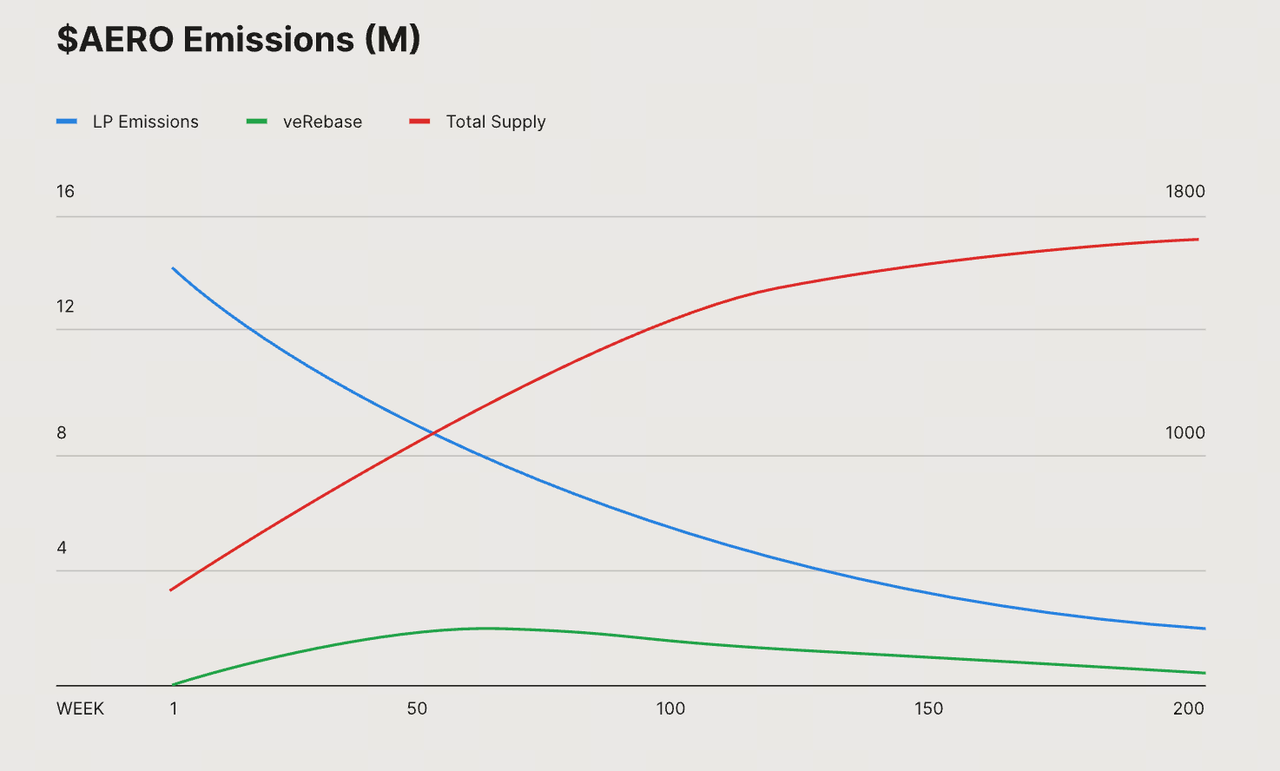
AERO uses an uncapped supply model with controllable emissions. Emissions are distributed weekly to liquidity providers. The design is described using a 40 percent lock rate assumption and a scenario where Aero Fed keeps emissions unchanged.
Emissions are structured in three phases:
- Take off phase runs for the first 14 weeks, with weekly emissions increasing by 3 percent to quickly bootstrap liquidity.
- Cruise phase follows, where weekly emissions decline by 1 percent to gradually reduce inflation pressure.
- Aero Fed functions as a decentralized central bank. Once weekly emissions fall below 9 million, monetary policy moves to veAERO governance voting, which can decide to increase emissions, decrease emissions, or keep them unchanged.
This can be understood as a DAO based central bank mechanism embedded inside token issuance policy.
(Source: Aerodrome)
How Aerodrome Manages Supply and Balances Inflation and Deflation
Aerodrome introduces a rebase mechanism to balance inflation pressure with governance dilution risk. When liquidity providers receive emissions and potentially sell tokens on the market, the protocol redistributes part of weekly AERO emissions back to veAERO lockers as compensation for inflation effects. This helps preserve the relative weight of long term governance participants.
Rebase intensity adjusts dynamically based on the overall lock rate. When the lock rate declines, rebase allocation increases to encourage more capital to lock and stabilize governance structure. In practice, this design acts as a protection mechanism against governance dilution while still maintaining market liquidity and aligning long term participants with protocol development.
How the ve(3,3) Incentive Model Works: Bribes and Vote Rewards
(Source: Aerodrome)
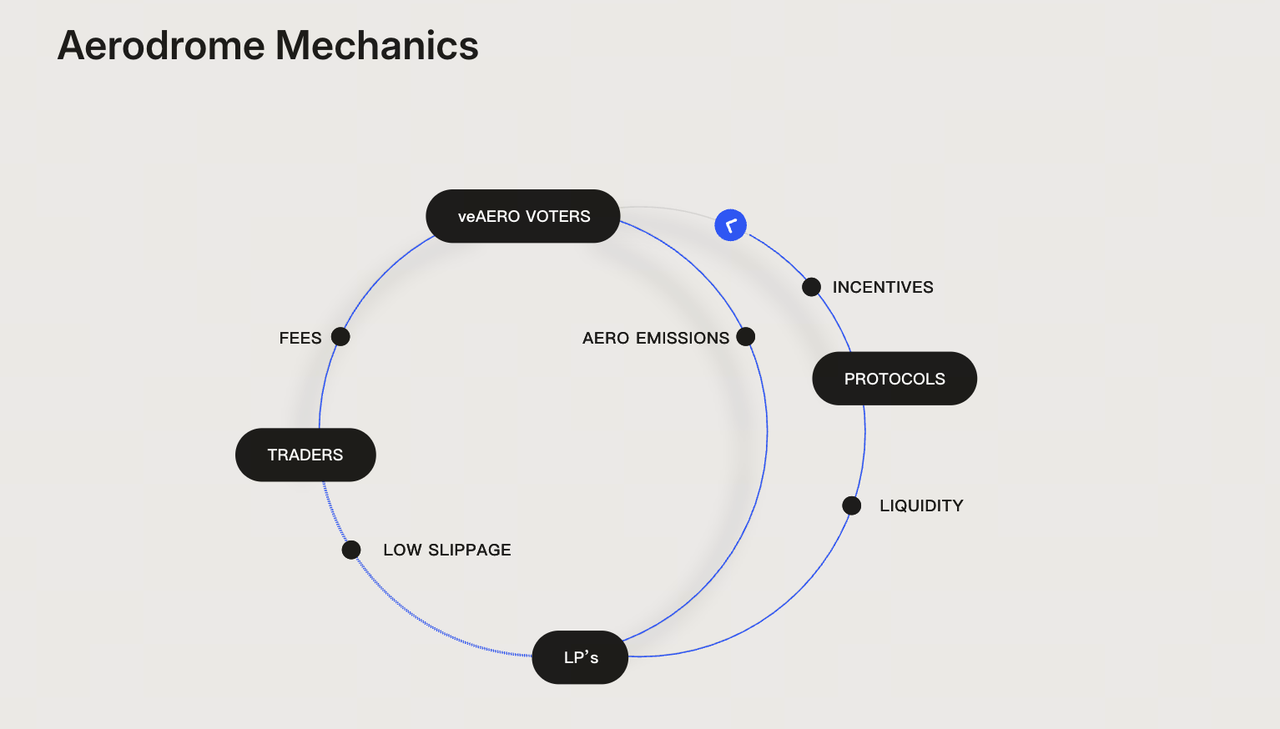
In Aerodrome’s ve(3,3) model, traders, liquidity providers, and veAERO voters form an interdependent incentive structure. Traders need low slippage liquidity. Liquidity providers seek higher emissions based returns. Voters focus on fee revenue sharing and bribe based rewards.
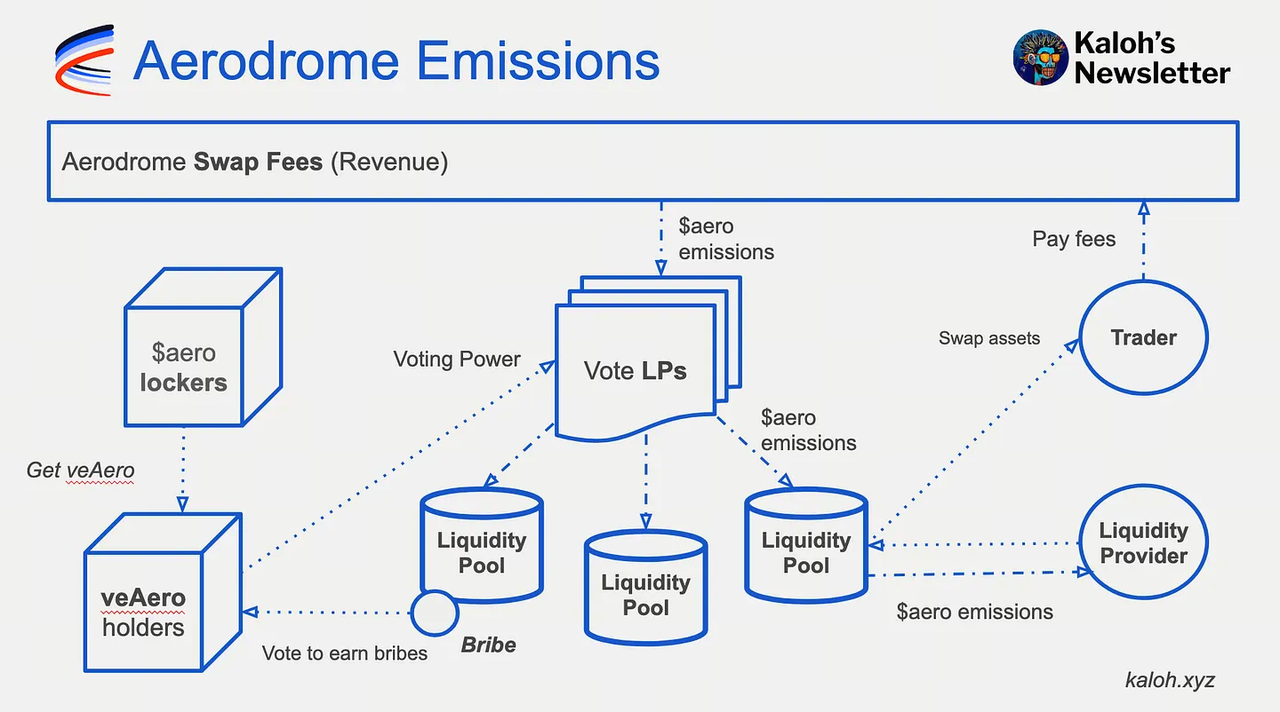
Each week, veAERO holders use Gauge voting to decide how emissions are allocated across liquidity pools. Higher voting weight results in more AERO emissions routed toward the selected pools. Projects can also provide additional tokens as bribes to attract votes toward specific pools, increasing the emissions and liquidity depth directed there.
The typical flow is described as follows. A protocol creates a pool and sets bribes. Voters allocate weight. Emissions flow into targeted pools. Liquidity providers supply liquidity. Trading volume grows and generates fees, which are then shared back with voters. This forms a self reinforcing loop driven by emissions and real trading demand. At its core, it is a market based mechanism for renting liquidity.
Permissionless Bribes as a Market Driven Liquidity Allocation Tool
Aerodrome allows anyone to provide tokens to a specific pool’s reward contract as bribes, incentivizing veAERO holders to direct voting weight toward that pool. Voters receive additional rewards based on the weight they allocate.
This mechanism shifts liquidity allocation from protocol controlled distribution to market based bidding. Projects use rewards to attract emissions and liquidity depth. Liquidity providers earn higher yields. Voters receive fee revenue plus bribes. The result is a positive loop where voting, liquidity, and trading volume reinforce each other, and Aerodrome can route emissions toward pools with stronger demand or strategic value. This reinforces its role as a liquidity hub within the Base ecosystem.
(Source: Kaloh’s Newsletter)
AERO Value Capture and Risk Considerations
Aerodrome’s token economics are structured around how protocol revenue is generated, distributed, and balanced against long-term participation risks.
100% Fee Distribution
One of Aerodrome’s defining features is its fee distribution model. All trading fees generated by the protocol are distributed entirely to veAERO holders. The protocol itself does not retain a portion of fees and does not allocate revenue to a treasury.
The main sources of protocol revenue currently include:
- Slipstream concentrated liquidity pools
- V1 traditional stable and volatile pools
- Monthly fee distribution exceeding approximately 6.9 million USD to voters
Risk Factors
This model is associated with several risk considerations:
- Liquidity lock risk, as veAERO positions can be locked for up to four years
- Ongoing emission-driven inflation
- Increasing competition within the Base ecosystem
Overall, this represents a high-yield model that also requires a high level of long-term commitment.
Summary
Aerodrome tokenomics are not simply a liquidity mining framework. They function as a complete DeFi governance engine. Through the ve(3,3) model, Gauge voting, and a design that distributes 100 percent of trading fees to governance lockers, Aerodrome binds trading volume, liquidity, and governance power into a self growing economic flywheel. For long term participants, AERO is not merely a token, but a representation of sustainable revenue rights. For the broader Base ecosystem, Aerodrome is reshaping how DEX value distribution and liquidity competition are designed.







