Who Should Use Contract Trading? Can Beginners Really Get Involved?
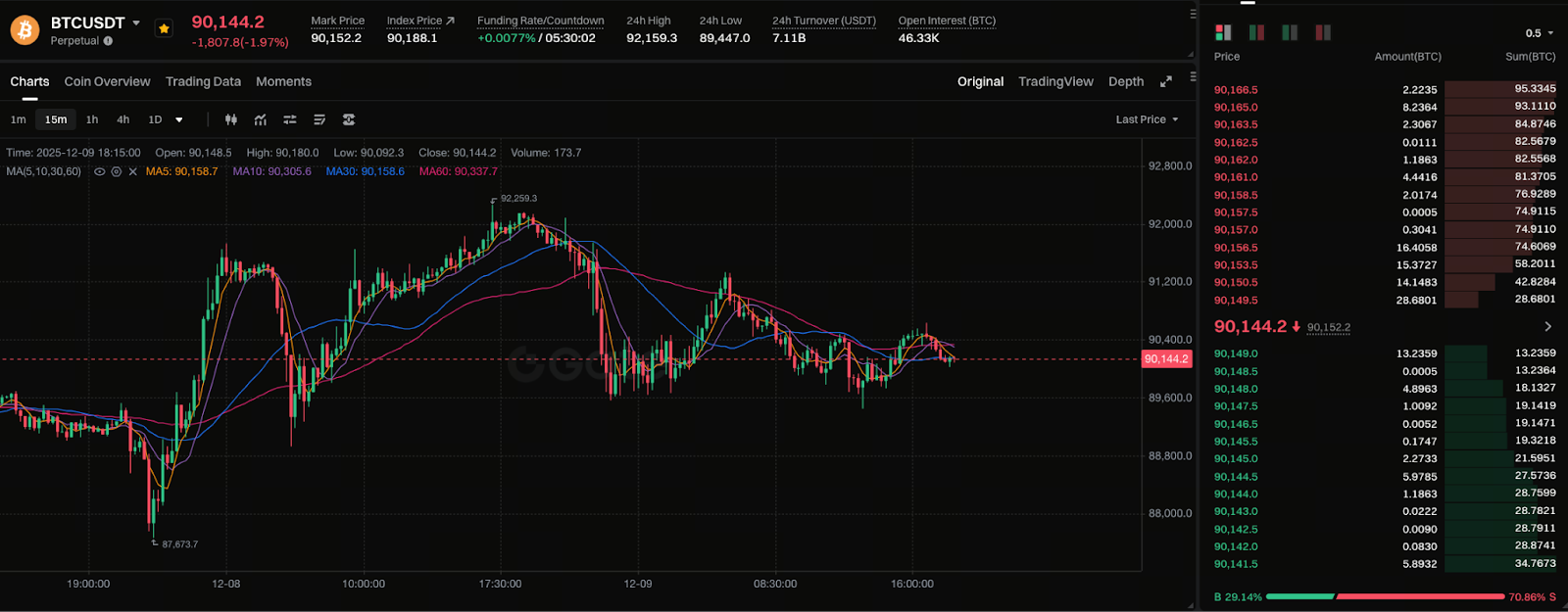
Image source: https://www.gate.com/futures/USDT/BTC_USDT
Many people see contract trading as synonymous with high risk, high leverage, and high volatility, making it seem fit only for seasoned traders. In reality, contract trading itself doesn’t prohibit beginners; the real threshold is understanding risk.
If you meet the following criteria, you have the foundation to start learning about contract trading:
- You can handle short-term price swings
- You understand that leverage magnifies both gains and losses
- You’re willing to use stop-losses to manage risk
- You don’t treat contracts as a get-rich-quick scheme
Contract trading isn’t inherently dangerous—what’s risky is trading blindly without knowing the rules.
Gate Contract Trading: Core Structure Overview
On Gate, contract trading is organized into five main modules:
- Trading Pairs: BTC, ETH, and a wide range of major and trending cryptocurrencies
- Leverage & Margin: Adjust your exposure and manage position risk
- Order & Execution: Market, limit, and conditional orders
- Position & Risk Management: Isolated margin, cross margin, liquidation price, risk ratio
- PnL & Funding Rate: Real-time profit/loss tracking and long-short balancing mechanisms
This structure demonstrates that contract trading is much more than just guessing price direction—it’s a comprehensive risk management system.
The Five Essential Concepts in Contract Trading
Before you start trading, you must grasp these five fundamentals—otherwise, you risk heavy losses right out of the gate.
1. Leverage
Leverage determines how much capital you control with your own funds. For example, with 5x leverage, $100 USDT lets you manage a $500 position. Both gains and losses are amplified.
2. Long / Short
- Long: You expect the price to rise
- Short: You expect the price to fall
This is the defining difference between contract and spot trading.
3. Margin
Margin is the capital you provide as collateral for a contract. If your margin falls short, your position will be forcibly closed (liquidated).
4. Liquidation Price
If the market price hits your liquidation price, the system will automatically close your position to prevent further losses.
5. TP / SL (Take Profit / Stop Loss)
These tools let you lock in profits or cap your losses in advance—they’re the most critical safeguards in contract trading.
A Beginner’s Step-by-Step Guide to Your First Contract Trade on Gate
Here’s a standard process tailored for newcomers:
Step 1: Transfer a Small Amount of Funds
Move a modest sum from your spot account to your contract account. When you’re just starting out, avoid committing too much capital.
Step 2: Choose a USDT Perpetual Contract
USDT contracts are easy to calculate and have transparent risk, making them ideal for beginners.
Step 3: Set Low Leverage
Use 1–3x leverage to prioritize position safety over chasing bigger returns.
Step 4: Use Isolated Margin Mode
Isolated margin mode limits the risk of each position to its own margin, so one mistake won’t wipe out your whole account.
Step 5: Pick a Direction and Place Your Order
Decide to go long or short based on your market outlook. Use limit orders whenever possible to avoid slippage from market orders.
Step 6: Set Take-Profit and Stop-Loss Together
Set your stop-loss to define your maximum loss, and your take-profit to lock in gains. This step is non-negotiable.
Step 7: Close Your Position and Review
Win or lose, always review your trade before jumping into the next one.
The Essential Risk Management Mindset for Contract Trading
In contract trading, risk control—not technical analysis—is what truly determines the life span of your trading account.
1. Position Management Beats Win Rate
Even if your win rate is just 50%, you can still be profitable long-term if you size your positions properly and enforce strict stop-losses.
2. There’s No Such Thing as a “Sure-Win Market”
Every market move can reverse. Going all-in is always a high-risk bet.
3. Stop Trading After Consecutive Losses
Emotional trading is the number one reason for forced liquidation in contract trading.
4. Leverage Is a Tool, Not a Toy
Use leverage to improve capital efficiency—not to chase thrills.
Gate Contract Trading’s Real-World Advantages
For beginners, Gate’s contract system offers several tangible benefits:
- Intuitive trading interface with clear position data
- Real-time display of liquidation price and risk ratio
- Multiple automated take-profit and stop-loss options
- Strong market depth and liquidity for major pairs
- Comprehensive features so beginners can manage basic risks without extra tools
These features aren’t about making trading more exciting—they’re designed to keep your account safe during volatile markets.
Conclusion: Contract Trading Is a Tool, Not a Gamble
At its core, contract trading is a full-featured leveraged trading system. It can boost your capital efficiency—but it can also magnify losses quickly.
Your results don’t depend on the platform. They depend on whether you have these three qualities:
- A clear understanding of risk
- Strict position management
- Long-term discipline
Gate’s contract trading covers all the essentials for everyone from beginners to advanced traders. The right path for newcomers isn’t “get rich quick”—it’s to learn the rules, start small, and only then pursue bigger returns.







