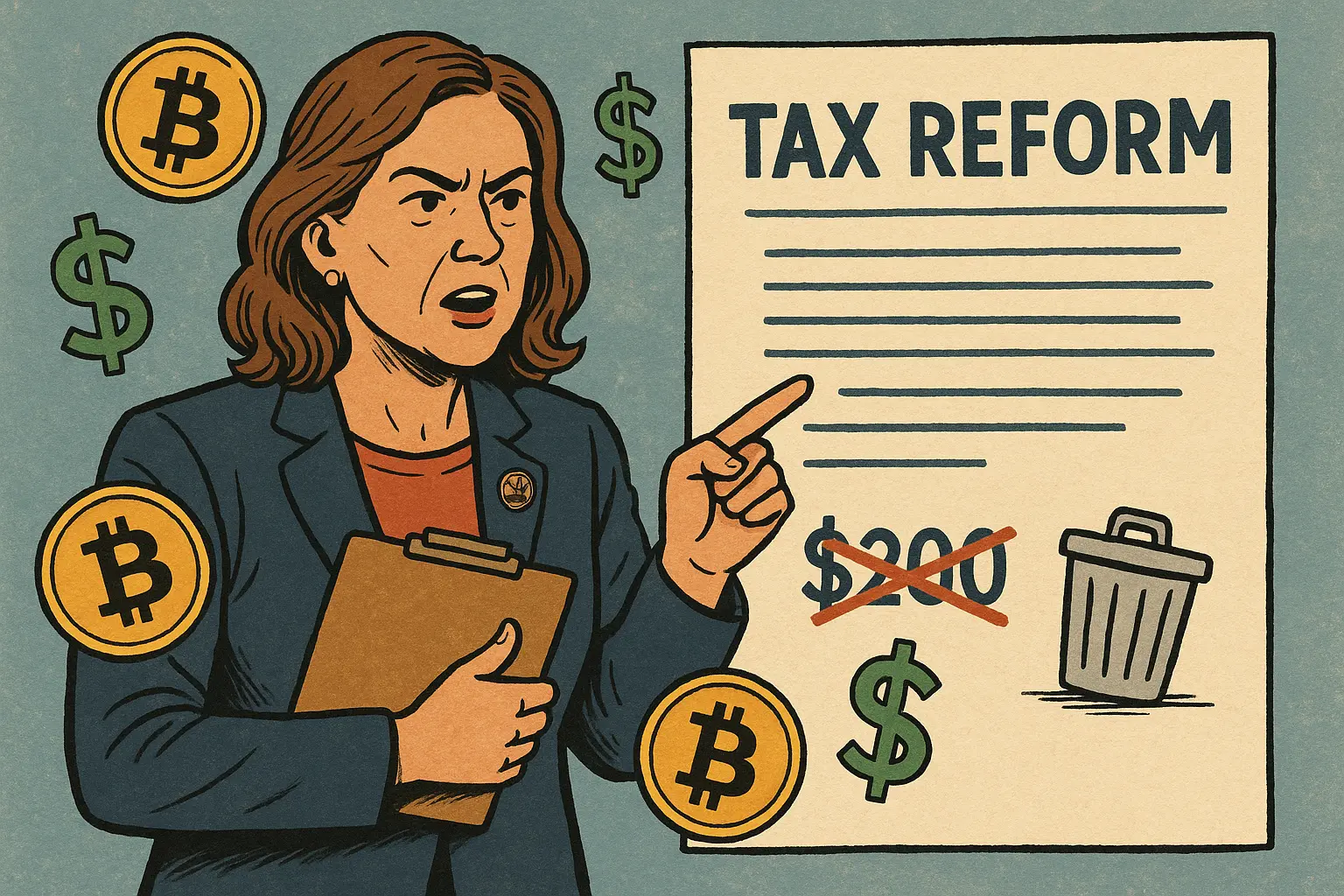
U.S. Representatives Steven Horsford and Max Miller have recently reintroduced the “Protecting, Accounting, Regulation, Innovation, Taxation, and Revenue Act” (PARITY Act), aiming to comprehensively update the framework of existing U.S. cryptocurrency tax policies. The latest version removes the $200 small-transaction de minimis threshold, formally introduces wash sale rules for digital asset transactions, and clearly distinguishes “passive staking” from active trading and participation.
Legislative Background of the PARITY Act: A Bipartisan Attempt at Crypto Tax Reform
Current U.S. cryptocurrency tax policy requires holders to report the capital gains or losses from all digital asset transactions, even routine small payments, which the industry widely criticizes as an overly burdensome administrative requirement and as a disincentive to promoting cryptocurrencies as a payment tool.
The PARITY Act is being advanced by lawmakers from both parties. Its bipartisan nature is seen as a strategic attempt to build broad support for the crypto industry during tax policy debates. Over the next few months, the U.S. Congress will broadly discuss tax matters, and industry insiders expect that any tax legislation that could potentially become law will strongly push to include provisions related to cryptocurrencies.
Three Major Core Amendments: Substantive Changes in the Latest Version
Removal of the $200 De Minimis Threshold: The original draft set a $200 de minimis threshold for transactions involving “regulated payment stablecoins,” but the latest version deletes it. The replacement is: as long as the taxpayer’s cost basis in regulated payment stablecoins is not less than 99% of the redemption value, no gain or loss will be recognized upon sale; for exchange-traded transactions, there is a presumed cost basis of $1
Introducing Wash Sale Rules for Digital Assets: The latest draft explicitly provides that cryptocurrency transactions will be subject to wash sale rules (Wash Sale Rule), preventing investors from manufacturing tax losses by quickly selling and then buying back the same asset. This is not a highly controversial position—similar provisions were already included in Senator Cynthia Lummis’s tax bill last year
Distinguishing Passive Staking from Active Trading: The bill clearly distinguishes “passive staking” from active participation activities such as buying, selling, and trading, establishing a differentiated tax treatment framework for different types of cryptocurrency income.
Legislative Outlook: Timing Is Unclear, but the Industry Is Moving Fast
The legislative progress of the PARITY Act remains unclear for now. Although there are rumors in the industry that Congress may introduce a “Reconciliation Bill” that includes tax measures, President Trump has also already released his 2027 fiscal year budget request, but whether any cryptocurrency provisions can ultimately be included in any enacted tax legislation remains highly uncertain.
That said, signals from within the industry are clear: once any tax legislation that could become law is on the table, the cryptocurrency industry will fully push for the inclusion of related provisions. The PARITY Act’s reintroduction lays a more concrete documentary foundation for the industry’s policy demands during this tax legislative cycle.
Frequently Asked Questions
Why did the PARITY Act remove the $200 small de minimis threshold?
In the December 2025 draft, the $200 threshold originally mainly applied to regulated payment stablecoins and was associated with the GENIUS Act. The March 2026 version changed the standard for determining whether to not recognize gains or losses to “cost basis not less than 99% of the redemption value,” which in substance provides a broader de minimis framework for eligible stablecoin transactions and no longer relies on a fixed dollar threshold.
What specific impact would wash sale rules have on investors after they apply to cryptocurrencies?
Wash sale rules prohibit investors from buying back the same or substantially similar asset within 30 days after selling at a loss, and using that loss for tax deductions. Currently, this rule is applied in the U.S. stock market, but cryptocurrencies have not yet been included. If the bill passes, investors would not be able to indefinitely generate book tax losses through wash sale operations at year-end, and existing tax planning strategies would need to be adjusted accordingly.
How far is the PARITY Act from becoming law right now?
The bill is still at the discussion draft stage and has not entered the formal legislative process. Progress depends on how quickly the U.S. Congress advances overall tax legislation and whether cryptocurrency provisions can be included in a tax reconciliation bill that could be advanced. The industry plans to actively lobby during the upcoming tax legislative cycle, but specific outcomes are still difficult to predict.
Disclaimer: The information on this page may come from third parties and does not represent the views or opinions of Gate. The content displayed on this page is for reference only and does not constitute any financial, investment, or legal advice. Gate does not guarantee the accuracy or completeness of the information and shall not be liable for any losses arising from the use of this information. Virtual asset investments carry high risks and are subject to significant price volatility. You may lose all of your invested principal. Please fully understand the relevant risks and make prudent decisions based on your own financial situation and risk tolerance. For details, please refer to
Disclaimer.
Related Articles
BIS Warns Global Stablecoin Regulatory Fragmentation Will Fuel Arbitrage and Fragment Cross-Border Markets
The BIS's Pablo Hernandez de Cos warned that differing stablecoin regulations threaten cross-border markets and create arbitrage opportunities. He noted stablecoins' inadequacy for payments, potential market destabilization risks, and regulatory challenges linked to money laundering and sovereignty.
GateNews51m ago
SEC and CFTC Propose Raising Private Fund Reporting Threshold to $1 Billion
The SEC and CFTC propose to reduce hedge fund reporting requirements by exempting smaller advisors and increasing the asset threshold for Form PF from $150 million to $1 billion, with data used confidentially for oversight.
GateNews6h ago
Hong Kong SFC Launches Pilot Framework for Secondary Trading of Tokenised Investment Products
Hong Kong's SFC launched a pilot framework for secondary trading of tokenised investment products on licensed platforms, enhancing retail access and blockchain settlement. The framework includes investor protection measures and aims to expand the tokenised products market.
GateNews10h ago
Hong Kong SFC issues two tokenized offering circulars on the same day (26EC22 / 26EC23): Full breakdown of VATP secondary trading and primary subscription and redemption rules
The Hong Kong Securities and Futures Commission will issue two guidance circulars for tokenized products in 2026, covering primary-market subscription and redemption and secondary-market trading requirements, respectively. The circulars will clearly define the responsibilities of product providers, liquidity requirements, and fair pricing mechanisms. The new regulatory framework will affect how the industry operates and will create new business opportunities for compliance lawyers, forming a template for tokenized finance regulation in the Asia-Pacific region.
ChainNewsAbmedia10h ago
Hong Kong SFC prepares the world’s first tokenized assets trading framework for VATP: money market funds to lead the way, gradually expanding to all authorized products
The Hong Kong Securities and Futures Commission will publish a framework in April 2026 that will allow licensed virtual asset trading platforms to conduct secondary-market transactions of tokenized assets, with the first batch including money market funds and future expansion to stocks, bonds, and more. This will make Hong Kong the first market to use Web3 infrastructure, and it will advance in step with the regulatory technology “CrypTech” to establish a regulatory template for tokenized finance. The move is intended to secure Hong Kong’s position as an Asia-Pacific digital-asset hub and to create competitive pressure on Taiwan-based industry players.
ChainNewsAbmedia11h ago
BIS calls for globally coordinated stablecoin regulation: warns that Tether and Circle account for 85% of those showing “security-like characteristics”
The Bank for International Settlements (BIS) once again emphasized the importance of global stablecoin regulatory coordination, pointing out three major risks that stablecoins face at this stage, including regulatory challenges related to cross-border flows and issues with market concentration. BIS proposed a unified ledger framework and argued that central banks need to lead the development of digital currencies, which would pose challenges to existing stablecoin issuers such as Tether and Circle. Overall, in the future, stablecoins may face a more stringent regulatory framework.
ChainNewsAbmedia12h ago


