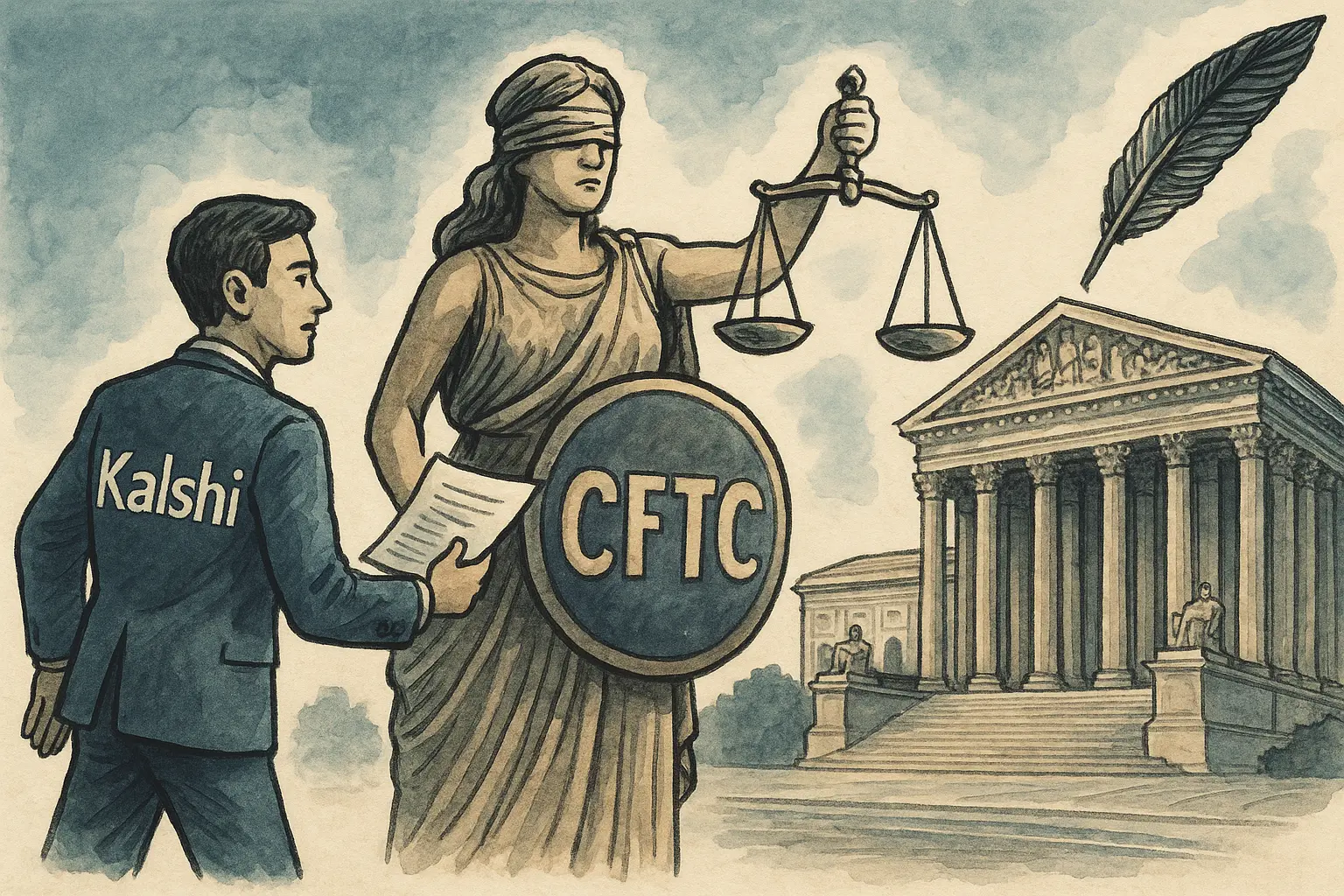
Prediction market platform Kalshi has appealed a ruling by the state of Nevada banning its event contracts, and the U.S. Ninth Circuit Court of Appeals held oral arguments on April 17, but did not issue an immediate decision after the hearing. The core dispute in the case is whether Kalshi’s event contracts are “swap agreements” that fall under the jurisdiction of the Commodity Futures Trading Commission (CFTC), or whether they must be regulated by state-level activity under gambling licensing regimes. Multiple legal experts predict that the case may ultimately be appealed to the U.S. Supreme Court.
Case Core: A Head-On Conflict Between CFTC Federal Jurisdiction and State Gambling Regulations
Kalshi’s key defense position is that the event contracts provided on its platform are “swap transactions” under the framework of the Commodity Exchange Act, and should be subject to exclusive federal oversight by the CFTC rather than constrained by state gambling regulations. The lower court previously ruled that Kalshi’s operations in Nevada require a gambling license issued by the state government, and this appeal challenges that ruling.
Attorney Colleen Sinzdak, representing Kalshi, pointed out during the hearing: “I think what we really need to avoid is state court and federal court simultaneously considering exactly the same issues and potentially reaching different results.” CFTC Chair Michael Celig has also explicitly supported the federal-jurisdiction position in lawsuits between the Crypto.com prediction market and Nevada’s regulators.
Current Multi-State Enforcement: From Arizona Criminal Charges to Federal Court Blockage
The arguments before the court also revealed that state-level enforcement actions against prediction markets have spread across multiple jurisdictions, with direct conflicts emerging at both the federal and state levels:
Arizona: Filed criminal charges against Kalshi event contracts, but were blocked last week by a federal court, prohibiting Arizona authorities from taking enforcement action against Kalshi under state gambling laws
Nevada: The lower court ruled that Kalshi must hold a gambling license, triggering the Ninth Circuit appeal
Multiple States: Have taken enforcement actions of varying degrees against prediction market platforms such as Kalshi and Polymarket
This pattern reflects a fundamental disagreement between federal and state regulatory frameworks on how to characterize prediction markets—an underlying reason this case may ultimately require a final ruling by the Supreme Court.
Supreme Court Outlook: Coinbase’s General Counsel’s Long-Term Prediction
Although not a party to this case, Coinbase Chief Legal Officer Paul Grewal posted after the hearing stating: “The questions raised during oral argument can’t reliably predict the court’s leanings. In any event, I stand by my long-standing prediction—that the Supreme Court will decide whether sports contracts on designated contract markets are swap transactions, and thus subject to the CFTC’s exclusive jurisdiction.”
Any ruling by the Ninth Circuit will directly affect the operating framework of prediction market platforms such as Kalshi and Polymarket. This market—estimated to reach a size of $1 trillion by 2030—is currently facing ongoing legal uncertainty due to the ambiguous zone between state and federal regulation. Notably, in its 2018 ruling in Murphy v. NCAA, the U.S. Supreme Court granted broad power to states to regulate sports betting. How this precedent will interact with the present case is a key focus for legal observers.
Frequently Asked Questions
Why were Kalshi’s event contracts deemed to require a gambling license?
The lower court in Nevada determined that, structurally, Kalshi’s event contracts are similar to gambling activities—users bet on the outcome of a specific event—therefore they should be subject to state gambling regulations and require a license. Kalshi objected, arguing that its contracts are financial derivatives regulated by the CFTC and that state gambling laws should not apply. This classification dispute is the central legal issue throughout the entire litigation.
What role does the CFTC play in this case?
While the CFTC is not a direct party to the lawsuit, its position is crucial. CFTC Chair Michael Celig has clearly supported the stance that prediction market event contracts fall within the scope of federal regulation. If the Supreme Court ultimately rules that the CFTC has exclusive jurisdiction, it would directly limit the ability of states to take independent enforcement actions against prediction markets—constituting a fundamental change to the nationwide industry landscape.
How will the outcome of this case affect the overall prediction market industry?
If the claim of federal jurisdiction is supported, platforms such as Kalshi could expand nationwide under a unified framework, ending the fragmented pattern in which states handle matters independently. If the states’ claims are supported, the industry would continue to face high compliance costs from applying for licenses state by state—similar to the current landscape of online sports betting—and could significantly slow the industry’s overall growth rate.
Disclaimer: The information on this page may come from third parties and does not represent the views or opinions of Gate. The content displayed on this page is for reference only and does not constitute any financial, investment, or legal advice. Gate does not guarantee the accuracy or completeness of the information and shall not be liable for any losses arising from the use of this information. Virtual asset investments carry high risks and are subject to significant price volatility. You may lose all of your invested principal. Please fully understand the relevant risks and make prudent decisions based on your own financial situation and risk tolerance. For details, please refer to
Disclaimer.
Related Articles
CLARITY Bill enters a critical 28-day window! Polymarket: Probability of passing drops to 38%
According to data from Polymarket prediction markets on April 27, the probability that the “Digital Asset Market Clarity Act” (CLARITY Act) will be completed into law in 2026 has fallen from a previous peak of 70% to 38-50%. As of April 27, there are only 28 days left until May 25, 2026, Memorial Day holiday in the United States.
MarketWhisper1h ago
SSRN Research Paper: Polymarket’s Pricing Accuracy Comes From 3.14% Informed Traders
According to academic paper published on SSRN on April 20, a research team from London Business School and Yale University analyzed Polymarket’s complete trading records and concluded that the platform’s pricing accuracy is mainly driven by 3.14% of informed traders, rather than the collective intelligence of all accounts. The study covers 98,906 events, 210,322 markets, involves 1.72 million accounts, and total trading volume reaches $13.76 billion.
MarketWhisper2h ago
Research reveals: Polymarket players take home 30% of profits by winning 3% of the positions—more than 70% of players absorb all losses
A new study analyzes Polymarket’s trading records from 2023–2025 and shows that only 3.14% of experienced winners control more than 30% of the profits. Crowd participation alone is not enough to explain overall accuracy; at the same time, it tracks 1,950 highly suspicious insider trading accounts that, while not driving predictions, amplified price volatility. The case shows that large bets were placed and profits were made before the U.S. announced developments regarding Venezuela. The research questions “wisdom of crowds” and emphasizes the need for increasingly strict regulation.
ChainNewsAbmedia3h ago
Polymarket Analysis: Crypto Events Account for 40% of Top 10 Most Volatile Markets
Gate News message, April 27 — Polysights, a third-party prediction market data platform, analyzed over 20,000 Polymarket markets from the past six months and released a volatility ranking. The analysis revealed that cryptocurrency-related markets account for four of the top ten most volatile markets
GateNews4h ago
Polymarket Announces April 28 Upgrade: Collateral Assets Migrated to pUSD, Trading Paused for About 1 Hour
According to an official announcement posted on X on April 27 by Polymarket developers, Polymarket will roll out a full platform infrastructure upgrade at 11:00 UTC on April 28, with trading paused for about 1 hour. This upgrade includes new generation trading contracts, a rebuilt order book, and the introduction of a new collateral token, pUSD. The platform’s existing collateral assets will be migrated from USDC.e to pUSD.
MarketWhisper4h ago
Polymarket Non-Sports Volume Reaches $7.5B vs. Kalshi's $1.6B, Says Blockchain Capital Partner
Gate News message, April 27 — According to Spencer Bogart, a partner at Blockchain Capital, Kalshi and Polymarket have nearly identical total trading volumes of approximately $12.2 billion each (Kalshi at $12.29 billion, Polymarket at $12.22 billion). However, when sports-related trades are
GateNews5h ago


