
Bitcoin (BTC) started the week with stagnant gains, currently around $74,140 as of March 18. The US SEC and CFTC jointly released a 68-page new guideline, clarifying that most cryptocurrencies are not securities. Tether launched an AI framework, enabling training of billion-parameter AI models on mobile devices.
Macro Events & Crypto Highlights
- The US SEC and CFTC jointly issued a 68-page new guideline, clarifying that most cryptocurrencies are not securities. SEC Chair Paul Atkins stated at the Washington Blockchain Summit that this move will provide market participants with clear guidance on how federal securities laws apply to crypto assets.
The guideline details classifications for stablecoins, digital commodities, and “digital tools,” all deemed non-securities. It explains how “non-security crypto assets” can transform into securities and how federal securities laws apply to mining, protocol staking, and airdrops. Digital commodities are defined as assets “intrinsically linked to the functional operation and supply-demand dynamics of functional cryptosystems, from which value is derived.” Digital collectibles are also not considered securities.
Atkins said, “We are no longer the Securities and Exchange Commission,” contrasting sharply with former SEC Chair Gary Gensler’s stance of classifying most cryptocurrencies as securities. CFTC Chair Michael Selig also attended the summit.
- Tether’s QVAC Fabric launched the world’s first cross-platform LoRA fine-tuning framework for Microsoft’s BitNet (a one-bit LLM), significantly reducing the GPU and memory requirements for training large models. The framework supports LoRA fine-tuning and inference acceleration on Intel, AMD, Apple Silicon M-series, and mobile GPUs (such as Adreno, Mali, Apple Bionic).
News & Updates
-
Analysis: MicroStrategy increased Bitcoin holdings last week primarily through preferred stock financing.
-
Hong Kong stablecoin payment company RedotPay is raising $150 million, aiming for a US IPO with a valuation exceeding $4 billion.
-
Vitalik: A new fast confirmation mechanism for Ethereum can provide transaction immutability guarantees within 12 seconds.
-
US Senator Tim Scott: Negotiations on the Crypto Market Structure Bill are making progress.
-
Hyperliquid HIP-3 daily open interest reached $1.43 billion, a new record high.
-
Bitrefill disclosed a cyberattack earlier this month, suspected to be carried out by North Korea’s Lazarus Group.
-
TD Cowen: The US and Canada’s crypto legislation review window may be extended to the August recess, with potential delays until 2027 if not passed.
-
The SEC and CFTC released new crypto guidelines, clarifying that most digital assets are not securities.
-
Trump lashed out at allies and threatened to withdraw from NATO: Stammer is not Churchill, Macron, or about to step down.
-
Iran has designated multiple substitutes for key national positions; the Secretary of the Supreme National Security Council has previously confirmed death.
Market Trends
-
Latest Bitcoin news: $BTC started the week with stagnant gains, currently around $74,140. Over the past 24 hours, liquidations reached $93.96 million, mainly long positions.
-
US stock markets closed higher for the second consecutive day on March 17, as investors bought the dip, showing confidence despite escalating tensions in Iran. Airlines and travel stocks rose. The Dow Jones Industrial Average gained 46.85 points, up 0.1%, closing at 46,993.26; the S&P 500 rose 16.71 points, up 0.25%, closing at 6,716.09; the Nasdaq increased 105.35 points, up 0.47%, closing at 22,479.53. The Philadelphia Semiconductor Index rose 40.58 points, up 0.52%, ending at 7,836.83.
 (Source: Gate)
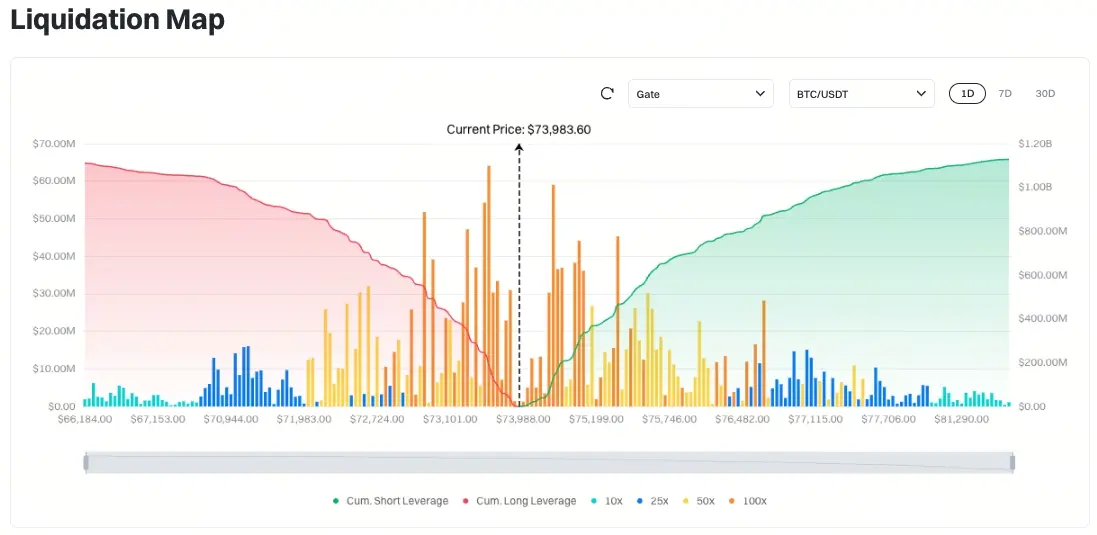
- According to Gate’s BTC/USDT liquidation map, with the current price at $73,983.60, if the price drops to around $73,389, total long liquidation exceeds $190 million; if it rises to around $74,871, total short liquidation exceeds $130 million. Short liquidations are lower than longs, so it’s advisable to control leverage reasonably to avoid large-scale liquidations during market fluctuations.
 (Source: Coinglass)
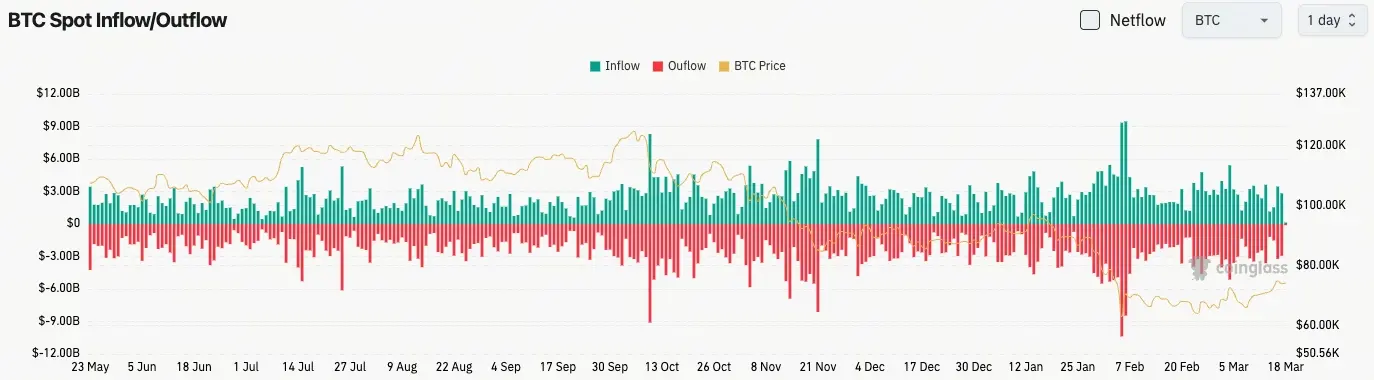
- In the past 24 hours, spot inflow was $2.83 billion, outflow was $2.93 billion, net outflow $100 million.
 (Source: Coinglass)
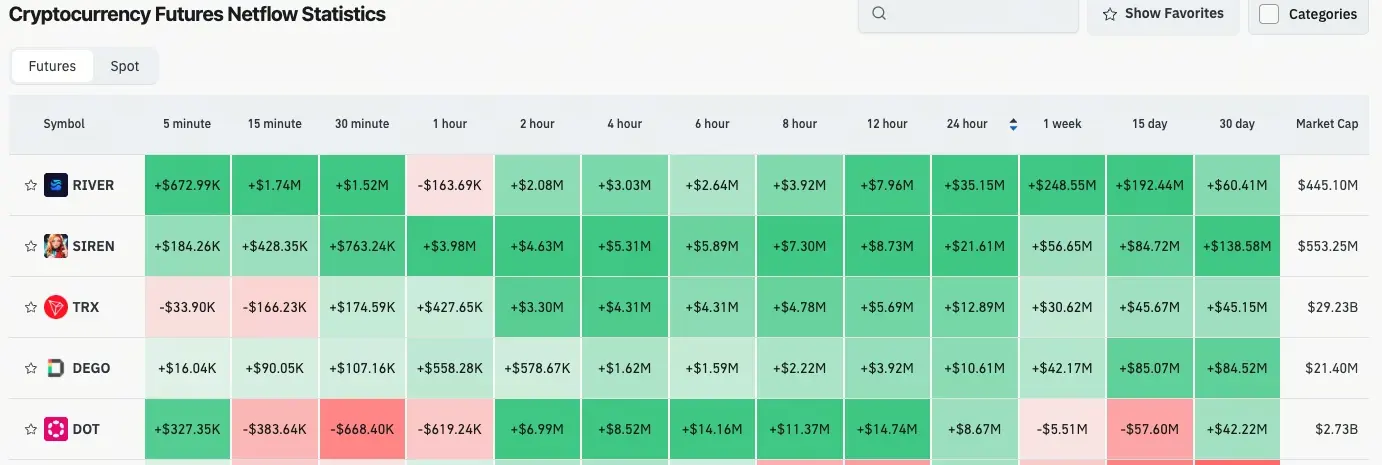
- In the past 24 hours, net outflows led in contracts for $RIVER, $SIREN, $TRX, $DEGO, $DOT, indicating trading opportunities.
Selected Insights from X KOL
Phyrex Ni (@Phyrex_Ni): “Over the past month, the Nasdaq has been oscillating between 24,000 and 25,000 points with little volatility, indicating that although the war has progressed, the market has not yet entered panic mode. Everyone knows that while the war has driven oil prices higher last week, leading to inflation concerns, it’s unlikely to last long. Investors also do not expect the Fed to cut rates before Powell’s departure.”
“Although the market seems lively, the bigger risk isn’t the current war. Of course, if the war escalates, risks will rise. If it reaches nuclear levels, that’s the ultimate risk. Currently, the biggest concern is pessimism driven by high interest rates, as credit still seems stable but institutions are already on edge.”
“Thursday morning, the Fed’s FOMC meeting will be held. No major changes are expected. The main questions will likely focus on the war’s impact on inflation. Due to tariff changes, Powell might lean slightly dovish this time.”
“Looking at Bitcoin data, the turnover rate is decreasing today. While prices are slightly rising, trading volume isn’t expanding, indicating that sellers aren’t very eager. Monday’s turnover was already quite active, and the chip structure remains unchanged, showing healthy data overall.”
“In the short term, only unexpected events could significantly change $BTC. If everything proceeds normally, Bitcoin is likely to remain in a consolidation phase. Lower oil prices would reduce market risks; if oil prices spike, risk markets will face more trouble.”
Today’s Outlook
-
Eurozone February Consumer Price Index (final, YoY), previous 1.9%
-
Eurozone February Consumer Price Index (final, MoM), previous 0.7%
-
US February Producer Price Index (YoY), previous 2.9%
-
Canada overnight target interest rate, previous 2.25%
-
US EIA crude oil inventory change last week (thousand barrels), previous 382.4
Disclaimer: The information on this page may come from third parties and does not represent the views or opinions of Gate. The content displayed on this page is for reference only and does not constitute any financial, investment, or legal advice. Gate does not guarantee the accuracy or completeness of the information and shall not be liable for any losses arising from the use of this information. Virtual asset investments carry high risks and are subject to significant price volatility. You may lose all of your invested principal. Please fully understand the relevant risks and make prudent decisions based on your own financial situation and risk tolerance. For details, please refer to
Disclaimer.


