
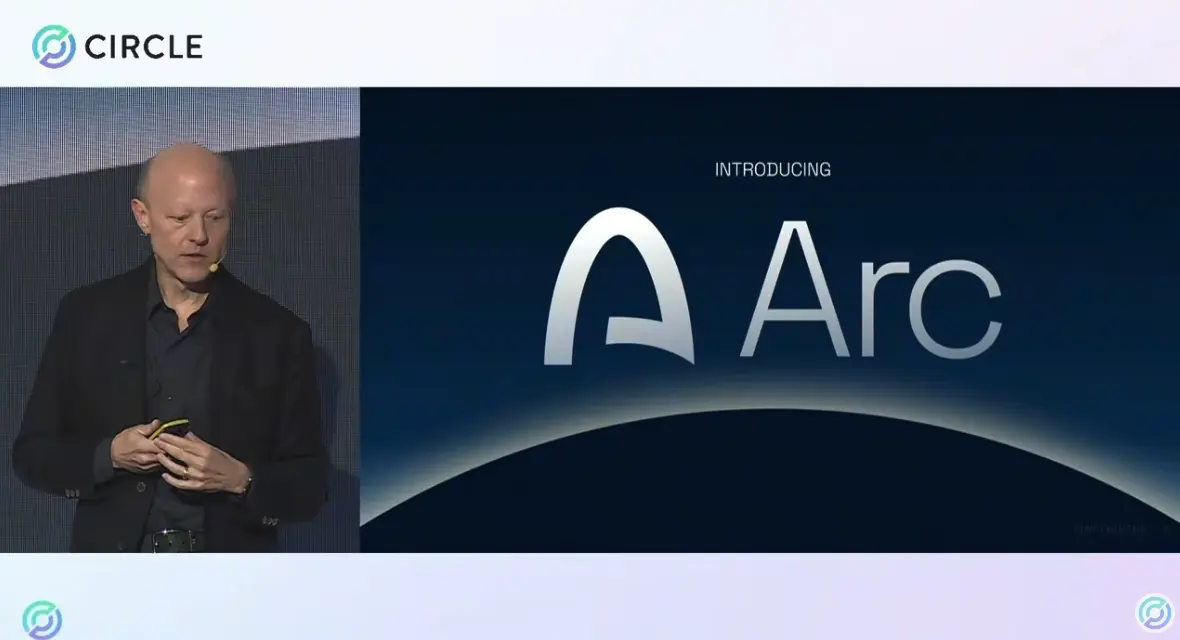
Circle co-founder and CEO Jeremy Allaire confirmed on April 14 during an in-person event in Seoul, South Korea, that Circle is exploring the issuance of a native token for Arc Network, its stablecoin payment public chain. The design goals cover three core functions: governance, ecosystem incentives, and economic incentives aligned with stakeholders. It also plans to gradually transition to a proof-of-stake (PoS) system.
Core Token Plan Architecture: Governance, Incentives, and PoS Transition
 (Source: Youtube)
According to Allaire’s remarks, Arc Network’s token issuance plan is designed around three main directions: first, protocol governance, allowing token holders to participate in network decision-making; second, ecosystem incentives, using token mechanisms to attract validators, developers, and users to actively participate; and third, economic alignment, ensuring the protocol’s long-term interests remain consistent with those of all participants.
This path is highly aligned with the tokenized models of existing mainstream Layer-1 blockchains, but Arc Network’s special aspect is that it is backed by Circle, the issuer of the USDC stablecoin, and is positioned around a design whose core use case is stablecoin payments using fiat-pegged stablecoins. As of now, Allaire has not disclosed the token’s issuance timeline, total supply, or specific allocation plan, indicating that more complete details will be formally announced “in the not-too-distant future.”
Arc Network’s Technical Differences: Post-Quantum Signatures Built In from Day One of the Mainnet
Behind the confirmed token plan is the technical architecture difference Arc Network has already established. This Circle-supported Ethereum Virtual Machine (EVM)-compatible Layer-1 blockchain will have post-quantum signature support built in starting from the very first day its mainnet goes live—rare among mainstream Layer-1 projects for such front-loaded deployment.
Arc Network Post-Quantum Security Phased Roadmap
Mainnet launch in sync: Post-quantum signature support; wallets get quantum resistance first
Near-term enhancements: Quantum-resistant private smart contract state protection, preventing on-chain data from being decrypted by future quantum computers
Mid-term goals: Full construction of the underlying infrastructure for quantum resistance
Long-term upgrades: Validator signature hardening to achieve quantum security across the network’s validation layer
Arc adopts a “voluntary migration” design rather than forcing a network-wide reset—something that could require months of processing time in large networks like Bitcoin. Arc’s sub-second block finality mechanism (500 milliseconds) also compresses the effective time window for an attacker to forge validator signatures from the design level. On the technical challenge side, while traditional signatures are 64 to 65 bytes, post-quantum signatures may be larger by an order of magnitude, posing engineering difficulties for throughput and storage efficiency.
Background on the Quantum Threat: Why Deployment in 2026 Is Crucial
Arc Network’s decision to build quantum resistance into the mainnet from day one reflects a clear market-timing judgment. Recently, Google researchers warned that advances in quantum computing may threaten existing cryptographic infrastructure faster than expected, and they predict that by 2032 Bitcoin could face real quantum attacks. The U.S. National Institute of Standards and Technology (NIST) has also warned about the risks of “collect now, decrypt later” attacks: an attacker intercepts encrypted data now, then decrypts it once quantum computing becomes powerful enough. This means the security threat to the data exists earlier than the point at which quantum computers are officially usable.
Upgrading quantum resistance in existing mainstream blockchains also faces complex coordination problems. Arc’s documentation states: “The organizations that will lead this transformation are those that start building before the urgency becomes unmistakable.”
Frequently Asked Questions
What is the relationship between Arc Network’s native token and Circle’s USDC?
Arc Network’s token design is positioned as a governance and PoS staking tool, not a stablecoin. USDC is a U.S. dollar-pegged stablecoin issued under Circle, and the two belong to different asset categories. Arc Network’s token plan is used for protocol governance decisions and validator incentives, while USDC continues to circulate in the ecosystem as a payment medium.
Why can Arc Network deploy post-quantum signatures on day one of the mainnet?
Arc’s advantage is that it builds a new chain from scratch, allowing it to adopt post-quantum cryptography standards directly during the architecture design phase, without having to deal with coordination issues for migrating the huge existing user base and infrastructure of an established network. Arc also adopts a voluntary onboarding model, further reducing resistance to quantum upgrades, offering a sharp contrast to solutions that might require forced migration for months in large networks such as Bitcoin.
How should Circle track the next steps of Arc Network’s token issuance plan?
After Allaire’s confirmation of the token plan in Seoul, he said more detailed information will be formally released “in the not-too-distant future,” including key parameters that have not been disclosed yet, such as the token issuance structure, total supply, and PoS transition timeline. Market attention will focus on whether the token allocation plan tilts toward the community, the mainnet launch timeline, and the specific design of the PoS validation mechanism.
Disclaimer: The information on this page may come from third parties and does not represent the views or opinions of Gate. The content displayed on this page is for reference only and does not constitute any financial, investment, or legal advice. Gate does not guarantee the accuracy or completeness of the information and shall not be liable for any losses arising from the use of this information. Virtual asset investments carry high risks and are subject to significant price volatility. You may lose all of your invested principal. Please fully understand the relevant risks and make prudent decisions based on your own financial situation and risk tolerance. For details, please refer to
Disclaimer.
Related Articles
Aave Proposes 25,000 ETH for Kelp DAO Exploit Relief Fund
Aave service providers put forth a governance proposal on Friday that would contribute 25,000 ETH worth nearly $58 million from the protocol's DAO to DeFi United, a coordinated relief effort to restore backing for rsETH following the Kelp DAO exploit. The proposed contribution aims to close the rema
CryptoFrontier6h ago
XRP Breakout Holds as XRPL Lending Vote Gains Momentum
Key Insights
XRP maintains weekly strength above major cryptocurrencies as price holds above key EMAs, reflecting sustained momentum despite minor daily declines in trading sessions.
XRPL validators advance lending upgrades through XLS-65 and XLS-66, introducing pooled liquidity vaults and f
CryptoNewsLand7h ago
XRP Breakout Holds as XRPL Lending Vote Gains Momentum
XRP shows weekly strength, trading above EMAs after breaking from a descending wedge; XRPL advances XLS-65/66 lending upgrades with pooled vaults and fixed-term loans; derivatives rise in volume, open interest, and options activity.
Abstract: This report notes XRP's persistent weekly momentum and price strength above key moving averages following a breakout from a descending wedge. It covers XRPL validators voting on XLS-65 and XLS-66, enabling native lending, pooled liquidity vaults, and fixed-term loans to expand on-chain financial activity. It also reports rising derivatives participation, with higher trading volume, open interest, and a surge in options activity, suggesting increasing trader positioning for a continued breakout.
CryptoNewsLand7h ago
Charles Hoskinson Launches Midnight With $250M in Tokenized Deposits From Monument Bank
Gate News message, April 25 — Charles Hoskinson, founder of Cardano, has launched Midnight, a privacy-focused blockchain project, with approximately $250 million in tokenized deposits from Monument Bank. The partnership represents a significant institutional collaboration aimed at integrating blockc
GateNews10h ago
JPMorgan ETF Trend Report: API-ification, Active Management at 83%, Tokenization Split into Two Paths—Synthetic and Native
JPMorgan Chase’s report highlights three major trends: 1) AP’s API automated trading accounts for about 50% of top-tier market traffic; 2) in 2025, actively managed ETFs make up 83% of new issuance, and are expected to become mainstream in 2026–27; 3) tokenization splits into two paths: synthetic (mirroring prices through derivatives) and native (issued on the blockchain). The report emphasizes improving transparency and governance with tools such as Athena, and monitors subsequent follow-through and the timeline toward formal productization.
ChainNewsAbmedia10h ago
Drift Product Lead Minh Don Plans Relaunch of Forked Exchange in May or June
Gate News message, April 25 — Drift Protocol's product lead Minh Don announced plans to relaunch the forked exchange in May or June, according to a statement made on the official Discord server. The team will spend several weeks optimizing the codebase, removing and adding features that, while
GateNews11h ago


