On Threads, there are rumors from someone claiming to be an accountant that Taiwan’s special act will ban USDT. In reality, it’s fear-based marketing. The draft explicitly states that offshore stablecoins may be traded if the competent authority agrees. Citizens are urged not to believe the rumors and turn toward illegal underground coin dealers, but instead to choose licensed trading platforms to avoid scams.
Someone claiming to be an accountant spreads rumors: the special act—once passed—USDT will be banned
Yesterday (4/8), an anonymous netizen on Threads who claims to hold a CPA accounting license made sensational remarks about the draft of the “Virtual Asset Services Act” recently passed by the Executive Yuan.
The netizen claimed that Articles 34 and 35 of the new law clearly stipulate that stablecoins must obtain the competent authority’s approval and consult with the central bank, and it also says the conservative central bank will never allow Tether ( $USDT ) to circulate legally in Taiwan. Once the regulation takes effect, all licensed exchanges in Taiwan will comprehensively prohibit providing trading services, and $USDT will become an out-of-standard account with no credentials. As of now, the post has already received 20k views.
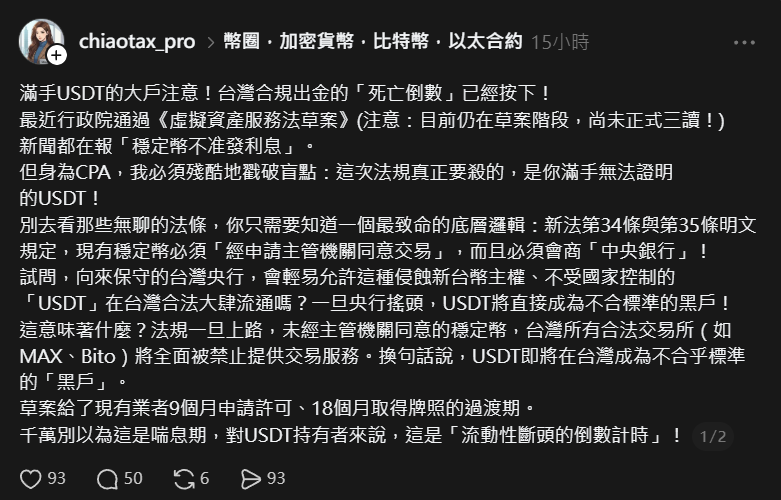
Image source: Threads
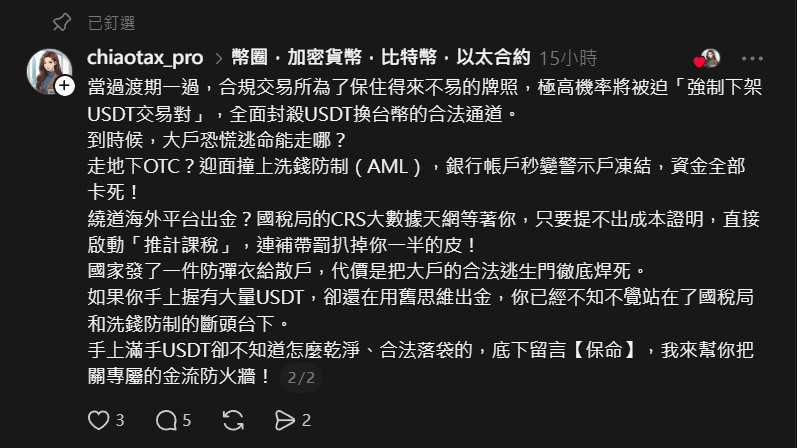
Image source: Threads
Editor-in-chief of “Crypto City,” Max, responded to this, saying that the fear-mongering in this article is done quite well, but the interpretation of the regulations is far too off the mark. The value of compliant expertise lies in helping funds find lawful and feasible paths. Amplifying the vague gray areas of the draft and describing them as escape doors that are completely welded shut entirely departs from the essence of professional analysis.
Max emphasized that the core of the draft is the admission and risk-control mechanisms for virtual asset service providers. The asset itself is not directly the regulated target. The inference that potentially delisted trading pairs will automatically translate into “liquidity fragmentation” is overly linear, and the draft is packaged in a doomsday-narrative style, which is extremely irresponsible and unprofessional.
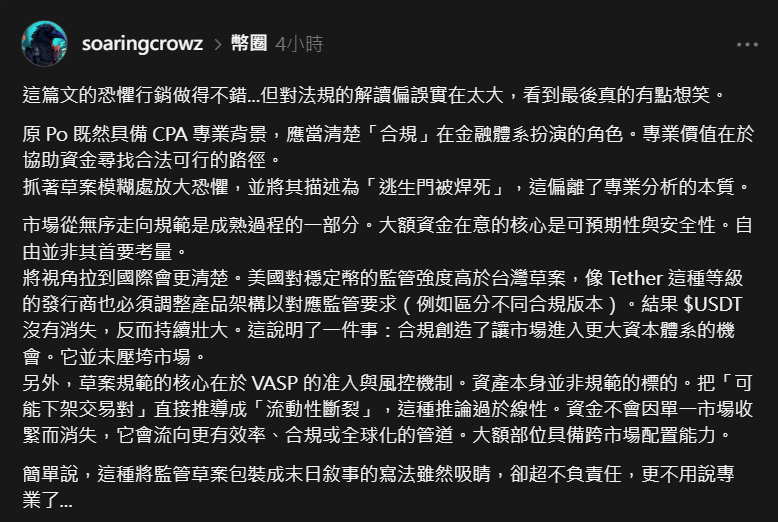
Image source: Threads
Also, judging from the account’s pinned posts, it seems they’ve been portraying themselves as an accountant for some time. However, the names on the CPA certificate are obscured and the profile picture is generated by AI. It makes you wonder: if they really want to build a brand as their own real-life accountant, would they really obscure their identity like this?

Review the 35th article of the special act draft and puncture the netizen’s fallacy
By actually examining Article 35 of the draft “Virtual Asset Services Act” passed by the Executive Yuan, you can easily refute the ridiculous logic of that netizen.
In the “Explanation” section of Article 35 of the draft, it is written in black and white:
Where a virtual asset service provider’s services involve stablecoins, it is limited to stablecoins issued in our country with permission from the competent authority, or—although not issued in our country—stablecoins approved by the competent authority for trading in our country.
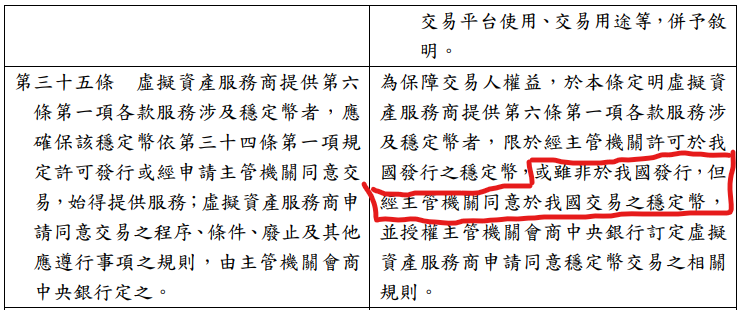
Image source: Draft “Virtual Asset Services Act” legal provisions
This passage clearly shows that for offshore stablecoins that are not issued in Taiwan, the regulation already has a mechanism in place for applying for approval to trade.
The logic error of this Threads user is that without any basis, they assume that after the special act is passed, the central bank will inevitably reject all offshore stablecoins in full, and they treat this imagined assumption as established fact to alarm people.
In fact, the purpose of the regulation is to bring the market under oversight. It requires platform operators, before offering relevant trading pairs, to have comprehensive assessment and application procedures. To slide “establishing review and compliance mechanisms” directly into “comprehensively banning USDT” simply does not hold up logically.
Breaking down the community rumor playbook: shoot first, then draw the target
Looking back at recent panic posts on social media about Taiwan exchange deposits and withdrawals, you can see that these rumor posts generally follow very similar writing structures and tactics. Most of them have a strong “AI vibe,” and they either explicitly or implicitly indicate at the end of the post that you should find another channel for withdrawals.
Let the writer break down the structure of this kind of post:
- First, the post will use an extremely sensational headline to create panic like Taiwan’s crypto deposits and withdrawals are being cut off.
- Next, it amplifies the risk-control upgrades at licensed exchanges recently, hacker incidents, or even wording from the draft, completely negating the official deposit and withdrawal routes.
- Finally, at the end of the article, it guides readers to DM, or requires comments with specific keywords to obtain an exclusive “life-saving” channel.
The core purpose of these posts is purely to destroy the public’s trust in licensed platforms, and then convert that traffic and capital into underground exchange and remittance groups privately operated by the poster.
Related coverage:
Are Taiwan’s NT-dollar deposits/withdrawals out of control? Beware—don’t tell you to use an exchange; it actually promotes the author’s own personal coin dealer
Huge number of AI matrix accounts on Threads! Driving users to illegal coin dealers—CryptoBan Responds
Don’t panic when regulation goes live—stay away from illegal underground coin dealers
The government has already clearly stated that virtual asset service providers must complete anti–money laundering requirements and service energy registration. Any individual coin dealer operating without registering in accordance with the law is conducting illegal business. At worst, they may face up to 2 years’ imprisonment or be fined up to TWD 5 million.
The draft “Virtual Asset Services Act” also stipulates that unlicensed operation or operating stablecoins will be punishable by up to 7 years’ imprisonment, and may be subject to fines of up to 100 million yuan.
According to information from the Criminal Investigation Bureau, after the new rules were implemented at the end of 2024, police have been carrying out investigations and arrests targeting illegal street coin dealers, and have seized large sums of money.
- **Related coverage:**Taipei: 4 days, 3 crypto coin-for-coin hand-to-hand robbery cases! They fool people with “no fees” script, police urge use of licensed exchanges
Use licensed coin dealers to avoid ending up with “black U” or scams
Although Threads sometimes has posts like this, this time directly claiming to have an accountant identity is relatively rare.
When facing these community panic posts, stay rational. If you’re influenced and start DM’ing the anonymous netizen, you could be lured into using illegal coin dealers, or fall into a scam trap of unknown origin.
If you want to trade cryptocurrencies, you must choose legitimate operators announced by the Financial Supervisory Commission, and use normal channels that leave transaction records—such as bank transfers. Do not expose your funds to extremely high risk in underground markets just because you want convenience for a moment or because you believe online rumors.
Listed below are the current licensed virtual asset service providers in Taiwan (VASP), sorted by the number of strokes in their names:
- 禾亞數位科技 (HOYA BIT)
- 拓荒數碼科技 (ZONE Wallet)
- 現代財富科技 (MaiCoin, MAX exchange)
- 重量科技 (KryptoGO)
- 富昇數位科技 (TWEX)
- 跨鏈科技 (Chainss)
- 幣託科技 (BitoPro)
- 鏈科股份有限公司 (XREX exchange)
Disclaimer: The information on this page may come from third parties and does not represent the views or opinions of Gate. The content displayed on this page is for reference only and does not constitute any financial, investment, or legal advice. Gate does not guarantee the accuracy or completeness of the information and shall not be liable for any losses arising from the use of this information. Virtual asset investments carry high risks and are subject to significant price volatility. You may lose all of your invested principal. Please fully understand the relevant risks and make prudent decisions based on your own financial situation and risk tolerance. For details, please refer to
Disclaimer.
Related Articles
US Sanctions Iran-Linked Crypto Wallets Holding $344M Frozen by Tether
U.S. Treasury Secretary Scott Bessent announced sanctions on multiple wallets linked to Iran as part of President Donald Trump's efforts to increase economic pressure on the country amid an ongoing ceasefire, according to CNN. The action followed Tether's freeze of $344 million in USDT on Tron,
CryptoFrontier27m ago
CFTC Faces Enforcement Crisis as 24% Staff Cuts Hit Insider Trading Oversight in Crypto and Prediction Markets
Gate News message, April 26 — The U.S. Commodity Futures Trading Commission (CFTC) has cut 24% of its workforce since Donald Trump returned to office, leaving the agency at its lowest staffing level in 15 years amid growing insider-trading risks across crypto, oil futures, and prediction markets. Th
GateNews37m ago
Brazil Bans Polymarket, Kalshi, 26 Other Prediction Platforms
Brazil has enacted a sweeping ban on prediction markets and betting platforms, according to local media and government filings. The two leading prediction markets, Polymarket and Kalshi, were confirmed inaccessible to researchers based in the country, with the Banco Central do Brasil publishing a fo
CryptoFrontier1h ago
Justin Sun Skips Trump Memecoin Event Amid Legal Dispute with World Liberty
Gate News message, April 26 — Justin Sun, one of the largest investors in the TRUMP token, notably did not attend a memecoin-themed event hosted by US President Donald Trump at Mar-a-Lago in Florida this year, marking a significant shift from his prominent appearance at a similar event last year.
T
GateNews2h ago
U.S. Military Confirms Bitcoin Node Operations as Multiple Nations Adopt Crypto for Statecraft
Gate News message, April 26 — Admiral Samuel Paparo, Jr., who leads U.S. forces across the Indo-Pacific, told a Senate panel that Bitcoin matters to national security. The Pentagon is running its own Bitcoin node and conducting operational tests to secure and protect networks using the Bitcoin
GateNews3h ago
Tennessee Bans Crypto ATMs Statewide, Second State After Indiana
Tennessee has become the second U.S. state to outright ban crypto ATMs, with Governor Bill Lee signing House Bill 2505 into law on April 13, 2024, after it passed both chambers unanimously. The ban will take effect July 1, 2024, and makes it a misdemeanor to operate or host the machines anywhere in
CryptoFrontier4h ago


