
The death of Iran’s leader sparks controversy in prediction markets; Kalshi refunds $2.2 million, with the CEO claiming they refused “death arbitrage.” Before the airstrike, U.S. lawmakers demanded strict scrutiny of contracts related to war and assassination predictions, with a deadline to respond by March 9.
Kalshi’s “Khamenei Resignation” Prediction Contract Sparks Debate
Following the joint U.S. and Israeli airstrikes that resulted in the death of Iran’s Supreme Leader Ali Khamenei, Kalshi CEO Tarek Mansour stated that their platform’s trading volume exceeded $50 million on contracts related to the event. He emphasized that their goal was to prevent investors from profiting from the death.
The contract was titled: “Will Khamenei step down as Iran’s Supreme Leader?” with rules stating that if Khamenei dies, settlement would be based on the last trading price before death. When news of Khamenei’s death broke, a surge of funds flooded into the contract, and Kalshi suspended trading due to settlement chaos.
Kalshi later admitted that the settlement terms contained ambiguous language and ultimately decided to refund users’ net losses. Sources told Bloomberg that this move cost the platform about $2.2 million.
Kalshi’s Promotion and Settlement Standards Under Fire
After Kalshi processed refunds, criticism emerged within the community, mainly because Kalshi had promoted this contract at the time of the event. Last Saturday morning, news of Khamenei’s death began circulating, Kalshi posted on X: “Breaking: The probability of Khamenei no longer serving as Iran’s Supreme Leader has surged to 68%,” which Mansour also retweeted.
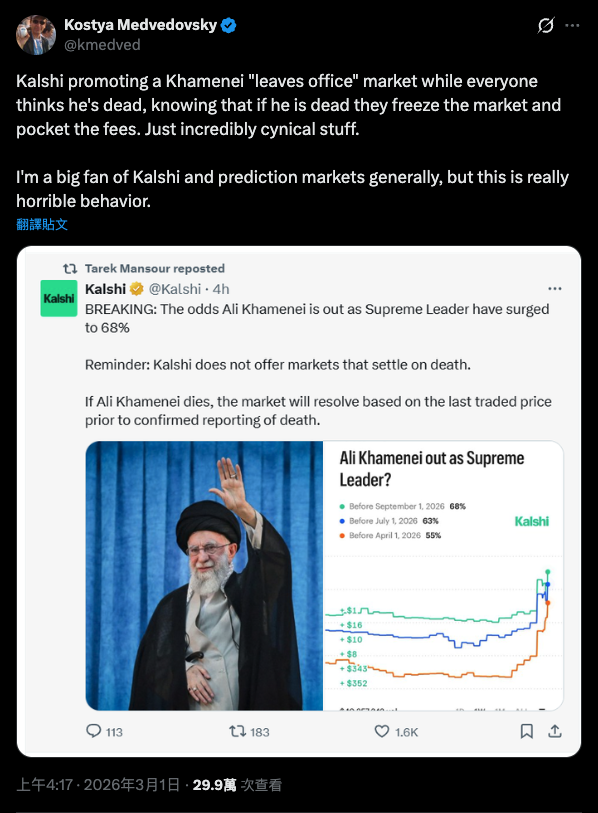
Image source: X
Former SEC Chief of Staff Amanda Fischer criticized this, saying Kalshi’s actions were akin to providing a marketplace for assassination proxies.
Users also criticized Kalshi’s settlement standards, pointing out that when Jimmy Carter passed away, the platform settled his contract as “no,” accusing the platform of only applying special terms when losing money.
Dennis Kelleher, CEO of Better Markets, stated that Kalshi’s actions reveal an attempt to balance expanding trading volume with avoiding clear laws banning assassination-related bets.
Prediction Markets Cross the Line, U.S. Lawmakers Call for Investigation
Prediction markets are often seen as “anything can be traded,” but this incident highlights their limits. Before the U.S.-Israel airstrikes on Iran, California Democratic Senator Adam Schiff sent a letter to CFTC Chair Michael Selig demanding strict regulation of contracts related to war and assassination, with a response deadline of March 9.
Connecticut Democratic Senator Chris Murphy also announced he is drafting legislation to ban such market contracts to prevent insider trading and manipulation based on known outcomes. The Kalshi settlement controversy proves that such betting markets should not exist.
Polymarket’s Wordplay Sparks Controversy
Compared to Kalshi, Polymarket still hosts 187 Iran-related markets. One of these predicts whether the U.S. will forcibly remove Khamenei before March 31. Polymarket ultimately settled this contract as “no,” reasoning that the U.S. only contributed or assisted in the killing, which sparked strong dissatisfaction among some commentators and calls for dispute resolution.
Because Polymarket relies on blockchain-based decentralized settlement mechanisms, the fairness of contract judgments remains under scrutiny.
On-chain data shows that, hours before the airstrike, six anonymous wallets collectively bet on “U.S. attacking Iran before February 28,” ultimately earning about $1.2 million. These wallets were almost all newly created accounts in February, with funds transferred within 24 hours before the event. Such suspicious trading patterns have raised concerns about military secrets leaking and potential on-chain insider arbitrage.
Related report:
Pre-airstrike prediction? Polymarket traders bet on US-Iran war, earning $1.2 million, sparking controversy
Disclaimer: The information on this page may come from third parties and does not represent the views or opinions of Gate. The content displayed on this page is for reference only and does not constitute any financial, investment, or legal advice. Gate does not guarantee the accuracy or completeness of the information and shall not be liable for any losses arising from the use of this information. Virtual asset investments carry high risks and are subject to significant price volatility. You may lose all of your invested principal. Please fully understand the relevant risks and make prudent decisions based on your own financial situation and risk tolerance. For details, please refer to
Disclaimer.
Related Articles
Polymarket bets on Iran war event, exposing the limitations of prediction markets in Wall Street applications
The prediction market platform Polymarket has shown limitations in trading related to the Iran situation. Despite an increase in trading volume, it failed to demonstrate its ability to hedge geopolitical risks and instead became a cautionary example, highlighting its lack of signals for institutional investors.
GateNews1h ago
Polymarket prediction market account profits of 285% in two weeks through 3 GPT-5.4 bets
Gate News reports that on March 6, according to PolyBeats monitoring, the "OpenAI will release GPT-5.4 before March 5" market on the prediction market platform Polymarket, which was previously tracked for 5 suspected insider accounts buying in, has now been settled. Among them, the account with the address 0x169527179bbc4bd99288585fc39eb0e117bf2842 profited 285% within two weeks by placing three consecutive bets on the release date of GPT series models.
GateNews4h ago
A newly created wallet address has invested $50,000 in bets on the Strait of Hormuz situation and has already lost 36%.
Gate News Report, March 6 — According to Lookonchain monitoring, a new wallet address named "Idothisfromtimetotime" was created 3 hours ago and has wagered $50,000 betting that Iran will not close the Strait of Hormuz before March 31. Currently, this wallet has lost $18,000, with a loss rate of 36.15%.
GateNews4h ago
Polymarket Data: The probability of a certain CEX IPO in 2026 has dropped to 17%, with ICE investing at a $25 billion valuation yesterday.
Gate News Report, March 6 — According to data from the Polymarket website, the probability that "a certain CEX will go public in 2026" has declined from a high of 57% in early January to 17% currently, with a trading volume exceeding $400,000. Previously, on March 5, the parent company of the New York Stock Exchange, ICE, invested in the exchange with a valuation of $25 billion. ICE has not disclosed the specific investment amount or terms but emphasized a shared vision for the future between the two companies.
GateNews5h ago
Polymarket's prediction of the likelihood of Iran's Supreme Leader's succession has fallen back to 50%, with trading volume exceeding $5 million.
Gate News Report, March 6: According to data from the Polymarket website, the probability of "Iran's next Supreme Leader being Ayatollah Khamenei's son, Mojtaba Khamenei," rose to 82% at one point, currently falling back to 50%, with trading volume exceeding $5 million. Previously, Trump stated that he would not accept Khamenei's son taking over as Supreme Leader and that he would need to be personally involved in Iran's succession arrangements.
GateNews5h ago
Vitalik: Prediction markets help understand the world and the near future, hoping the project can optimize market conditions.
Gate News Announcement, March 6th, Ethereum founder Vitalik Buterin stated that prediction markets help us better understand the world and the near future. He hopes prediction market projects will focus more on optimizing this direction, especially by developing more conditional markets.
GateNews5h ago


