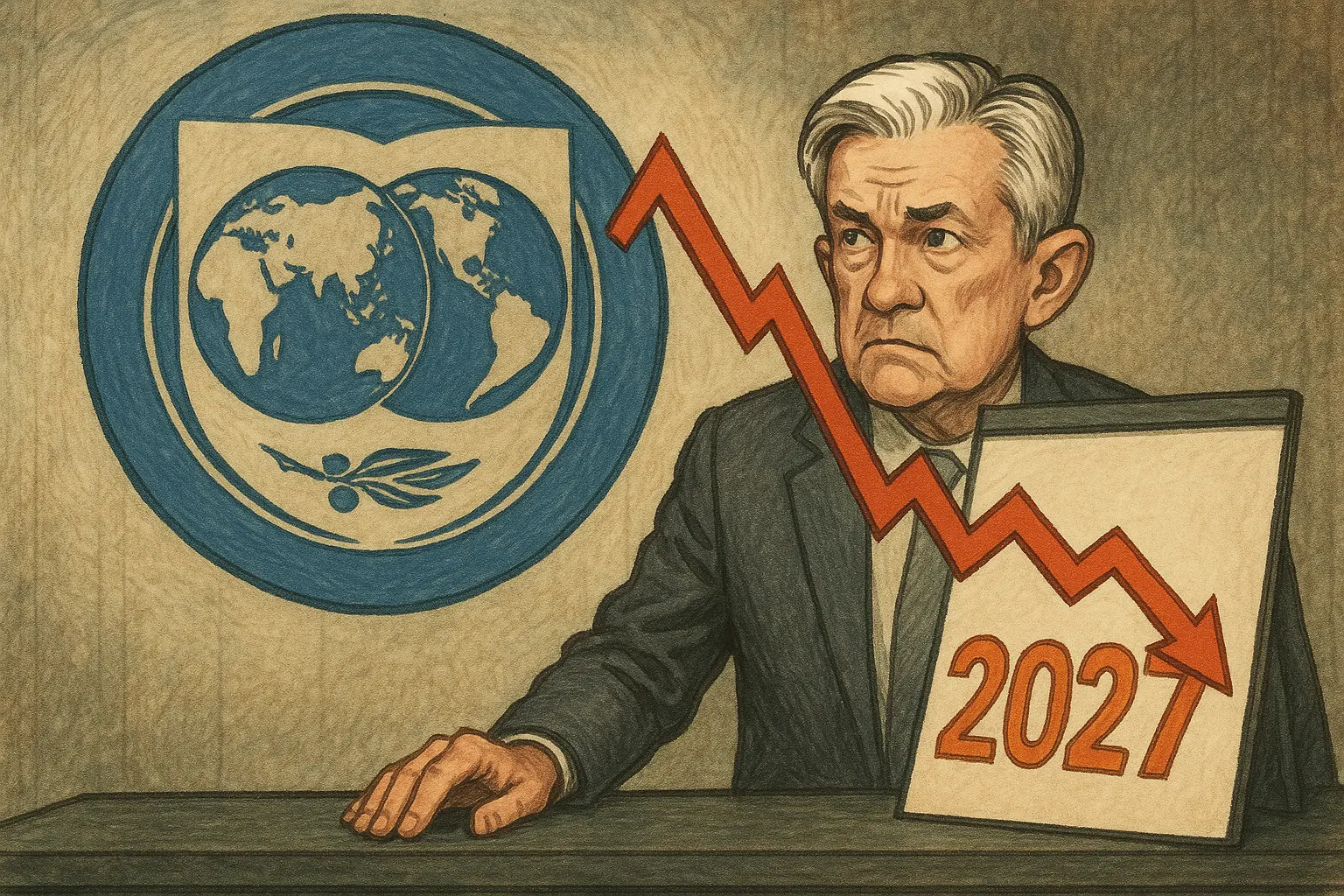
The International Monetary Fund (IMF) report states that the U.S. inflation rate will not return to the Federal Reserve’s 2% target until early 2027, clearly reinforcing expectations that high interest rates will persist for a longer period. IMF Managing Director Kristalina Georgieva also warned that the U.S. current account deficit is “too large,” estimated to reach 3.5% to 4% of GDP in the short term.
Key Findings of the IMF Review Report
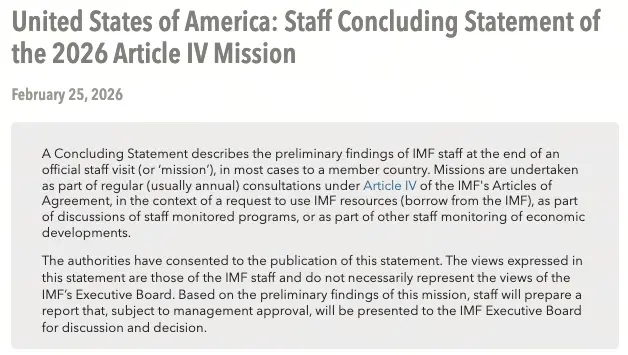
This fourth review reveals several structural data points that significantly impact the outlook for U.S. fiscal and monetary policies:
Inflation Target Timeline: The U.S. inflation rate is expected to return to the Fed’s 2% target only by early 2027, greatly reducing the urgency for the Fed to cut interest rates.
Federal Fiscal Deficit: Projected to remain between 7% and 8% of GDP, more than double the target set by Treasury Secretary Scott Bessent.
Government Debt Trajectory: By 2031, U.S. government debt will reach 140% of GDP. The IMF warns this poses an “increasingly serious stability risk.”
U.S. GDP Growth in 2026: Forecasted to stay steady at 2.4%, further weakening the case for the Fed to adopt easing policies.
Disagreements on Deficit Solutions: The IMF recommends fiscal consolidation rather than tariffs to reduce trade imbalances, directly opposing the Trump administration’s tariff strategies.
Nigel Chalk, IMF Regional Director for the Western Hemisphere, explicitly states that fiscal consolidation—not tariffs—is the most effective way to reduce the deficit. This stance fundamentally conflicts with the current government’s trade policy direction.
Trump’s Interest Rate Optimism vs. IMF’s Structural Reality
The IMF report was released one day after Trump’s State of the Union address, creating a stark contrast. Trump claimed that mortgage rates have fallen to their lowest in four years and that mortgage costs have decreased by nearly $5,000 annually since taking office, positioning lower borrowing costs as a key solution to housing issues.
However, the IMF’s structural analysis presents a very different picture: inflation will not reach the 2% target until 2027, and the fiscal deficit will remain above 7% of GDP in the long term. These two factors together form a structural basis for maintaining high interest rates over the long term. Ironically, the report hints at a key contradiction: the historic tax cuts implemented by the Trump administration have been a major factor in expanding the fiscal deficit and supporting a high-interest-rate environment. In other words, the government aims to lower interest rates, but its own expansionary fiscal policies fundamentally hinder this goal.
The IMF does not directly predict a sovereign debt crisis for the U.S., explicitly stating that “U.S. sovereign debt risks are relatively low.” However, the described trajectory—rising debt, persistent deficits, delayed inflation slowdown—strongly suggests that the Fed’s room to cut rates is constrained by multiple structural factors.
Implications for the Cryptocurrency Market
The combination of persistently high inflation and expanding fiscal deficits directly reduces the likelihood of significant Fed rate cuts in 2026. The cryptocurrency market’s rally in 2025 was partly driven by expectations that the rate-cut cycle would continue into late 2025, providing liquidity support for risk assets. The release of the IMF report further reinforces market expectations that high interest rates will persist longer, which theoretically could suppress risk assets.
Frequently Asked Questions
Q: The IMF predicts inflation will only reach 2% by 2027. How does this affect the Fed’s plans to cut rates?
A: Achieving the 2% inflation target is one of the core conditions for the Fed to start cutting rates. If inflation only reaches 2% by early 2027, it significantly limits the Fed’s room to cut rates before then. Market expectations of a substantial rate cut in 2026 will need to be revised, and high interest rates may persist until around 2027.
Q: What does the U.S. debt-to-GDP ratio reaching 140% mean for global markets?
A: The IMF warns that the rising trend in U.S. public debt relative to GDP poses “increasingly serious stability risks” for the U.S. and the global economy. Potential impacts include rising long-term U.S. Treasury yields, pressure on the dollar’s credit rating, and increased risk aversion in global capital markets, which could affect risk assets including cryptocurrencies.
Q: The IMF recommends fiscal consolidation instead of tariffs. What specific policies does this entail?
A: The IMF’s advice focuses on reducing fiscal spending and controlling budget deficits through fiscal tightening measures, viewing this as a more effective and sustainable way to narrow the U.S. current account deficit, rather than exerting pressure on trade partners through tariffs. This approach fundamentally differs from the tariff strategies currently employed by the Trump administration.
Disclaimer: The information on this page may come from third parties and does not represent the views or opinions of Gate. The content displayed on this page is for reference only and does not constitute any financial, investment, or legal advice. Gate does not guarantee the accuracy or completeness of the information and shall not be liable for any losses arising from the use of this information. Virtual asset investments carry high risks and are subject to significant price volatility. You may lose all of your invested principal. Please fully understand the relevant risks and make prudent decisions based on your own financial situation and risk tolerance. For details, please refer to
Disclaimer.
Related Articles
Institutional analyst: Poor February employment data does not change the Federal Reserve's expectation of rate cuts this year; the market expects only one rate cut this year.
Carson Group analyst Sonu Varghese stated that despite poor employment data in February, the Federal Reserve's interest rate cut expectations for this year remain unchanged, and risks in the labor market still exist. Meanwhile, energy prices and artificial intelligence bottlenecks will keep the Federal Reserve cautious on rate cuts, and the market may only expect one rate cut.
GateNews9m ago
70% of assets heavily invested in Bitcoin! Mexican billionaire urges "buy quickly during the dip," and the wealthy dad is also increasing his holdings
Mexican billionaire Ricardo Salinas Pliego is heavily investing in Bitcoin, believing it can hedge against inflation and symbolize personal freedom. Robert Kiyosaki warns that a stock market crash is imminent and continues to increase his holdings in Bitcoin and precious metals, remaining confident. They both believe that Bitcoin has long-term value potential, and the current price dip is a good buying opportunity.
区块客23m ago
White House Economic Council Chair Harret: Expecting 4% economic growth in the US this year
Gate News Report, March 6th, the Director of the U.S. White House National Economic Council, Hasset, stated that the U.S. economy is expected to grow by 4% this year and emphasized the importance of focusing on the average employment figures.
GateNews27m ago
U.S. non-farm employment data fell short of expectations, unemployment rate rose, and oil prices surged significantly
Gate News Announcement, March 6 — Annex Wealth Management Chief Economist Brian Jacobsen stated that the latest non-farm employment data deviates from expectations, with the unemployment rate rising and oil prices surging. The Federal Reserve is currently facing policy choices: whether to take measures to support the labor market or to maintain the current stance to curb inflation expectations.
GateNews28m ago
White House Economic Advisor Hassett: No plans to discuss tapping the Strategic Petroleum Reserve in the near future; focus on tariffs and tax refund litigation
Gate News Report, March 6 — The Director of the National Economic Council at the White House, Jared Bernstein, made a statement on various economic policy issues. Bernstein stated that prediction markets have their uses. Regarding Iran and oil issues, he pointed out that there will be no discussion of deploying the Strategic Petroleum Reserve (SPR) in the near future, as the military is developing a plan to ensure ship passage. When discussing tariff refunds, Bernstein said that they are monitoring lawsuits initiated by large corporations, and the private sector will agree on the specific method of refunds.
GateNews29m ago
U.S. non-farm employment data for December and January revised downward, a total decrease of 69,000 jobs
Gate News Announcement: On March 6, the U.S. Bureau of Labor Statistics released revised data, showing that non-farm payroll employment added 48,000 jobs in December, revised down to -17,000 jobs, and 126,000 jobs in January, revised from 130,000. After revisions, the total new jobs added in December and January decreased by 69,000 compared to the initial figures.
GateNews54m ago


