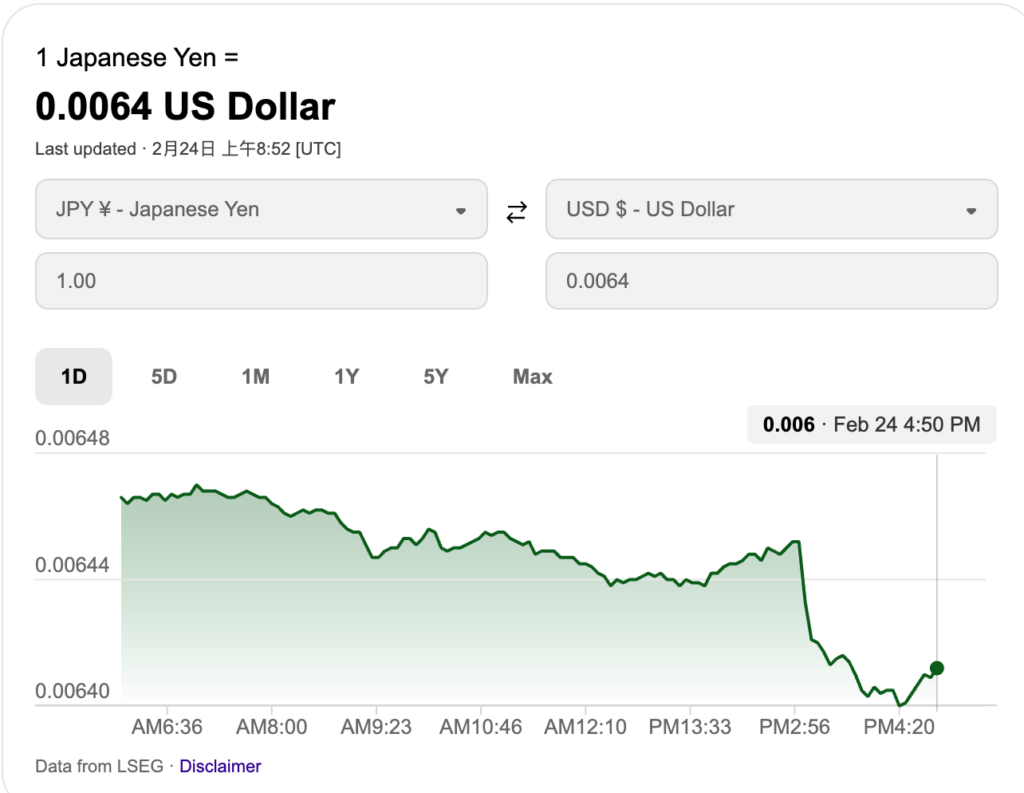
According to Japan’s Mainichi Shimbun on Tuesday, citing sources familiar with the matter, Japanese Prime Minister Sanae Takaichi conveyed concerns about further interest rate hikes during a meeting with Bank of Japan Governor Kazuo Ueda last week. Following the news, the yen weakened against the US dollar and euro. If true, Takaichi’s recent refusal to support additional rate increases could complicate the BOJ’s timetable for tightening, as markets had widely expected the BOJ to possibly raise rates again as early as March or April.
(Background: Weak Yen Triggers Inflation Red Line: BOJ May Be Forced to Hike Rates Early)
(Additional context: Countdown to BOJ Rate Hike — Will Crypto Markets Repeat the Downtrend?)
Table of Contents
Toggle
- Both sides have their statements; details remain unclear
- Market reaction: Yen weakens
- Why should crypto markets pay attention?
According to Mainichi Shimbun, Japanese Prime Minister Sanae Takaichi explicitly expressed concerns about further rate hikes during her meeting with BOJ Governor Kazuo Ueda last week. This marks the first time since taking office that she has reportedly privately pressured the central bank to pause its tightening policies.
Both sides have their statements; details remain unclear
Ueda’s response to the meeting was relatively cautious. He stated that last week’s discussion mainly involved general exchanges on economic and financial conditions and emphasized that the Prime Minister did not make any specific monetary policy demands.
Takaichi, on her part, declined to comment on the details of the meeting, only saying she hopes the BOJ will work closely with the government to achieve a 2% inflation target along with wage growth. However, if Mainichi’s report is accurate, Takaichi’s resistance to rate hikes could make coordination between the BOJ and the new government more challenging.
Market reaction: Yen weakens
After the news broke, the yen depreciated against both the US dollar and euro. Market interpretation suggests that if the Prime Minister publicly or privately opposes rate hikes, the BOJ might be forced to delay its tightening schedule under political pressure.
The timing of this meeting is particularly sensitive — market speculation had previously suggested that, due to the yen’s persistent weakness pushing up living costs, the BOJ could raise rates again as early as March or April. The BOJ only raised its benchmark rate to 0.75% in December last year, the highest in 30 years.
Why should crypto markets pay attention?
For crypto investors, the BOJ’s interest rate decisions have historically influenced global risk asset trends. Since 2024, every unexpected rate hike by the BOJ has been accompanied by Bitcoin dropping over 20%, primarily due to the unwinding of yen carry trades — when the yen appreciates and interest rate differentials narrow, large positions financed in low-interest yen to invest in high-risk assets are forced to liquidate.
If Takaichi is indeed secretly restraining the BOJ’s rate hike pace, short-term global liquidity tightening pressures could ease, which might be a positive signal for risk assets. However, in the medium to long term, continued yen depreciation would further boost domestic inflation pressures in Japan, potentially forcing the BOJ to accelerate rate hikes again, which could lead to more intense market shocks.

Disclaimer: The information on this page may come from third parties and does not represent the views or opinions of Gate. The content displayed on this page is for reference only and does not constitute any financial, investment, or legal advice. Gate does not guarantee the accuracy or completeness of the information and shall not be liable for any losses arising from the use of this information. Virtual asset investments carry high risks and are subject to significant price volatility. You may lose all of your invested principal. Please fully understand the relevant risks and make prudent decisions based on your own financial situation and risk tolerance. For details, please refer to
Disclaimer.
Related Articles
U.S. non-farm employment data fell short of expectations, unemployment rate rose, and oil prices surged significantly
Gate News Announcement, March 6 — Annex Wealth Management Chief Economist Brian Jacobsen stated that the latest non-farm employment data deviates from expectations, with the unemployment rate rising and oil prices surging. The Federal Reserve is currently facing policy choices: whether to take measures to support the labor market or to maintain the current stance to curb inflation expectations.
GateNews15m ago
Goldman Sachs expects the Federal Reserve to complete the remaining two rate cuts, but the timing remains uncertain.
Goldman Sachs Multi-Asset Fixed Income Investment Director Lindsay Rosner stated that the Federal Reserve should be cautious about delaying interest rate cuts in the face of a weak labor market. Meanwhile, the Middle East conflict influences policy directions, and the complex interplay between inflation and U.S. employment makes the timing of rate cuts uncertain. Goldman Sachs expects to complete two rate cuts to return to a neutral interest rate.
GateNews39m ago
Traders increase bets on the Federal Reserve cutting interest rates at least once in 2026
Gate News Report: On March 6, traders increased their bets, expecting the Federal Reserve to cut interest rates at least once by 2026.
GateNews42m ago
U.S. Treasury yields rise as traders bet on the Federal Reserve cutting interest rates by a total of 44 basis points by December
Following the disappointing employment report, U.S. Treasury yields declined as the market expects the Federal Reserve to cut interest rates this year. The 10-year Treasury yield dropped to 4.1%, and the 2-year Treasury yield fell to 3.53%. Interest rate swaps indicate that traders expect a total of 44 basis points of rate cuts by December.
GateNews42m ago
ETH 15-minute sharp decline of 1.53%: Large investors' short-term profit-taking and ETF capital outflows resonate, triggering a significant drop
From 13:45 to 14:00 on March 6, 2026 (UTC), ETH experienced a significant fluctuation, with a short-term decline of 1.53%. The price fluctuated sharply between 2019.21 and 2051.26 USDT, with an amplitude of 1.56%. High-frequency sell orders surged, market attention spiked, trading volume increased, and the divergence between bulls and bears intensified. Market sentiment became more cautious.
The main driving force behind this fluctuation was large investors and whale accounts reducing their positions after a short-term rebound, leading to a rapid release of large sell orders and triggering short-term selling pressure in the market. On the ETF front, holdings
GateNews43m ago
Weak February employment data in the US sparks expectations of rate cuts; Besant's economic growth claims are contradicted by the data
Natixis analyst Hodge pointed out that weak February employment data could influence Federal Reserve Waller's stance, reinforcing dovish views. Analyst Anstey believes this is a blow to Treasury Secretary Yellen, who had previously seen employment growth in the construction industry as a success model, but recent data shows declines in both construction and manufacturing employment.
GateNews43m ago


