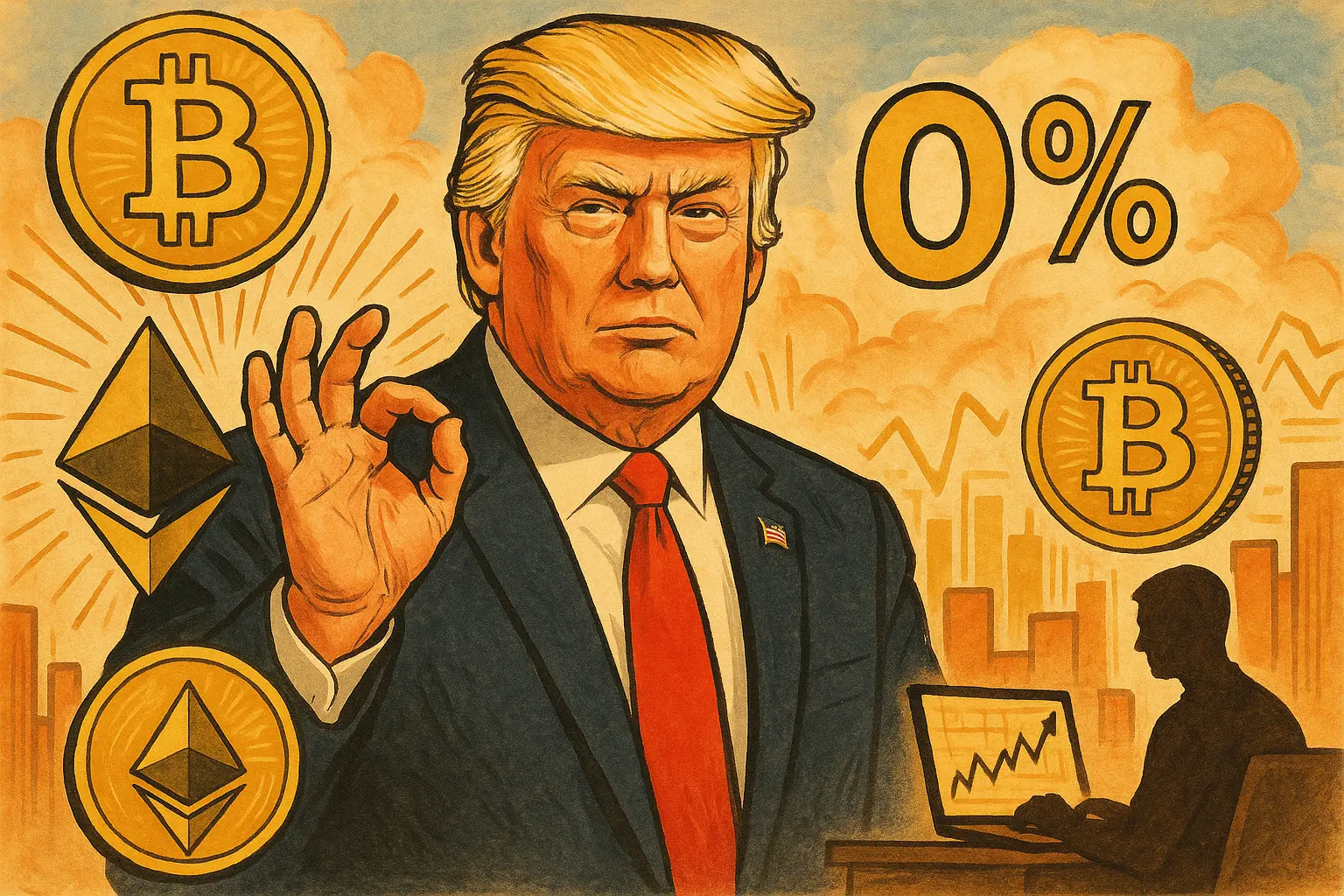
U.S. President Donald Trump’s plan to implement a 0% capital gains tax on all Bitcoin and cryptocurrency investments will completely change the investment cost structure of the cryptocurrency market and have a profound impact on retail investors, institutional investors, and industry talent allocation. Currently, the details of the policy need to be further clarified, including the scope of applicable assets and holding period requirements.
How capital gains tax affects cryptocurrency investment decisions
The current capital gains tax system requires investors to pay a certain percentage of taxes when realizing profits, which directly affects position decisions and realization behavior. In the cryptocurrency market, tax costs are one of the main factors that inhibit long-term holding intentions; Some investors even choose to transfer funds to overseas platforms to optimize tax arrangements, resulting in a capital outflow effect.
Trump’s 0% capital gains tax plan removes this barrier entirely. If the policy is officially implemented, the profit calculation of crypto assets will be greatly simplified, and at the same time, it will have a reshoring effect on overseas funds, which will help strengthen the liquidity base of exchanges in the United States. For institutional investors, hedge funds and asset managers often adjust their asset allocation ratios based on regulatory clarity, and the zero capital gains tax environment may significantly reduce institutional resistance to their entry.
The potential scope of impact for various market participants
This policy has different directions and depths of impact on different types of market participants.
potential beneficiaries for various types of investors
Retail investors: After the elimination of tax costs, profit calculations tend to be simple and transparent, the attractiveness of long-term holding of crypto assets has increased, and the motivation for frequent short-term transactions to avoid taxes has also decreased
Institutional investors: 0% The capital gains tax environment significantly reduces institutional friction in entering the market, helping hedge funds and asset managers expand their digital asset allocation
Blockchain startups: A friendly tax environment sends a clear signal to the world that the government supports innovation, helping to attract venture capital and accelerate new product launches
Developers and founders: The tax planning complexity of token compensation has been greatly reduced, and the attractiveness of the United States to global cryptocurrency talent has increased relatively
Core issues to be clarified in the policy and investor risk assessment
Despite the significant market appeal of the 0% capital gains tax plan, investors need to carefully evaluate several policy details that remain unclear. First, does this policy apply to all crypto tokens, or is it limited to specific asset classes like Bitcoin? Secondly, Does the holding period constitute a condition of application? Until the official response is clear, there is still considerable uncertainty in the market’s interpretation space.
In addition, the elimination of capital gains tax does not represent an exemption from all regulatory obligations. Anti-money laundering (AML) regulations, securities laws, and other compliance requirements remain in place, and investors must continue to pay attention to their own compliance obligations and should not interpret tax incentives as a signal of overall regulatory easing. The uncertainty of policy details may also attract speculative capital inflows in the short term, thereby increasing the risk of market volatility.
Frequently Asked Questions
Is Trump’s 0% capital gains tax plan officially in effect?
Currently, the plan is still in the policy announcement stage, and the specific legislative procedures, effective time, and scope of application have not yet been fully announced. Investors should continue to track official regulatory documents and legislative progress in Congress, rather than making decisions based solely on market sentiment.
Does 0% capital gains tax apply to all cryptocurrencies, or is it limited to specific assets?
Currently, the policy statement does not clearly specify the specific scope of applicable assets, whether it covers all crypto tokens or only specific asset classes such as Bitcoin, and whether the holding period constitutes applicable conditions, all of which need to be further clarified by the official government.
After the abolition of capital gains tax, do crypto investors still have other compliance obligations?
Yes. The adjustment of capital gains tax does not affect the applicability of other regulatory frameworks. Anti-money laundering (AML) regulations, securities laws, and related transaction reporting obligations remain in place, and investors must maintain existing standards of compliance and continue to monitor the latest guidance from relevant regulatory bodies.
Disclaimer: The information on this page may come from third parties and does not represent the views or opinions of Gate. The content displayed on this page is for reference only and does not constitute any financial, investment, or legal advice. Gate does not guarantee the accuracy or completeness of the information and shall not be liable for any losses arising from the use of this information. Virtual asset investments carry high risks and are subject to significant price volatility. You may lose all of your invested principal. Please fully understand the relevant risks and make prudent decisions based on your own financial situation and risk tolerance. For details, please refer to
Disclaimer.
Related Articles
Federal Reserve Board Member Mullan: Interest rates should be lowered to a neutral level of 2.5%-2.75%
Gate News reports that on March 6th, Federal Reserve Board Member Milan expressed his views on interest rate policy, stating that the neutral interest rate is approximately 2.5% to 2.75%. Milan pointed out that if the Federal Reserve does not cut interest rates this month, he will oppose it, believing that the Fed should lower rates to the neutral level and then reassess the policy direction.
GateNews2h ago
Federal Reserve Board Member Mullan: The Federal Reserve usually does not respond to oil prices
Gate News Report, March 6 - Federal Reserve Board Member Michelle Bowman stated that the Federal Reserve generally does not respond to oil prices. She pointed out that if there is any impact, oil price fluctuations tend to push the Fed toward a more dovish policy stance, as oil shocks could dampen core inflation by hurting demand.
GateNews2h ago
Federal Reserve's Goolsbee: Expect interest rate cuts to begin before the end of this year
Gate News Report, on March 6th, Federal Reserve official Goolsby stated that rate cuts could begin before the end of this year. He pointed out that the timing for taking prudent action has been continuously delayed.
GateNews4h ago
Schroders Chief Economist: U.S. Non-Farm Payrolls Data Below Expectations, but Recent Factors May Weaken the Need for Rate Cuts
Gate News Report, March 6 — Schroders Global Chief Economist David Rees commented on the U.S. non-farm payroll data. Rees pointed out that the non-farm employment figures were significantly below expectations, providing a basis for dovish discussions within the Federal Reserve. He stated that at least part of the deviation below expectations was due to strikes in the healthcare industry, which are expected to be reversed. Additionally, despite the soft employment report, the continued growth in labor demand persists amid the ongoing strong U.S. economic expansion. Rees mentioned that Kevin Woor, who is about to become the Federal Reserve Chair, previously expressed the view that the application of artificial intelligence would greatly enhance U.S. productivity and create room for rate cuts. However, he also noted that the recovery of the labor market and inflation risks from Middle Eastern events would weaken the need for rate cuts in the short term.
GateNews4h ago
Institutional analyst: Poor February employment data does not change the Federal Reserve's expectation of rate cuts this year; the market expects only one rate cut this year.
Carson Group analyst Sonu Varghese stated that despite poor employment data in February, the Federal Reserve's interest rate cut expectations for this year remain unchanged, and risks in the labor market still exist. Meanwhile, energy prices and artificial intelligence bottlenecks will keep the Federal Reserve cautious on rate cuts, and the market may only expect one rate cut.
GateNews4h ago
U.S. non-farm employment data fell short of expectations, unemployment rate rose, and oil prices surged significantly
Gate News Announcement, March 6 — Annex Wealth Management Chief Economist Brian Jacobsen stated that the latest non-farm employment data deviates from expectations, with the unemployment rate rising and oil prices surging. The Federal Reserve is currently facing policy choices: whether to take measures to support the labor market or to maintain the current stance to curb inflation expectations.
GateNews4h ago


