As blockchain technology matures and meme coin culture continues to grow, a platform has emerged in the Solana ecosystem that has sent shockwaves through the market - Pump.fun. With an extremely low barrier to entry, instant trading, and a massive user base, it has become a central hub for meme coin issuance and trading, driving explosive growth in on-chain volume and community activity across Solana.
This article offers a comprehensive breakdown of Pump.fun’s mechanics, advantages, and risks, helping you understand why it has attracted such widespread attention in the crypto world.
What Is Pump.fun? Project Background and Platform Positioning
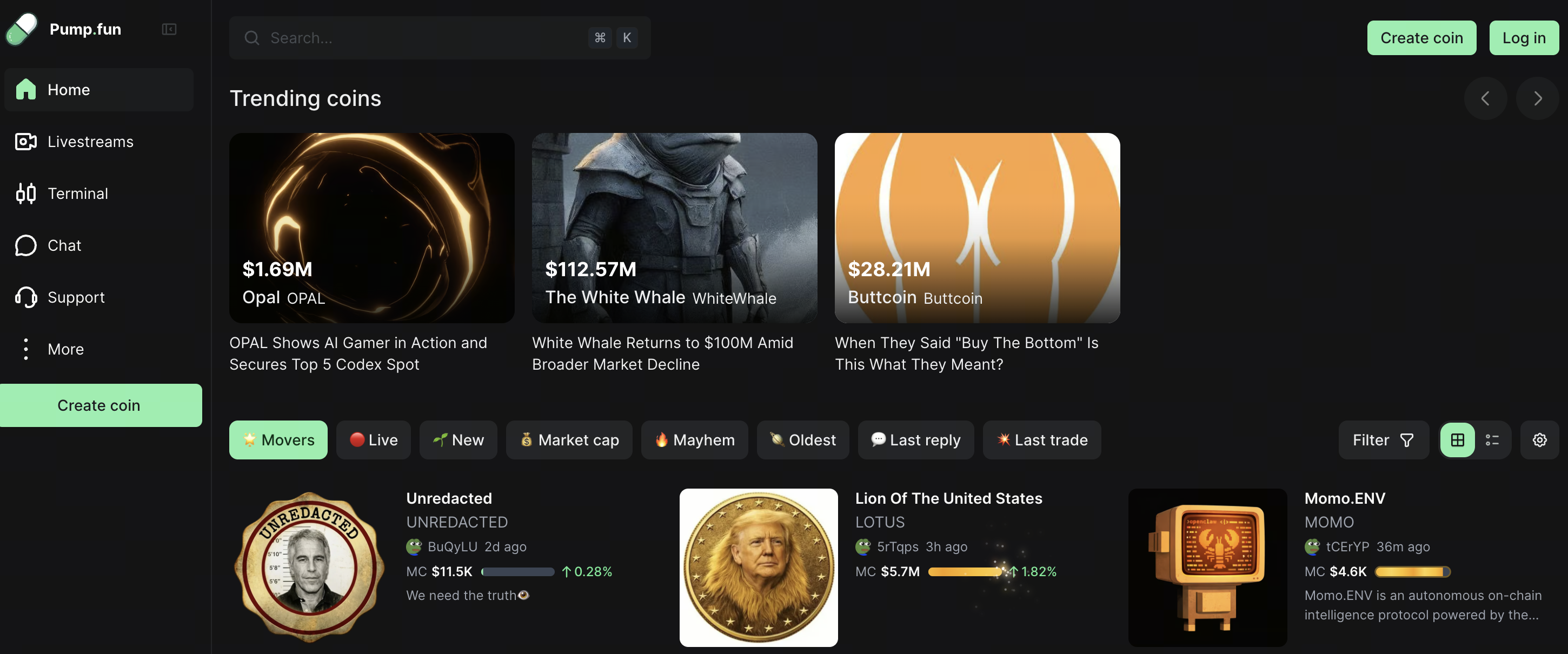
Pump.fun is a meme coin launch platform built on the Solana blockchain. It allows anyone, even without a technical background, to create, issue, and trade crypto tokens. It functions both as a token launchpad and as a decentralized trading environment (DEX), enabling token creation and trading to take place on the same platform. Its core features are fair launch and instant liquidity, with smart contracts automatically setting prices and trading mechanisms for newly created tokens.
Pump.fun aims to break down the technical barriers of traditional token issuance and liquidity provision, allowing creators and communities to directly participate in the creation of blockchain assets.
How Does Pump.fun Work? A Breakdown of One-Click Meme Coin Launching
The standout feature of Pump.fun is its “one-click meme coin launch.” Users simply connect a Solana wallet and fill in basic information such as the token name, symbol, and icon to publish a new token. No smart contract coding is required, and there is no need to manually add liquidity.
At the core of this system is the bonding curve model:
- In the initial stage, token prices are extremely low and automatically rise as more users buy in.
- All trades are priced through a predefined curve formula, enabling instant pricing and built-in liquidity without traditional counterparties.
- Once a token reaches a preset market cap or liquidity threshold, it can migrate to larger DEXs such as Raydium for broader trading.
This design reduces reliance on traditional order books or liquidity pools, allowing tokens to be traded immediately after launch.
How Did Pump.fun Come Into Existence?
Pump.fun launched on Solana on January 19, 2024. It was initiated by Noah Tweedale, Alon Cohen, Dylan Kerler, and others, with the original goal of making it easy for everyday users to issue their own crypto tokens.
In its early days, Pump.fun was not positioned as a professional exchange but as a community-driven meme coin experiment. Over time, it evolved into core infrastructure with a massive user base and trading volume, becoming the most active hub for meme coin creation and trading on Solana.
Why Did Pump.fun Explode in Popularity Within the Solana Ecosystem?
Extremely low technical barriers
Creating a token no longer requires writing contracts or understanding blockchain development. Even complete beginners can launch a token in minutes.
Solana’s high throughput and low fees
Solana’s low transaction costs and fast confirmations make large-scale meme coin launches and rapid trading feasible.
Community-driven culture
Meme coins thrive on social sharing. Pump.fun’s interface and ecosystem actively encourage participation and sharing, driving explosive community engagement.
Together, these factors have made Pump.fun the core engine of the “Solana meme economy.”
How Do Token Issuance and Trading Work on Pump.fun?
Pump.fun uses a fair launch model for token issuance. All tokens are fully open to the public at launch, with no presales, insider allocations, or lockups. This design aims to reduce manipulation risks.
On the trading side, the platform charges a small transaction fee, generally around 1 percent, which serves as one of its revenue sources. When a token reaches a certain scale, Pump.fun automatically creates a liquidity pool on a larger DEX, helping the token “graduate” to a broader market.
How Is Pump.fun Different From Traditional Token Launch Platforms or Launchpads?
| Contrast Dimension |
Pump.fun |
Traditional Launchpad |
| Platform Positioning |
Meme coin rapid issuance and trading platform |
Project token issuance and fundraising platform |
| Is Review Required? |
No, anyone can issue a token |
Project review is usually required |
| Is KYC Required? |
No |
Required in most cases |
| Issuance Threshold |
Extremely low, only a small amount of SOL is needed |
Relatively high, requires project-level preparation |
| Issuance Method |
Fair Launch |
Presale / Allowlist / Public Offering |
| Pricing Mechanism |
Bonding Curve automatic pricing |
Fixed price or auction |
| Source of Liquidity |
Automatically generated by the platform mechanism |
Manually provided by the project team |
| Trading Start Time |
Tradable immediately after creation |
Listed only after the sale ends |
| Core Driving Force |
Community sentiment and meme narratives |
Project fundamentals and market expectations |
| Risk Characteristics |
High volatility and strong speculation |
Relatively more controllable, but still carries risk |
Unlike the traditional Launchpad, the features of Pump.fun can be summarized as follows:
- No approval or KYC required: Anyone can issue a token without identity checks.
- Instant issuance and trading: Tokens are tradable immediately after launch, with no approval delays.
- Automated liquidity and pricing: Bonding curves replace order books and manual liquidity provisioning.
Traditional launchpads usually require due diligence, presales, and multiple review stages. Pump.fun operates more like an open, decentralized marketplace.
How Does Pump.fun Impact the Meme Coin and On-Chain Trading Ecosystem?
The rise of Pump.fun has had far-reaching effects:
- A massive increase in on-chain activity: with daily active wallets and transaction counts surging and pushing Solana network usage higher.
- Lower participation barriers: allowing everyday users to take part in token creation and trading.
- Cultural Communication Effect: meme coins and community-driven activity become a defining phenomenon in crypto culture.
That said, the low barrier to entry also results in highly uneven project quality.
How Can Ordinary Users Create or Trade Tokens on Pump.fun?
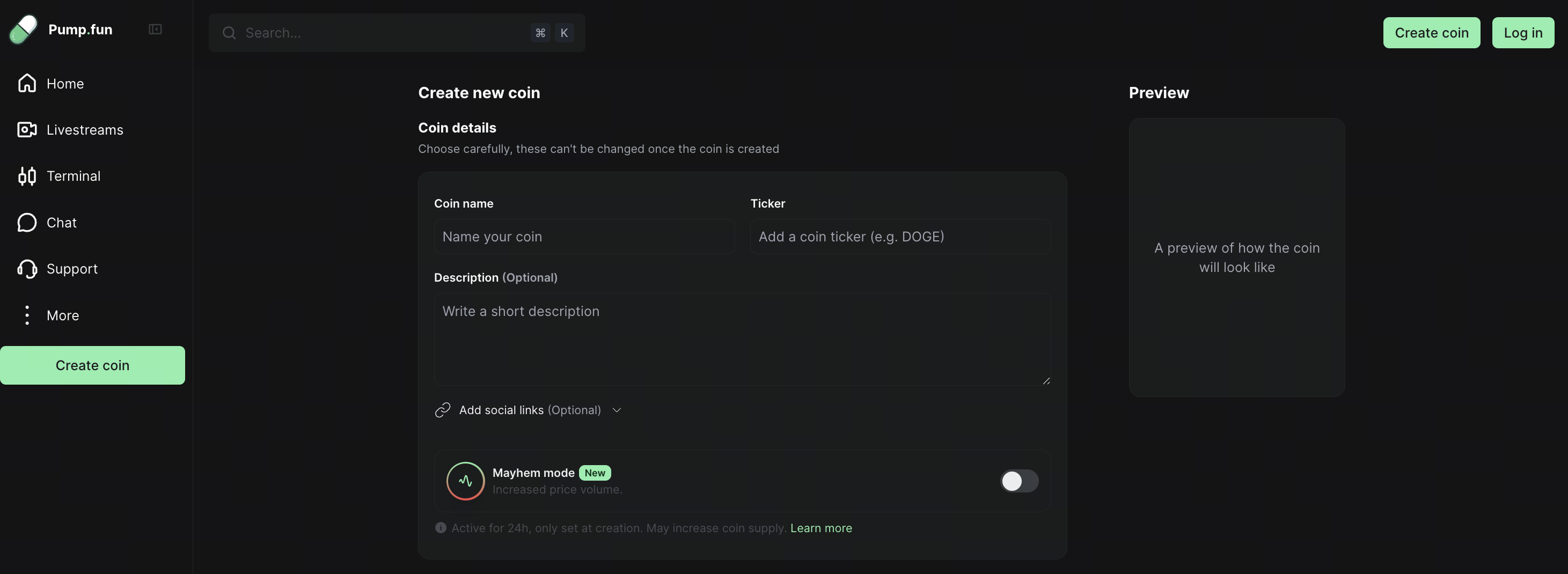
- Connect a Solana-compatible wallet, such as Phantom.
- Visit the Pump.fun website and choose to create a new token.
- Enter the token name, symbol, icon, and description.
- After publishing, the token automatically activates the bonding curve mechanism and becomes tradable.
- Once market cap or liquidity thresholds are met, the token can migrate to a larger DEX.
Risks and Opportunities of Pump.fun Projects
Opportunities
- Unleashed creativity, encouraging user innovation and participation in financial markets.
- Community-driven growth that fuels active social economies.
Risks
- High speculation and volatility, with many tokens experiencing rapid rises and falls.
- Lack of protection mechanisms, leaving users exposed to potential losses.
- Regulatory uncertainty, including possible legal and securities-related risks.
Overall, Pump.fun clearly lowers the barrier to token issuance and energizes community creativity. At the same time, its open design amplifies speculation and risk. For users, it is more of a high-volatility experimental playground than a mature issuance platform with investment safeguards.
Successful Meme Coin Cases and Community-Driven Models
Within the Pump.fun ecosystem, a “successful meme coin” does not mean a token with long-term, sustainable technical value. Instead, it refers to coins that leverage community hype and viral momentum to launch, explode in the market, and even enter mainstream trading venues in a very short time. Among these, $GOAT (Goatseus Maximus) is one of the most representative examples.
The Birth and Surge of $GOAT
$GOAT is one of the meme coins launched on Solana via Pump.fun. It first went live around October 10, 2024, and quickly gained traction thanks to exceptionally strong community attention and narrative momentum. According to market data, shortly after its launch, $GOAT’s market capitalization surged to hundreds of millions of dollars, or even higher, across Pump.fun and on-chain trading, making it one of the largest and most closely watched meme coins on the platform at the time.
Community Narratives and Viral Spread
Unlike traditional projects that rely on roadmaps and technical development, $GOAT’s success was largely driven by several community-focused factors:
- A strong meme narrative: “GOAT,” symbolizing “Greatest Of All Time,” carries powerful cultural resonance and spreads easily across social platforms and crypto communities.
- Marketing effects tied to AI and sentiment signals: Early promotion involving AI bots and automated accounts helped the topic surface repeatedly on social platforms, fueling secondary viral spread.
- Price action as narrative: Under Pump.fun’s bonding curve model, increased buying automatically pushes prices higher. This visible price movement becomes content in itself, accelerating social sharing and hype.
This combination of cultural narrative, price signals, and social amplification is a key reason meme coins on Pump.fun can gain explosive momentum in such a short time.
How Does Pump.fun Amplify This Effect?
Pump.fun’s issuance mechanism provides unique conditions for this type of meme coin:
- Fair launch: No presales and no team allocations mean anyone can create or participate in a token, greatly increasing community appeal.
- Bonding curve pricing: Prices rise automatically with buying pressure, which is easily interpreted as a signal of community consensus and further drives participation.
- Automated liquidity and migration to mainstream DEXs: Once a token reaches certain market cap and liquidity thresholds, Pump.fun automatically adds liquidity on DEXs like Raydium, allowing the token to gradually integrate into the broader Solana trading ecosystem.
These mechanisms create a complete path from issuance to widespread trading, making community behavior and sentiment key drivers of expansion.
Common Traits and Limits Behind Success
From observing $GOAT, several shared characteristics of “successful meme coins” on Pump.fun emerge:
- Narrative-driven rather than project-driven: Success comes from meme virality, not technology or fundamentals.
- Community behavior determines price elasticity: Buying is not just trading but also an expression of collective emotion.
- Short-term breakout does not equal long-term value: Graduation to major DEXs or attention from derivatives markets represents a phase of success, not a guarantee of sustainable growth.
It is also important to note that among the many tokens launched on Pump.fun, only a tiny fraction ever reach high market caps or mainstream markets. Even tokens that see short-term activity often lose value quickly as community interest fades, a pattern common across the meme coin ecosystem.
Conclusion: Will Pump.fun Become Long-Term Infrastructure for Meme Coin Issuance?
Pump.fun’s rise in the crypto world is no accident. With its low entry barriers, innovative design, and strong community culture, it has fueled the meme coin economy within the Solana ecosystem. However, its high level of speculation and risk mean it currently functions more as an experimental innovation platform than as traditional financial infrastructure. Whether it can become a stable, long-term foundation will depend on regulatory developments, user behavior, and the overall maturation of the market.
FAQ
Q1: Is Pump.fun centralized or decentralized?
Pump.fun is a decentralized application built on Solana smart contracts, though certain functions may be managed by the development team.
Q2: Are tokens on Pump.fun safe?
Meme coins are inherently high-risk. Pump.fun provides issuance and trading mechanisms but cannot guarantee token quality or price performance.
Q3: How much does it cost for ordinary users to launch a token?
Typically, only a very small amount of SOL is required, around 0.015–0.02 SOL, which is almost equivalent to issuing a token for free.







