What Is Etherscan? The Most Essential On-Chain Data Gateway for Ethereum

Beginner
Quick Reads
Last Updated 2026-03-27 16:48:01
Reading Time: 1m
Etherscan is the leading on-chain analytics platform for Ethereum, offering transaction lookup, smart contract review, gas analytics, and fund flow tracking. These capabilities enable users to understand the on-chain environment quickly and efficiently. Whether you're making investment decisions, assessing risks, researching projects, or monitoring development. Etherscan is an indispensable tool for transparency in the Ethereum ecosystem.

What Is Etherscan?


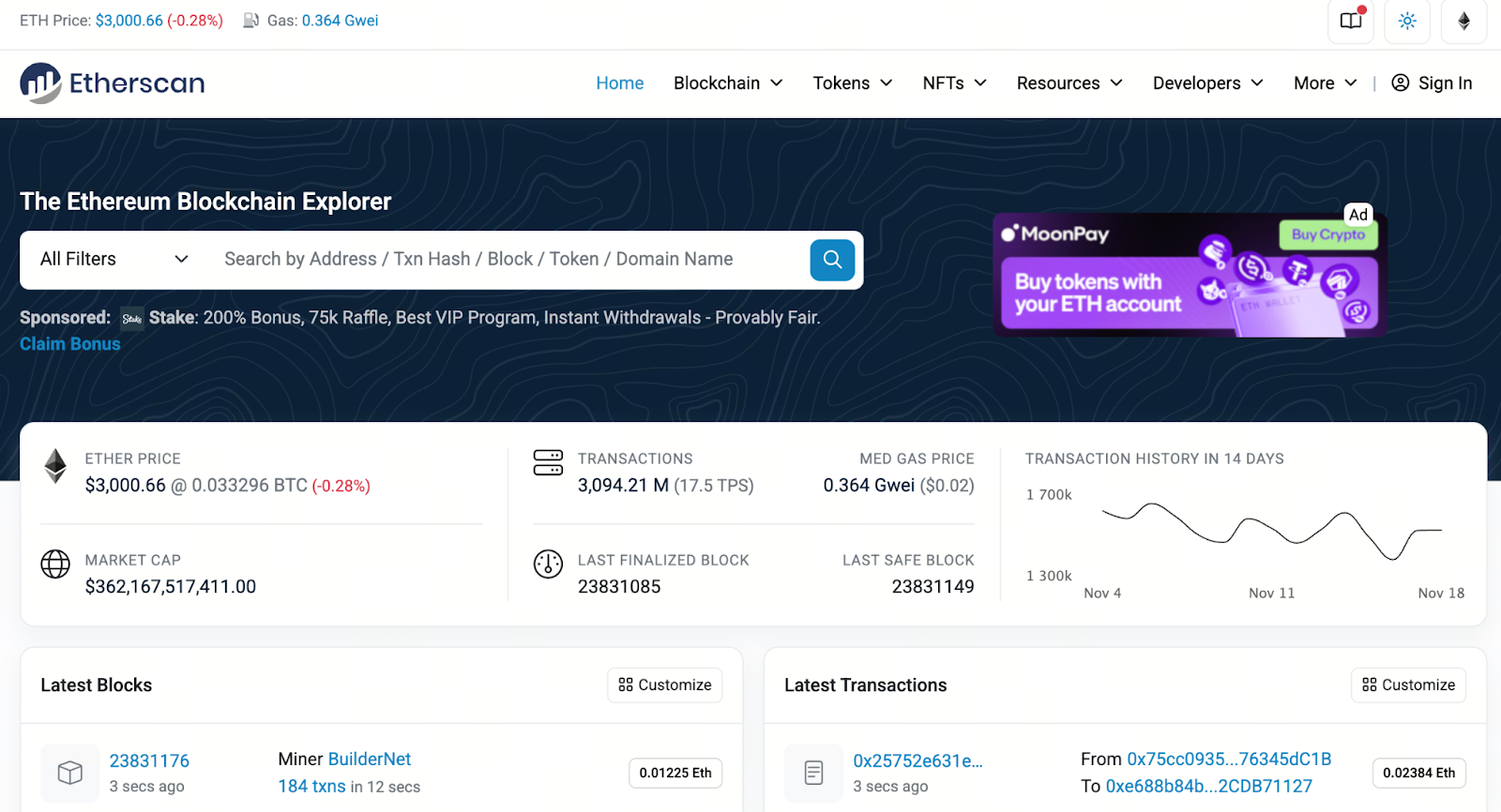
(Source: Etherscan)

Etherscan stands as the leading blockchain explorer and analytics platform for Ethereum. It offers users a comprehensive visual interface to track every transaction, asset movement, and smart contract activity on the network. Acting as Ethereum’s information console, Etherscan enables anyone to search, verify, and trace all blockchain actions. Investors, developers, and crypto asset holders alike rely on Etherscan as one of the most indispensable on-chain tools available.

Key Features

  1. Wallet and Transaction Lookup
    Enter any wallet address to instantly view balances, token holdings, transaction history, and the status of current transactions (success, failure, or pending). This complete transparency empowers users to monitor asset changes, track transaction records, and guard against potential fraud.
  2. Smart Contract Monitoring
    Etherscan enables users to review contract source code, audit transaction history, and inspect function execution and interaction records. Whether for DeFi, NFTs, blockchain gaming, or DAOs, users can clearly see where funds are, how they move, and spot any irregularities—crucial for effective risk assessment.
  3. On-Chain Data and Market Analytics
    The platform consolidates a wide range of metrics and tracking tools, such as gas price trends, top tokens and active addresses, whale wallet activity, and block production and network status. For researchers and investors, Etherscan serves as an essential hub for real-time market intelligence.
  4. Transaction and On-Chain Activity Insights
    With detailed records of transfer processes, users can trace fund flows, understand real interactions with transactions and DApps, and gain actionable insights into on-chain events. This not only deepens understanding but also dramatically reduces security risks.

Why Use Etherscan?

  1. Information Transparency
    Ethereum is inherently open, but its raw data is complex. Etherscan organizes this data into clear, accessible information, allowing anyone to verify transactions or review counterparties.
  2. Asset Security
    Users can track project wallets, whale activity, abnormal fund movements, and suspicious contracts, making it possible to spot rug pulls, hacks, or unusual risks early on.
  3. Indispensable for Research and Investment
    For crypto traders, NFT communities, DeFi power users, and developers, Etherscan is the go-to platform for verification, monitoring, and due diligence—and the gold standard for analyzing on-chain behavior.

Market and Technical Significance

Etherscan is more than just a transaction lookup tool—it plays a critical role within the Ethereum ecosystem by:

  • Translating complex data into intuitive visual information
  • Helping users avoid scams
  • Equipping developers with contract monitoring tools
  • Supporting investor due diligence
  • Enhancing the overall credibility of Ethereum operations

For developers, Etherscan functions as a dashboard after smart contract deployment, enabling real-time monitoring of transaction interactions, function executions, and anomalous events—vital for troubleshooting and product iteration.

Use Case Examples

Investor Perspective

To verify whether a new token is legitimate and transparent, simply enter its contract address to review:

  • Token transfer records
  • Circulation distribution
  • Developer token holdings
  • Any unusual concentration or large outflows

This enables more informed investment decisions.

Developer Perspective

After deploying a smart contract, developers can immediately:

  • Track user interactions
  • Monitor for abnormal calls
  • Analyze performance bottlenecks and transfer patterns

This data-driven approach allows for rapid on-chain product optimization.

Conclusion

Etherscan’s core value lies in converting inherently complex and abstract on-chain data into an interface that anyone can verify, understand, and act upon. Whether tracking fund flows, verifying smart contracts, analyzing token dynamics, or simply confirming the success of a transaction, Etherscan brings Ethereum’s open ethos to life. Blockchain transparency isn’t just a slogan—it means all activity leaves verifiable on-chain evidence. Etherscan is the vital gateway that makes this transparency real, traceable, and interpretable. For users, it’s more than a tool—it’s the premier window into how the Ethereum ecosystem truly operates.

Disclaimer
* The information is not intended to be and does not constitute financial advice or any other recommendation of any sort offered or endorsed by Gate.
* This article may not be reproduced, transmitted or copied without referencing Gate. Contravention is an infringement of Copyright Act and may be subject to legal action.

Related Articles

AI-Native Settlement Layers: How United Stables Is Building the Next Financial Rail
Beginner

AI-Native Settlement Layers: How United Stables Is Building the Next Financial Rail

Stablecoins were originally designed as dollar substitutes within exchanges, primarily used for asset pricing and trade settlement. As on-chain financial ecosystems have matured, their role has expanded beyond simple payments to include collateral assets, cross-chain liquidity mediums, and unified settlement units. In particular, as AI systems and automated agents begin to participate directly in economic activity, demand has risen sharply for programmable value units capable of instant settlement. This shift is pushing stablecoins toward the role of foundational financial infrastructure.
2026-03-25 03:16:17
DePIN Identity Network and Real World Applications: How Humanity Protocol Brings on-chain Identity Into the Physical World
Beginner

DePIN Identity Network and Real World Applications: How Humanity Protocol Brings on-chain Identity Into the Physical World

Most Web3 identity systems remain confined to on-chain environments and struggle to achieve meaningful adoption in real world settings. Through a DePIN architecture and physical verification hardware, Humanity Protocol aims to bring decentralized identity into access control systems, hospitality, public services, and offline events, allowing on-chain identity to function not just as a digital credential, but as foundational infrastructure for real world access.
2026-03-25 07:40:53
Gold Price Forecast for the Next Five Years: 2026–2030 Trend Outlook and Investment Implications, Could It Reach $6,000?
Beginner

Gold Price Forecast for the Next Five Years: 2026–2030 Trend Outlook and Investment Implications, Could It Reach $6,000?

Analyze current gold price trends alongside authoritative five-year forecasts, integrating an evaluation of market risks and opportunities. This gives investors insight into the potential trajectory of gold prices and the main drivers expected to shape the market over the next five years.
2026-03-25 18:13:30
Aster vs Hyperliquid: Which Perp DEX Will Prevail?
Beginner

Aster vs Hyperliquid: Which Perp DEX Will Prevail?

Aster and Hyperliquid are the two representative protocols of the "purpose-built L1 path" within the current decentralized perpetual exchange (Perp DEX) sector. As a pioneer in the field, Hyperliquid has built a deep liquidity moat through its highly mature order book architecture and strong community consensus. Conversely, Aster, as a rising challenger, seeks to leapfrog the competition in high-performance trading through more aggressive multi-chain aggregation logic, private transaction modules, and an underlying execution environment optimized for 2026 market demands.
2026-03-24 11:58:33
Aerodrome Tokenomics: How ve(3,3) Powers Base's Most Profitable DEX
Beginner

Aerodrome Tokenomics: How ve(3,3) Powers Base's Most Profitable DEX

AERO is the native token of Aerodrome Finance, a core decentralized exchange and liquidity protocol in the Base ecosystem. It is primarily used for liquidity incentives and ecosystem operations. veAERO is a governance NFT that users receive by locking AERO, representing both voting power and the right to share protocol revenue. Through a dual track structure of AERO as a utility token and veAERO as a governance credential, Aerodrome separates liquidity usage value from long term governance power, allowing participants to act as liquidity providers, governance decision makers, and revenue sharers within the same system.
2026-03-25 06:40:31
The ve(3,3) Flywheel Explained: How AERO Tokenomics Powers Aerodrome’s DeFi Economy
Beginner

The ve(3,3) Flywheel Explained: How AERO Tokenomics Powers Aerodrome’s DeFi Economy

In the competition for DeFi liquidity, high-inflation mining alone is no longer enough to build lasting advantages. Aerodrome applies the ve(3,3) economic model to redesign token emissions, voting mechanisms, and revenue distribution, creating a liquidity flywheel centered on governance and cash flow. This article examines AERO tokenomics, the veAERO locking mechanism, and protocol revenue models to explain how Aerodrome builds a sustainable DeFi economic system.
2026-03-25 06:41:58





