Aerodrome is a decentralized trading platform operating on the Base network, but its core role is not limited to token swaps. Instead, it is designed as liquidity infrastructure that provides foundational capital flow for the DeFi ecosystem. Officially described as a MetaDEX, Aerodrome integrates multiple AMM mechanisms, the ve(3,3) governance model, and immutable smart contract architecture. It emphasizes returning value to users, fully decentralized deployment, and community led governance, with the goal of building a sustainable on chain liquidity engine.
As the Base ecosystem and multi chain DeFi continue to expand, liquidity efficiency and incentive design have become critical factors shaping trading experience and capital allocation. Through the ve(3,3) economic model, Flashblocks high speed execution technology, and a multi pool AMM architecture, Aerodrome reduces slippage, improves execution efficiency, and establishes a long term incentive loop. Liquidity provision, governance decisions, and reward distribution reinforce each other within a self strengthening system. At the same time, fully on chain governance and a low inflation token model offer DeFi a more transparent and sustainable approach to liquidity infrastructure design.
This article provides a systematic introduction to what Aerodrome is and the role it plays within the Base ecosystem. It explains the project’s origins, how its MetaDEX architecture and ve(3,3) model function, and explores its multi pool AMM design, Flashblocks technology, and token economics. It also examines protocol security, risks, and competitive advantages, before looking ahead to Aerodrome’s position within multi chain DeFi and the future of liquidity infrastructure.
What Is Aerodrome?
(Source: AerodromeFi)
Aerodrome is a decentralized exchange operating on the Base network, but its positioning goes beyond a simple swap interface. It functions as a liquidity infrastructure layer. The protocol defines itself as a MetaDEX, meaning it integrates multiple liquidity mechanisms, incentive structures, and governance modules to provide a foundational capital engine for the broader DeFi ecosystem.
Unlike traditional DEXs, Aerodrome was built around three core principles from the outset:
- All protocol revenue is returned to users
- Fully decentralized and immutable deployment
- No reliance on venture capital or private fundraising
The Origin and Development of Aerodrome
To understand Aerodrome’s role within the Base ecosystem, it is helpful to look at the conditions under which the protocol was created and how its design evolved over time in response to on-chain liquidity challenges.
Background
Aerodrome Finance launched in 2023 as a native liquidity protocol for the Base ecosystem. It emerged during a period of rapid DeFi expansion, with the goal of addressing inefficient on-chain liquidity and one-dimensional incentive structures. The project set out to explore more flexible and sustainable liquidity provisioning models.
As a Base native protocol, Aerodrome incorporates design elements inspired by multiple established DeFi systems. It draws from Curve’s stable asset exchange logic, Convex’s incentive alignment mechanisms, and Uniswap’s automated market making model, combining them into a more integrated trading and yield framework for both users and liquidity providers.
Key Milestones
In 2023, Aerodrome was deployed on Base and introduced its multi-pool AMM architecture, quickly becoming a core component of the ecosystem. Throughout 2024, both total value locked and active user numbers grew steadily, with liquidity depth expanding significantly. On August 5, the AERO token reached an all-time high of 13.7 USD, reflecting strong market attention. Looking ahead to 2025, Aerodrome continues to deepen ecosystem integrations while strengthening protocol performance, security, and real-world usage through coordinated community and developer efforts.
Architecture and Functional Overview
At the architectural level, Aerodrome follows an extreme decentralization approach. All core logic is executed by immutable smart contracts, with no administrator privileges. Governance decisions, emissions, and voting processes are fully on chain, and the protocol does not rely on centralized APIs or backend indexing services.
From a capital structure perspective, Aerodrome deliberately avoided the traditional venture capital model. With no VC funding or private rounds, the protocol positions itself as public infrastructure maintained by the community, rather than a company-driven commercial product.
How the ve(3,3) Model Works
Aerodrome adopts the ve(3,3) model, connecting four participant roles:
- Users lock AERO to obtain veAERO
- veAERO holders vote to direct emissions
- Liquidity providers receive emissions by supplying liquidity
- Voters earn trading fees and incentive rewards
Together, these interactions form a self-reinforcing economic loop.
Flashblocks: Accelerating the Trading Experience
Aerodrome introduces Flashblocks technology, increasing block processing efficiency by up to ten times.
This delivers several practical benefits:
- Faster order execution
- Significantly reduced slippage
- More stable high-frequency trading
- Accelerated TVL growth
For traders and liquidity providers alike, this improves both user experience and capital efficiency.
How Aerodrome Operates
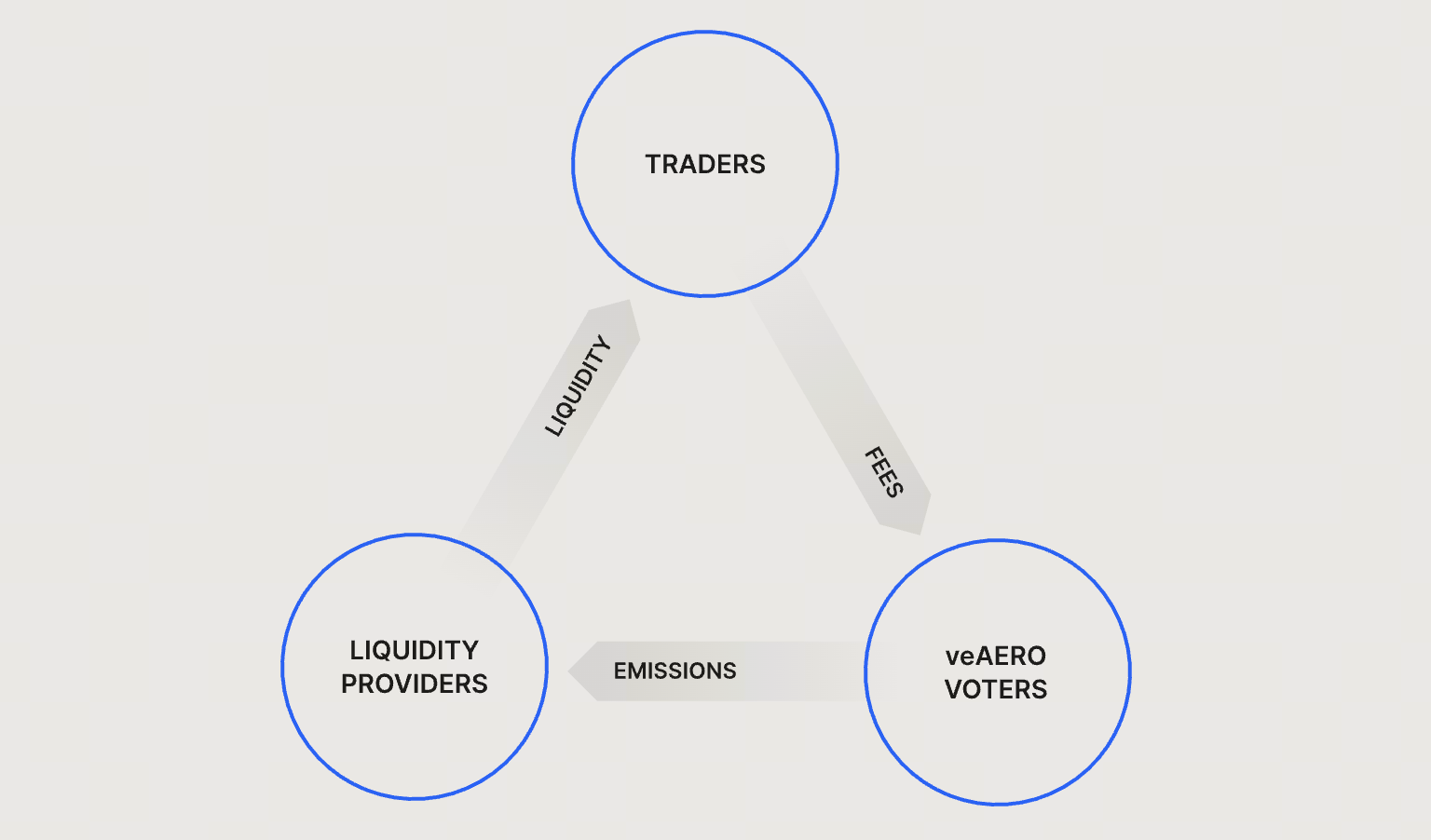
The protocol’s incentive and operating mechanisms are carefully designed to support long-term value creation, centered around three core user groups:
- Traders, who benefit from low slippage and predictable pricing
- Liquidity providers, who earn AERO emissions and trading fees
- Voters, who lock AERO into veAERO to direct emissions and receive protocol revenue
(Source: AerodromeFi)
Aerodrome’s Automated Market Models
Aerodrome’s liquidity system consists of three pool types designed for different trading needs:
- sAMM, optimized for low volatility asset pairs such as stablecoins, offering minimal slippage and high efficiency
- vAMM, similar to the Uniswap v2 model, designed for general token trading
- Slipstream, a concentrated liquidity model inspired by Uniswap v3, allowing liquidity to be deployed within specific price ranges for higher capital efficiency
Each pool can independently set trading fees ranging from 0.01% to 2%.
Aerodrome Token Economics
AERO is the core functional token of the Aerodrome ecosystem. Its token design emphasizes long-term stability and sustainability rather than short-term inflationary incentives. Through dynamic emission throttling, AERO’s annual inflation is maintained at around 1%, with emissions directed by governance voting instead of fixed distribution.
This approach allows Aerodrome to remain competitive in liquidity provision while avoiding excessive dilution, with the broader goal of building a self-sustaining liquidity system supported by real usage.
Dual Token Structure
Aerodrome operates a dual token model:
- AERO, the utility token used to reward liquidity providers
- veAERO, the governance token generated by locking AERO, used for voting and protocol governance
Lock periods can extend up to four years, with longer locks granting higher voting power. This structure balances incentives with governance participation to support long-term protocol stability.
Initial Token Distribution
| Category |
Allocation Item |
Share |
| AERO Allocation |
Voter Incentives |
8% |
|
Genesis Liquidity |
2% |
| veAERO Allocation |
veVELO Airdrop |
40% |
|
Public Goods Fund |
21% |
|
Core Development Team |
19% |
|
Flight School (Community) |
10% |
Overall, the distribution design is clearly weighted toward community participation and liquidity incentives. This structure helps ensure that governance power and resource allocation gradually return to actual users and contributors, reinforcing Aerodrome’s positioning as a community driven liquidity infrastructure rather than a centrally controlled protocol.
Security, Risks, and Challenges
Despite its central role in the Base ecosystem, Aerodrome faces ongoing challenges. Competition among DEXs on Base continues to intensify as new protocols emerge, increasing liquidity competition. At the same time, growing regulatory attention toward DeFi introduces long-term uncertainty.
Compared with many DeFi protocols, Aerodrome benefits from clear structural advantages. Its deep integration with Base, combined with Coinbase as a major traffic gateway, provides natural advantages in user acquisition and capital inflow. Fully on-chain governance and a user-aligned revenue model further strengthen transparency and incentive consistency, forming a durable competitive moat.
Future Outlook
Looking ahead, Aerodrome may expand beyond Base to explore deployment on other high-performance chains such as Solana. If its MetaDEX model proves adaptable across different technical architectures and user ecosystems, Aerodrome could evolve from a single-ecosystem DEX into a standardized, cross-chain liquidity infrastructure module.
Summary
Aerodrome is not just another DEX. It is a DeFi engine built around the idea that liquidity itself is infrastructure. Through the ve(3,3) model, Flashblocks acceleration, and deep integration with Coinbase Base, Aerodrome sits at the intersection of CeFi and DeFi, positioning itself as a key gateway for the next wave of users entering on-chain finance. In the narrative of DeFi Summer 2.0, Aerodrome is closer to the engine than the application layer.
FAQ
How is Aerodrome different from a typical DEX?
Aerodrome is positioned as liquidity infrastructure rather than a simple swap platform. By combining ve(3,3) economics, governance voting, and multiple AMM pool types, liquidity allocation is determined by the community, with fees and incentives returned to active participants.
What is veAERO and why lock AERO?
veAERO is a governance token created by locking AERO. Holders vote on emission allocation and earn a share of trading fees and incentives. Longer lock periods grant higher voting power, encouraging long-term participation.
Who is Aerodrome best suited for?
Aerodrome serves traders seeking low slippage and efficient execution, liquidity providers earning fees and AERO rewards, and governance participants who lock AERO to influence protocol direction and share in revenue.







