USCR Crypto Explained: What It Is, Why It’s Gaining Traction, and the Latest Price Trends

Beginner
Quick Reads
Last Updated 2026-03-26 20:38:45
Reading Time: 1m
In-depth analysis of USCR cryptocurrency (uscr crypto): project background, price movements, and current market updates. This includes an exploration of its connection to national digital reserve concepts and highlights the main areas of investor interest.

What Is USCR Cryptocurrency
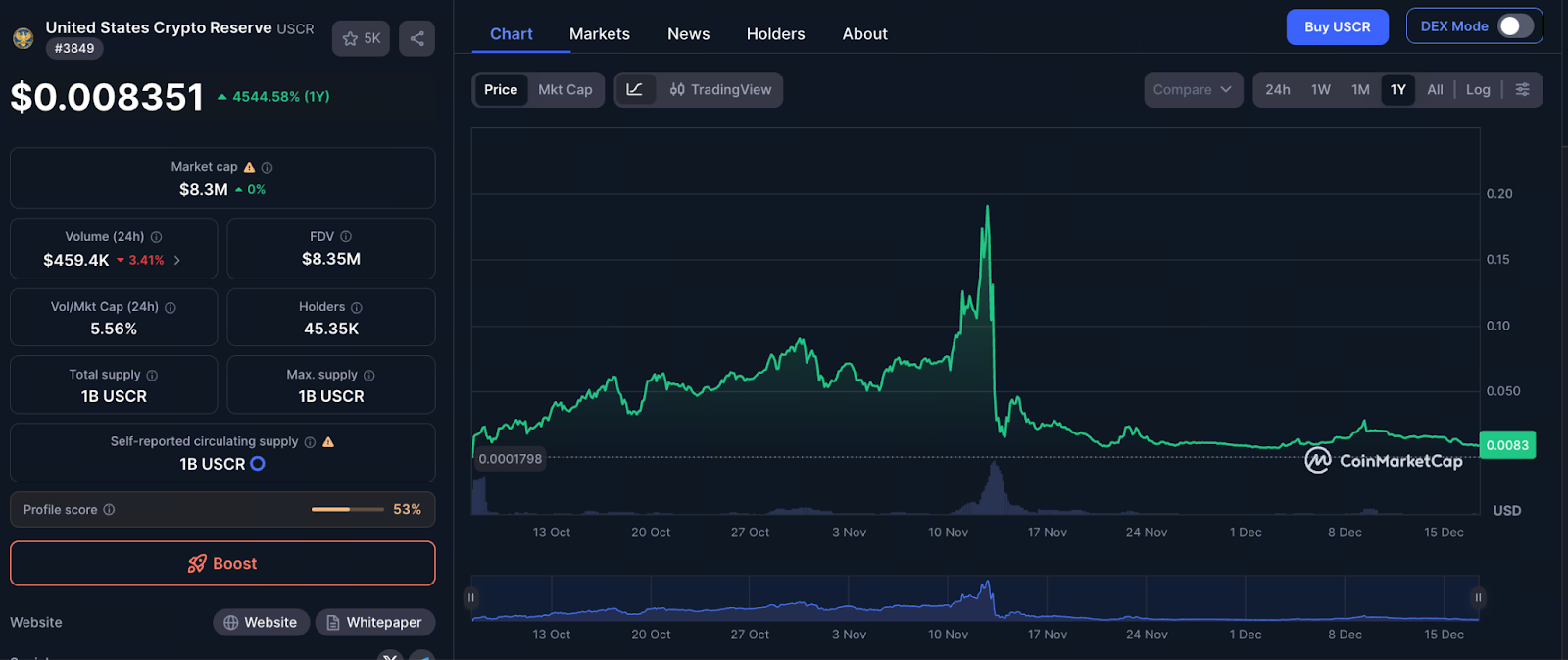
USCR, short for United States Crypto Reserve, is a cryptocurrency project often referred to as the “U.S. Crypto Reserve.” Launched on the Solana blockchain in October 2025, it aims to simulate a digital reserve or digital asset reserve for the blockchain era. USCR positions itself as a community-driven crypto asset, not an official government-backed digital reserve.

USCR quickly gained recognition as a “meme token” (memecoin or experimental token), especially in online community discussions. However, the project has no official affiliation with the U.S. government or the U.S. Treasury. Multiple sources have clarified that the name reflects a community concept rather than any actual government initiative.

USCR: Origins and Core Concept

USCR’s core idea stems from a conceptual experiment: What if a nation’s reserve assets were transparently placed on the blockchain, allowing the public to verify every transaction and reserve balance in real time? This aligns with the crypto community’s values of decentralization and transparency. USCR leverages Solana’s fast, low-cost network to make this possible, enabling holders to inspect on-chain data directly—without relying on traditional financial institutions or centralized reporting.

While this concept is innovative, it remains an experimental idea rather than a mature, national-level system. The USCR team has made it clear that the project is a “community-driven experimental initiative,” so investors should approach it with caution and understand its true nature.

USCR Latest Price Performance (as of December 2025)

According to the latest on-chain market data, USCR experienced extreme volatility shortly after launch. In a market event in November 2025, USCR’s price surged dramatically, briefly becoming a market hotspot.

The price then dropped sharply and is now fluctuating in the $0.0083–$0.0132 range, down more than 90% from its all-time high.

This high volatility is typical for many newly launched meme tokens—initial speculative surges followed by significant corrections.

Market Discussion and Investor Perspectives on USCR

USCR is a hot topic among investor communities. Some are excited by its concept, seeing it as a new narrative that combines national significance with blockchain transparency—potentially attracting more attention in the future. Others argue the project’s name is misleading, with some even likening it to hype-driven meme coins.

Importantly, many in the community have emphasized that USCR has no official government backing. The “government reserve” narrative is largely a product of market speculation, not fact.

USCR and the National Digital Reserve Narrative: Connections and Misconceptions

The USCR name often evokes associations with national digital reserves, but in reality, it’s mainly a branding and marketing strategy. Unlike digital reserve plans linked to former U.S. presidents (such as news reports about government interest in a “strategic crypto reserve,” which focus on mainstream assets like Bitcoin and Ethereum), USCR is not a government-authorized or supported project.

This misconception can lead investors to believe USCR has “official backing,” causing them to overlook its true community-driven nature.

Risks Investors Should Be Aware Of

While USCR has drawn attention due to its name and early price surges, it carries the following risks:

  • No official endorsement: USCR is not issued by the U.S. government or any institution and lacks the attributes of traditional official assets.
  • High volatility: The price has seen dramatic swings, making short-term risk extremely high.
  • Community-driven: The project relies on community enthusiasm and lacks a clear long-term mechanism or practical use case.
  • Potential for misunderstanding and regulatory risk: The name may cause confusion, and the project could face scrutiny from platforms or regulators in the future.

Investors should thoroughly assess risks before participating in any crypto asset and avoid making decisions based solely on a project’s name or hype.

Conclusion: USCR’s Future Outlook

In summary, USCR is a topical and experimental cryptocurrency that blends the concept of national reserves with blockchain transparency in its token narrative. Its early price surge drew significant attention, but the price has since corrected sharply and its core value has yet to be recognized by mainstream institutions. For investors, understanding its community-driven nature and inherent risks is essential.

Author: Max
Disclaimer
* The information is not intended to be and does not constitute financial advice or any other recommendation of any sort offered or endorsed by Gate.
* This article may not be reproduced, transmitted or copied without referencing Gate. Contravention is an infringement of Copyright Act and may be subject to legal action.

Related Articles

AI-Native Settlement Layers: How United Stables Is Building the Next Financial Rail
Beginner

AI-Native Settlement Layers: How United Stables Is Building the Next Financial Rail

Stablecoins were originally designed as dollar substitutes within exchanges, primarily used for asset pricing and trade settlement. As on-chain financial ecosystems have matured, their role has expanded beyond simple payments to include collateral assets, cross-chain liquidity mediums, and unified settlement units. In particular, as AI systems and automated agents begin to participate directly in economic activity, demand has risen sharply for programmable value units capable of instant settlement. This shift is pushing stablecoins toward the role of foundational financial infrastructure.
2026-03-25 03:16:17
DePIN Identity Network and Real World Applications: How Humanity Protocol Brings on-chain Identity Into the Physical World
Beginner

DePIN Identity Network and Real World Applications: How Humanity Protocol Brings on-chain Identity Into the Physical World

Most Web3 identity systems remain confined to on-chain environments and struggle to achieve meaningful adoption in real world settings. Through a DePIN architecture and physical verification hardware, Humanity Protocol aims to bring decentralized identity into access control systems, hospitality, public services, and offline events, allowing on-chain identity to function not just as a digital credential, but as foundational infrastructure for real world access.
2026-03-25 07:40:53
Gold Price Forecast for the Next Five Years: 2026–2030 Trend Outlook and Investment Implications, Could It Reach $6,000?
Beginner

Gold Price Forecast for the Next Five Years: 2026–2030 Trend Outlook and Investment Implications, Could It Reach $6,000?

Analyze current gold price trends alongside authoritative five-year forecasts, integrating an evaluation of market risks and opportunities. This gives investors insight into the potential trajectory of gold prices and the main drivers expected to shape the market over the next five years.
2026-03-25 18:13:30
Aster vs Hyperliquid: Which Perp DEX Will Prevail?
Beginner

Aster vs Hyperliquid: Which Perp DEX Will Prevail?

Aster and Hyperliquid are the two representative protocols of the "purpose-built L1 path" within the current decentralized perpetual exchange (Perp DEX) sector. As a pioneer in the field, Hyperliquid has built a deep liquidity moat through its highly mature order book architecture and strong community consensus. Conversely, Aster, as a rising challenger, seeks to leapfrog the competition in high-performance trading through more aggressive multi-chain aggregation logic, private transaction modules, and an underlying execution environment optimized for 2026 market demands.
2026-03-24 11:58:33
Aerodrome Tokenomics: How ve(3,3) Powers Base's Most Profitable DEX
Beginner

Aerodrome Tokenomics: How ve(3,3) Powers Base's Most Profitable DEX

AERO is the native token of Aerodrome Finance, a core decentralized exchange and liquidity protocol in the Base ecosystem. It is primarily used for liquidity incentives and ecosystem operations. veAERO is a governance NFT that users receive by locking AERO, representing both voting power and the right to share protocol revenue. Through a dual track structure of AERO as a utility token and veAERO as a governance credential, Aerodrome separates liquidity usage value from long term governance power, allowing participants to act as liquidity providers, governance decision makers, and revenue sharers within the same system.
2026-03-25 06:40:31
The ve(3,3) Flywheel Explained: How AERO Tokenomics Powers Aerodrome’s DeFi Economy
Beginner

The ve(3,3) Flywheel Explained: How AERO Tokenomics Powers Aerodrome’s DeFi Economy

In the competition for DeFi liquidity, high-inflation mining alone is no longer enough to build lasting advantages. Aerodrome applies the ve(3,3) economic model to redesign token emissions, voting mechanisms, and revenue distribution, creating a liquidity flywheel centered on governance and cash flow. This article examines AERO tokenomics, the veAERO locking mechanism, and protocol revenue models to explain how Aerodrome builds a sustainable DeFi economic system.
2026-03-25 06:41:58





