The Mystery of MegaETH’s $500 Million Pre-Deposit Withdrawal: From “Liquidity Commitment” to Full Refund

Beginner
Quick Reads
Last Updated 2026-03-27 07:52:52
Reading Time: 1m
MegaETH has issued full refunds of the planned $500 million pre-deposit. This decision was made due to smart contract errors and a poorly managed Know Your Customer (KYC) process. This failed presale may impact both the MegaETH ecosystem and user trust.

What Is MegaETH’s Pre-Deposit Program?

Prior to the mainnet launch, MegaETH introduced a “Pre-Deposit Bridge” program designed to provide early liquidity for its stablecoin, USDm. The official initial cap was set at $250 million to ensure a smooth capital transition during the mainnet rollout.

For most participants, this approach initially seemed both reasonable and appealing. Users would deposit funds in advance, the project would issue USDm stablecoins based on these deposits, and after the mainnet launch, users could complete the asset transfer and begin using their assets. If executed as planned, this sequence (pre-deposit → stablecoin → mainnet) would facilitate a seamless transition and offer early adopters an entry point into the new ecosystem.

Why Did the Project Team Decide to Issue Refunds?
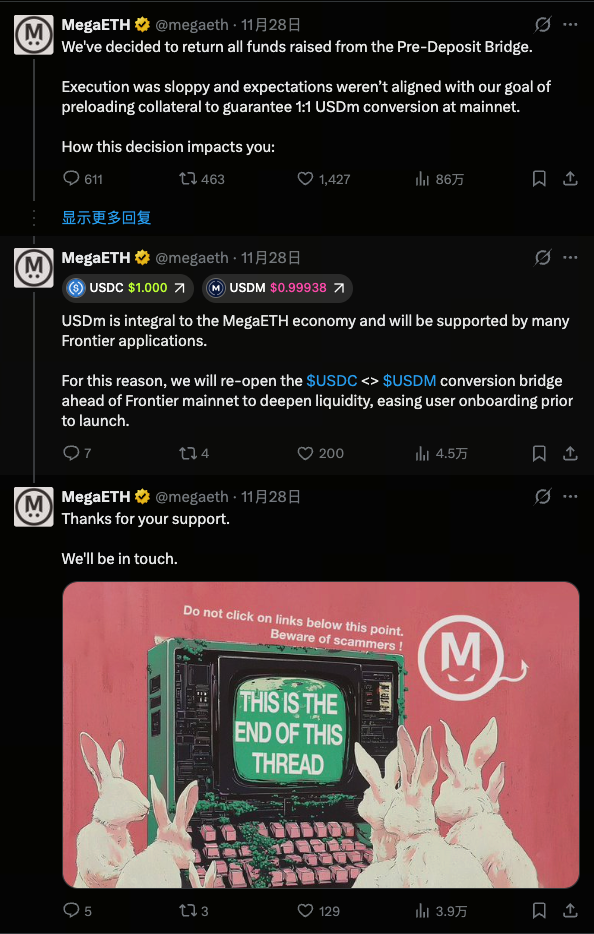

Image: https://x.com/megaeth/status/1994165259171397882

Despite the promising concept, the program faced major challenges from the outset. First, the SaleUUID contract misconfiguration prevented users from completing deposit transactions. The team had to urgently resolve this issue using a 4-of-6 multisig. Simultaneously, the third-party KYC provider implemented an incorrect rate limiting, which blocked many users from passing verification. The team identified and fixed this problem after almost 20 minutes. Even after the system recovered, the deposit window opened unpredictably. As a result, users who refreshed the page rapidly secured the entire $250 million allocation within minutes, while those relying on official notifications missed out almost entirely.

The team then attempted to raise the deposit cap from $250 million to $1 billion. However, an external party executed the multisig transaction roughly 30 minutes early, triggering a sudden influx of funds and causing the system to become unmanageable again. Subsequent attempts to adjust the cap to $400 million and $500 million both failed due to execution errors.

After a series of critical missteps, the team ultimately decided to halt the process and announced full refunds for all users.

What Were the Key Failures During the Process?

  • Contract misconfiguration: The SaleUUID error was the root technical issue.
  • Poor multisig management: The signature process, intended to be controlled, was triggered externally, resulting in premature cap increases.
  • KYC system rate limiting: Overly strict or misconfigured limits prevented some users from completing KYC.
  • Disorganized process design and poor user experience: Randomized deposit window openings created unfair competition, favoring users who refreshed the page over those waiting for notifications.

What Does This Mean for MegaETH’s Future and User Confidence?

This pre-deposit incident dealt a significant blow to MegaETH’s reputation. Technical execution, process management, and the commitment to fair user participation all came under widespread scrutiny.

Although the team repeatedly assured users that “all funds are safe and no assets are at risk,” and promised full refunds, the chaotic launch and abrupt suspension of the pre-deposit process have already led many participants to view the project as immature and unstable.

To regain community and investor trust, MegaETH must deliver clear, verifiable improvements on multiple fronts: stricter technical audits, greater operational transparency, faster user support, and a comprehensive review and reinforcement of both KYC providers and contract systems. The market will closely watch the execution of its future roadmap.

What Should Investors and Users Watch For?

  • Exercise caution when participating in “presale/pre-deposit + promised liquidity” models. If a project’s contracts, multisig configuration, or KYC process has not undergone a comprehensive public audit, do not place blind trust.
  • Before participating, verify that the project has published audit reports, contract code, detailed multisig configuration, and clearly outlined refund and contingency mechanisms. All of these are essential.
  • Always maintain risk awareness. Even projects promoted as “industry-leading initiatives” (such as those claiming support from Ethereum co-founders) can encounter critical issues due to process failures or technical vulnerabilities.
Author: Max
Disclaimer
* The information is not intended to be and does not constitute financial advice or any other recommendation of any sort offered or endorsed by Gate.
* This article may not be reproduced, transmitted or copied without referencing Gate. Contravention is an infringement of Copyright Act and may be subject to legal action.

Related Articles

AI-Native Settlement Layers: How United Stables Is Building the Next Financial Rail
Beginner

AI-Native Settlement Layers: How United Stables Is Building the Next Financial Rail

Stablecoins were originally designed as dollar substitutes within exchanges, primarily used for asset pricing and trade settlement. As on-chain financial ecosystems have matured, their role has expanded beyond simple payments to include collateral assets, cross-chain liquidity mediums, and unified settlement units. In particular, as AI systems and automated agents begin to participate directly in economic activity, demand has risen sharply for programmable value units capable of instant settlement. This shift is pushing stablecoins toward the role of foundational financial infrastructure.
2026-03-25 03:16:17
DePIN Identity Network and Real World Applications: How Humanity Protocol Brings on-chain Identity Into the Physical World
Beginner

DePIN Identity Network and Real World Applications: How Humanity Protocol Brings on-chain Identity Into the Physical World

Most Web3 identity systems remain confined to on-chain environments and struggle to achieve meaningful adoption in real world settings. Through a DePIN architecture and physical verification hardware, Humanity Protocol aims to bring decentralized identity into access control systems, hospitality, public services, and offline events, allowing on-chain identity to function not just as a digital credential, but as foundational infrastructure for real world access.
2026-03-25 07:40:53
The ve(3,3) Flywheel Explained: How AERO Tokenomics Powers Aerodrome’s DeFi Economy
Beginner

The ve(3,3) Flywheel Explained: How AERO Tokenomics Powers Aerodrome’s DeFi Economy

In the competition for DeFi liquidity, high-inflation mining alone is no longer enough to build lasting advantages. Aerodrome applies the ve(3,3) economic model to redesign token emissions, voting mechanisms, and revenue distribution, creating a liquidity flywheel centered on governance and cash flow. This article examines AERO tokenomics, the veAERO locking mechanism, and protocol revenue models to explain how Aerodrome builds a sustainable DeFi economic system.
2026-03-25 06:41:58
Aerodrome Tokenomics: How ve(3,3) Powers Base's Most Profitable DEX
Beginner

Aerodrome Tokenomics: How ve(3,3) Powers Base's Most Profitable DEX

AERO is the native token of Aerodrome Finance, a core decentralized exchange and liquidity protocol in the Base ecosystem. It is primarily used for liquidity incentives and ecosystem operations. veAERO is a governance NFT that users receive by locking AERO, representing both voting power and the right to share protocol revenue. Through a dual track structure of AERO as a utility token and veAERO as a governance credential, Aerodrome separates liquidity usage value from long term governance power, allowing participants to act as liquidity providers, governance decision makers, and revenue sharers within the same system.
2026-03-25 06:40:31
Aster vs Hyperliquid: Which Perp DEX Will Prevail?
Beginner

Aster vs Hyperliquid: Which Perp DEX Will Prevail?

Aster and Hyperliquid are the two representative protocols of the "purpose-built L1 path" within the current decentralized perpetual exchange (Perp DEX) sector. As a pioneer in the field, Hyperliquid has built a deep liquidity moat through its highly mature order book architecture and strong community consensus. Conversely, Aster, as a rising challenger, seeks to leapfrog the competition in high-performance trading through more aggressive multi-chain aggregation logic, private transaction modules, and an underlying execution environment optimized for 2026 market demands.
2026-03-24 11:58:33
Gold Price Forecast for the Next Five Years: 2026–2030 Trend Outlook and Investment Implications, Could It Reach $6,000?
Beginner

Gold Price Forecast for the Next Five Years: 2026–2030 Trend Outlook and Investment Implications, Could It Reach $6,000?

Analyze current gold price trends alongside authoritative five-year forecasts, integrating an evaluation of market risks and opportunities. This gives investors insight into the potential trajectory of gold prices and the main drivers expected to shape the market over the next five years.
2026-03-25 18:13:30





