STABLE Mainnet and TGE Launch Simultaneously — Native USDT Chain Debuts with Hot Airdrop Rewards

Beginner
Quick Reads
Last Updated 2026-03-27 02:24:46
Reading Time: 1m
STABLE’s mainnet launches alongside the TGE, delivering native USDT settlement with near-instant confirmation. The STABLE airdrop rewards campaign is now live. Early adopters are eligible for up to 3%–7% of the total airdrop allocation, which can be claimed through March 2026.

STABLE: Next-Generation Layer-1 Blockchain Engineered for Stablecoins

Image: https://www.stable.xyz/

StableChain, widely known as STABLE, is a Layer-1 blockchain supported by leading exchanges and institutions, purpose-built for stablecoins such as USDT. Unlike general-purpose blockchains like Ethereum or Tron, StableChain is designed specifically as “stablecoin settlement infrastructure.” Users can utilize USDT as the native gas token, with all transactions and payments settled in USDT, resulting in extremely low fees and near-instant settlement speeds.

This approach aims to lower entry barriers for users. There is no need to hold separate native gas tokens (such as Ether) to pay transaction fees—holding USDT alone is sufficient for transfers and trades. This dramatically streamlines stablecoin payments and everyday usage.

Mainnet and TGE Go Live Together: A Landmark Moment
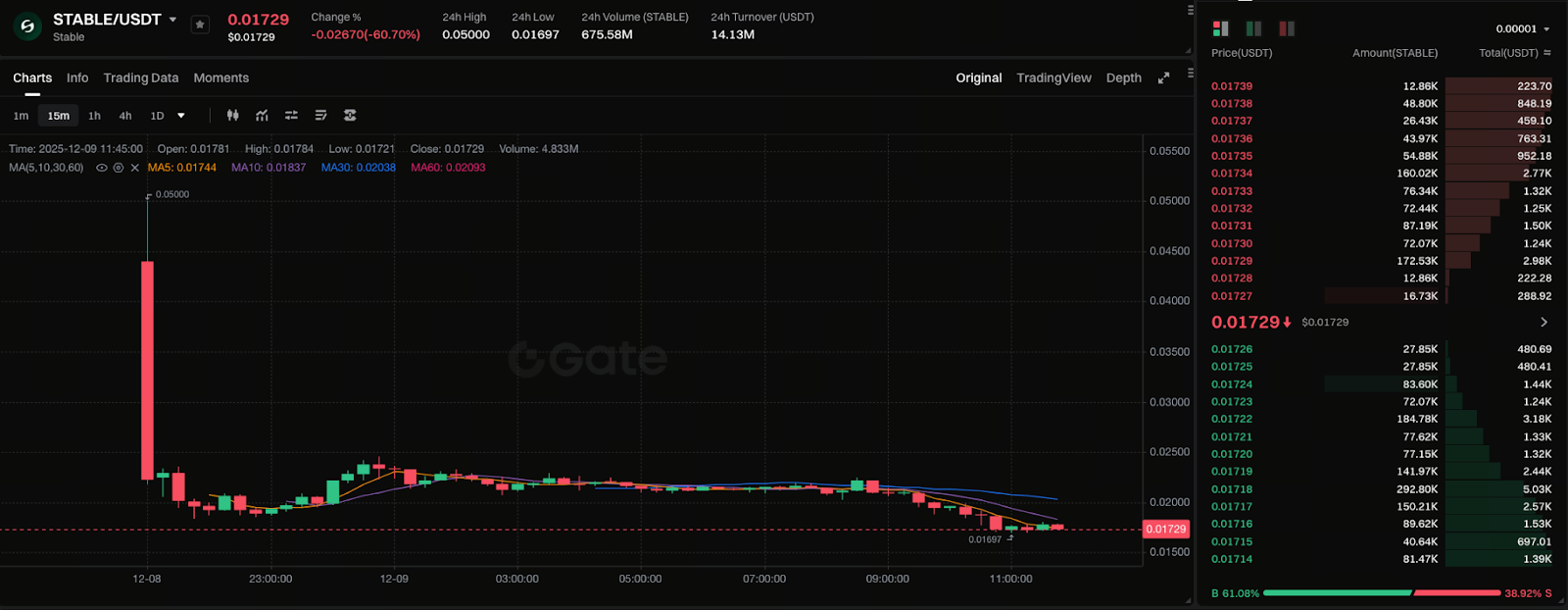

Image: https://www.gate.com/trade/STABLE_USDT

According to official announcements and multiple media reports, StableChain launched its mainnet on December 8, 2025, alongside its Token Generation Event (TGE). This milestone marks StableChain’s transition from “test/warm-up phase” to “full-scale operation and ecosystem launch.” With validator nodes now live and the network consensus mechanism activated, both users and developers can leverage StableChain’s mainnet for stablecoin transfers, settlements, and DeFi applications.

STABLE Tokenomics and Airdrop Framework

While StableChain uses USDT as gas, the project has also introduced its native token, STABLE. This token primarily serves to incentivize, reward, and govern ecosystem participants, including developers, liquidity providers, and early contributors.

According to official disclosures, STABLE has a fixed total supply allocated as follows:

  • 10% for Genesis distribution, supporting initial liquidity, community rewards, and ecosystem launch.
  • Approximately 40% for developers and ecosystem initiatives, fueling future grants, partnerships, and incentive programs.
  • The remainder is allocated to the team, early investors, and advisors, with portions locked and released gradually.

For airdrops and incentives, at mainnet launch, the project distributed STABLE rewards and airdrops through several channels. Early participants—including depositors, liquidity providers, and users of ecosystem services—could earn STABLE rewards. Depositors are expected to receive airdrop rewards equal to 3%–7% of their deposit amount. Those meeting multiple criteria (such as both depositing and providing liquidity) are eligible for higher allocations. The claim window is now open, with the deadline set for March 2, 2026 (UTC).

STABLE Market Pricing and Value Potential Analysis

STABLE’s launch sparked strong initial market interest. In select spot and derivatives markets, STABLE/USDT traded as high as $0.032. At this price point, full circulation of STABLE would yield a Fully Diluted Valuation (FDV) in the billions of dollars. Some market analysts and data platforms project STABLE’s FDV could exceed $2–3 billion.

However, some caution that since all StableChain transaction fees are paid in USDT and STABLE is not used as gas, its actual utility and demand may be limited. STABLE functions primarily as an incentive, governance, and reward token for the ecosystem. Its long-term value will depend on ecosystem growth, application adoption, and community engagement.

For everyday users and investors, STABLE’s value should be assessed by the ecosystem’s development, developer participation, and real-world deployment of DeFi, payments, and compliant on-chain applications, rather than short-term speculation.

Significance and Outlook for Users and Ecosystem Participants

  • For typical crypto users, StableChain’s launch means USDT transfers are now faster, cheaper, and more convenient—ideal for stablecoin payments, cross-border settlements, and everyday transactions.
  • For developers and DeFi projects, StableChain offers a purpose-built chain with native USDT support, making it ideal for stablecoin lending, payments, settlements, fiat on/off ramps, merchant integration, and more. The platform has strong potential to attract projects focused on stablecoin payments.
  • For early participants—such as depositors, liquidity providers, and contributors—receiving STABLE via airdrop represents a passive earning opportunity. If the ecosystem grows successfully, these tokens could deliver significant future value.

In summary, the synchronized launch of STABLE’s mainnet and TGE is a major milestone for blockchain and stablecoin payments. While market price and liquidity remain uncertain, StableChain’s success in enabling stablecoin payments, settlements, merchant adoption, and ecosystem development could unlock substantial future potential.

Gate launched Stable (STABLE) spot trading on December 8, 2025, at 13:00 UTC.

Author: Max
Disclaimer
* The information is not intended to be and does not constitute financial advice or any other recommendation of any sort offered or endorsed by Gate.
* This article may not be reproduced, transmitted or copied without referencing Gate. Contravention is an infringement of Copyright Act and may be subject to legal action.

Related Articles

AI-Native Settlement Layers: How United Stables Is Building the Next Financial Rail
Beginner

AI-Native Settlement Layers: How United Stables Is Building the Next Financial Rail

Stablecoins were originally designed as dollar substitutes within exchanges, primarily used for asset pricing and trade settlement. As on-chain financial ecosystems have matured, their role has expanded beyond simple payments to include collateral assets, cross-chain liquidity mediums, and unified settlement units. In particular, as AI systems and automated agents begin to participate directly in economic activity, demand has risen sharply for programmable value units capable of instant settlement. This shift is pushing stablecoins toward the role of foundational financial infrastructure.
2026-03-25 03:16:17
DePIN Identity Network and Real World Applications: How Humanity Protocol Brings on-chain Identity Into the Physical World
Beginner

DePIN Identity Network and Real World Applications: How Humanity Protocol Brings on-chain Identity Into the Physical World

Most Web3 identity systems remain confined to on-chain environments and struggle to achieve meaningful adoption in real world settings. Through a DePIN architecture and physical verification hardware, Humanity Protocol aims to bring decentralized identity into access control systems, hospitality, public services, and offline events, allowing on-chain identity to function not just as a digital credential, but as foundational infrastructure for real world access.
2026-03-25 07:40:53
Gold Price Forecast for the Next Five Years: 2026–2030 Trend Outlook and Investment Implications, Could It Reach $6,000?
Beginner

Gold Price Forecast for the Next Five Years: 2026–2030 Trend Outlook and Investment Implications, Could It Reach $6,000?

Analyze current gold price trends alongside authoritative five-year forecasts, integrating an evaluation of market risks and opportunities. This gives investors insight into the potential trajectory of gold prices and the main drivers expected to shape the market over the next five years.
2026-03-25 18:13:30
Aster vs Hyperliquid: Which Perp DEX Will Prevail?
Beginner

Aster vs Hyperliquid: Which Perp DEX Will Prevail?

Aster and Hyperliquid are the two representative protocols of the "purpose-built L1 path" within the current decentralized perpetual exchange (Perp DEX) sector. As a pioneer in the field, Hyperliquid has built a deep liquidity moat through its highly mature order book architecture and strong community consensus. Conversely, Aster, as a rising challenger, seeks to leapfrog the competition in high-performance trading through more aggressive multi-chain aggregation logic, private transaction modules, and an underlying execution environment optimized for 2026 market demands.
2026-03-24 11:58:33
Aerodrome Tokenomics: How ve(3,3) Powers Base's Most Profitable DEX
Beginner

Aerodrome Tokenomics: How ve(3,3) Powers Base's Most Profitable DEX

AERO is the native token of Aerodrome Finance, a core decentralized exchange and liquidity protocol in the Base ecosystem. It is primarily used for liquidity incentives and ecosystem operations. veAERO is a governance NFT that users receive by locking AERO, representing both voting power and the right to share protocol revenue. Through a dual track structure of AERO as a utility token and veAERO as a governance credential, Aerodrome separates liquidity usage value from long term governance power, allowing participants to act as liquidity providers, governance decision makers, and revenue sharers within the same system.
2026-03-25 06:40:31
The ve(3,3) Flywheel Explained: How AERO Tokenomics Powers Aerodrome’s DeFi Economy
Beginner

The ve(3,3) Flywheel Explained: How AERO Tokenomics Powers Aerodrome’s DeFi Economy

In the competition for DeFi liquidity, high-inflation mining alone is no longer enough to build lasting advantages. Aerodrome applies the ve(3,3) economic model to redesign token emissions, voting mechanisms, and revenue distribution, creating a liquidity flywheel centered on governance and cash flow. This article examines AERO tokenomics, the veAERO locking mechanism, and protocol revenue models to explain how Aerodrome builds a sustainable DeFi economic system.
2026-03-25 06:41:58





