Play Solana: Ushering in a New Era of Web3 Gaming | Exploring PlaySolana SuperHUB

Beginner
Quick Reads
Last Updated 2026-03-27 17:44:43
Reading Time: 1m
Play Solana is developing a next-generation Web3 gaming ecosystem, integrating hardware, gaming, identity, and DeFi. The PSG1 handheld device provides players with direct access to digital entertainment.

Why Web3 Games Haven't Broken Into the Mainstream
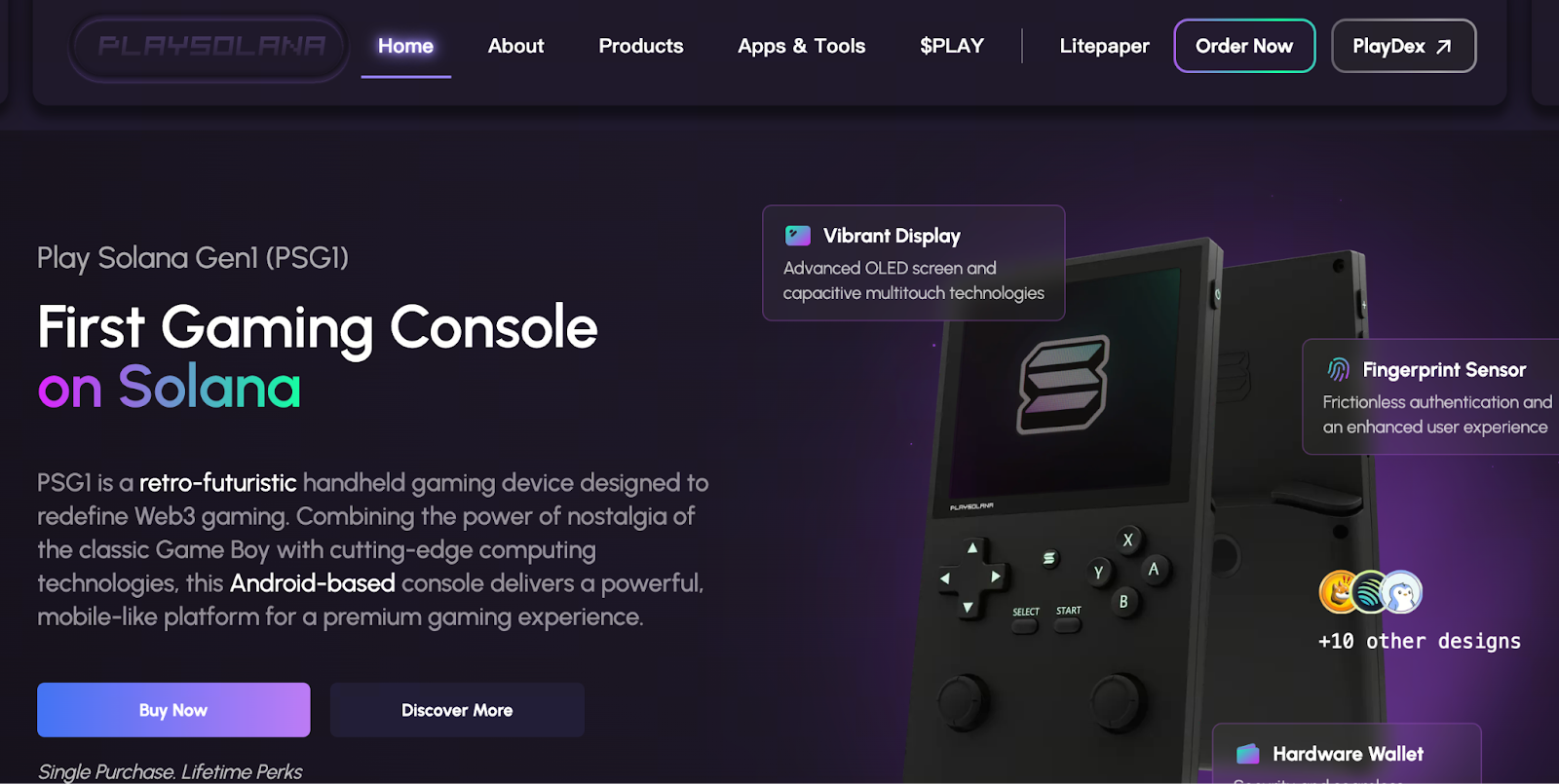

Image source: https://www.playsolana.com/

Web3 games have attracted billions in investment, yet their performance continues to lag far behind traditional gaming platforms. According to DappRadar (May 2025), blockchain games see just 4.9 million daily active wallets—less than 0.6% of the world’s 820 million active crypto wallets. By comparison, Roblox counts over 112 million daily active users, and Steam more than 69 million.

This gap stems from several core challenges:

  • Poor user onboarding: Most games assume players already own wallets and understand blockchain.
  • Lack of engaging gameplay: Play-to-Earn mechanics overshadow fun, drawing users mainly for financial rewards.
  • Fragmented ecosystem: Multiple wallets, dApps, and scattered rewards make it tough for users to maintain a unified identity and game progress.
  • No physical entry points: Unlike consoles or handheld devices, Web3 games lack hardware that integrates them into culture and daily life.

Play Solana < SuperHUB >: Architecture Explained

Play Solana isn’t a single game. It's a multi-layered Web3 platform merging hardware, software, and culture. Six foundational pillars define its core:

  • Hardware: The PSG1 handheld device blends retro style with modern tech.
  • Games: The Play Solana Gaming Library and Play < Gate > enable on-chain game publishing and releases.
  • Platform modules: Play < Dex > and Play < ID > unify progress, rewards, and identity.
  • IP branding: < Player1 > and < Player2 > NFTs act as dynamic identity and cultural icons.
  • DeFi: SvalGuard wallet and Play < Validator > integrate DeFi directly into gameplay.
  • Economic system: $PLAY serves as the core token for rewards, governance, and value flow.

PSG1 Handheld: The Physical Gateway to Web3

The PSG1 features an RK3588S2 SoC, a 3.92-inch OLED display, 8GB RAM, and 128GB storage. It supports Wi-Fi 6 and Bluetooth 5.4, balancing robust performance with advanced crypto security. The EchOS system unites gaming, wallet, and DeFi in one seamless, secure experience. SvalGuard delivers hardware-level encryption, allowing players to access DeFi services without browser extensions.

Play Solana Game Ecosystem and Developer Platform

Play Solana: Origins uses narrative-driven missions to teach players blockchain mechanics. Play < Gate > offers developers a full-featured channel for publishing and expanding games, supporting decentralized releases. A unified launcher makes it easy for users to discover, start, and interact with games, building an immersive experience.

$PLAY Economic System and DeFi Integration

$PLAY is the core token of SuperHUB, powering payments, rewards, and governance. Players can convert XP into $PLAY, linking progress, reputation, and value. Play < Validator > and SvalGuard bring together network security, DeFi, and gaming, fusing hardware-grade protection with economic incentives.

Partners and Real-World Applications

BONK Arena, Jupiter Wallet, and Pudgy Penguins have partnered with Play Solana, leveraging the PSG1 device for IP marketing and cultural integration. The MoonPay Edition PSG1 pioneers “phygital” gameplay, combining hardware, gaming, and scarcity.

How to Get Started with Play Solana

Players can connect wallets via Play < Dex >, explore missions, level up, and earn rewards. Developers can upload games through Play < Gate >, using the Unity SDK for PSG1 and GameFi integration.

PlaySolana is now available for spot trading on Gate. Click here to trade: https://www.gate.com/trade/PLAYSOLANA_USDT

Disclaimer
* The information is not intended to be and does not constitute financial advice or any other recommendation of any sort offered or endorsed by Gate.
* This article may not be reproduced, transmitted or copied without referencing Gate. Contravention is an infringement of Copyright Act and may be subject to legal action.

Related Articles

AI-Native Settlement Layers: How United Stables Is Building the Next Financial Rail
Beginner

AI-Native Settlement Layers: How United Stables Is Building the Next Financial Rail

Stablecoins were originally designed as dollar substitutes within exchanges, primarily used for asset pricing and trade settlement. As on-chain financial ecosystems have matured, their role has expanded beyond simple payments to include collateral assets, cross-chain liquidity mediums, and unified settlement units. In particular, as AI systems and automated agents begin to participate directly in economic activity, demand has risen sharply for programmable value units capable of instant settlement. This shift is pushing stablecoins toward the role of foundational financial infrastructure.
2026-03-25 03:16:17
DePIN Identity Network and Real World Applications: How Humanity Protocol Brings on-chain Identity Into the Physical World
Beginner

DePIN Identity Network and Real World Applications: How Humanity Protocol Brings on-chain Identity Into the Physical World

Most Web3 identity systems remain confined to on-chain environments and struggle to achieve meaningful adoption in real world settings. Through a DePIN architecture and physical verification hardware, Humanity Protocol aims to bring decentralized identity into access control systems, hospitality, public services, and offline events, allowing on-chain identity to function not just as a digital credential, but as foundational infrastructure for real world access.
2026-03-25 07:40:53
Aster vs Hyperliquid: Which Perp DEX Will Prevail?
Beginner

Aster vs Hyperliquid: Which Perp DEX Will Prevail?

Aster and Hyperliquid are the two representative protocols of the "purpose-built L1 path" within the current decentralized perpetual exchange (Perp DEX) sector. As a pioneer in the field, Hyperliquid has built a deep liquidity moat through its highly mature order book architecture and strong community consensus. Conversely, Aster, as a rising challenger, seeks to leapfrog the competition in high-performance trading through more aggressive multi-chain aggregation logic, private transaction modules, and an underlying execution environment optimized for 2026 market demands.
2026-03-24 11:58:33
Gold Price Forecast for the Next Five Years: 2026–2030 Trend Outlook and Investment Implications, Could It Reach $6,000?
Beginner

Gold Price Forecast for the Next Five Years: 2026–2030 Trend Outlook and Investment Implications, Could It Reach $6,000?

Analyze current gold price trends alongside authoritative five-year forecasts, integrating an evaluation of market risks and opportunities. This gives investors insight into the potential trajectory of gold prices and the main drivers expected to shape the market over the next five years.
2026-03-25 18:13:30
Aerodrome Tokenomics: How ve(3,3) Powers Base's Most Profitable DEX
Beginner

Aerodrome Tokenomics: How ve(3,3) Powers Base's Most Profitable DEX

AERO is the native token of Aerodrome Finance, a core decentralized exchange and liquidity protocol in the Base ecosystem. It is primarily used for liquidity incentives and ecosystem operations. veAERO is a governance NFT that users receive by locking AERO, representing both voting power and the right to share protocol revenue. Through a dual track structure of AERO as a utility token and veAERO as a governance credential, Aerodrome separates liquidity usage value from long term governance power, allowing participants to act as liquidity providers, governance decision makers, and revenue sharers within the same system.
2026-03-25 06:40:31
The ve(3,3) Flywheel Explained: How AERO Tokenomics Powers Aerodrome’s DeFi Economy
Beginner

The ve(3,3) Flywheel Explained: How AERO Tokenomics Powers Aerodrome’s DeFi Economy

In the competition for DeFi liquidity, high-inflation mining alone is no longer enough to build lasting advantages. Aerodrome applies the ve(3,3) economic model to redesign token emissions, voting mechanisms, and revenue distribution, creating a liquidity flywheel centered on governance and cash flow. This article examines AERO tokenomics, the veAERO locking mechanism, and protocol revenue models to explain how Aerodrome builds a sustainable DeFi economic system.
2026-03-25 06:41:58





