Japan’s Hawkish Policies Heat Up: Is Bitcoin at Risk of Falling Below $70K?

Last Updated 2026-03-26 17:16:11
Reading Time: 1m
The Bank of Japan is maintaining a hawkish stance, potentially signaling a shift in global liquidity conditions. As a result, market participants are debating the possibility of Bitcoin dropping below $70,000. This article provides an analysis from the perspectives of macroeconomic trends, capital flows, and price structure.

As major economies worldwide move toward normalizing monetary policy in 2025, the Bank of Japan’s evolving stance has emerged as a key focus for global financial markets. Japan has long maintained ultra-low or even negative interest rates, serving as a major source of global liquidity. Now, with persistent inflation and rising wages, the Bank of Japan is issuing more explicit hawkish signals.

This shift is prompting market participants to reassess how risk assets, including Bitcoin, are priced.

Macroeconomic Context for the Bank of Japan’s Policy Shift

For over a decade, Japan’s economy has faced persistent low inflation and weak growth, making accommodative monetary policy the norm. Recent data, however, show that domestic inflation remains elevated, corporate profitability has improved, and wage negotiations are yielding more positive results. These developments provide a solid foundation for policy tightening.

When the Bank of Japan adopts a hawkish tone, the impact extends well beyond Japan’s domestic market. Through exchange rates, bond yields, and global capital flows, its policy shift can indirectly affect high-risk assets such as Bitcoin.

Current Bitcoin Price Action and Market Sentiment

Bitcoin’s price has been consolidating at elevated levels, with repeated sharp pullbacks followed by rebounds. This price action signals a divided market. Some investors remain bullish for the long term, while others are cautious amid shifting macro conditions.

Historically, Bitcoin has outperformed during periods of global liquidity easing, but faces downward pressure when liquidity tightens. As a result, macroeconomic factors are playing a more prominent role in the current market environment.

How a “Hawkish Japan” Impacts the Crypto Market

The Bank of Japan’s hawkish pivot could affect the crypto market on three fronts:

First, higher yen funding costs reduce the appeal of traditional carry trades. In the past, low-cost yen was widely used to invest in high-yield or volatile assets. As funding costs rise, these positions may be unwound.

Second, global risk appetite may temporarily decline. Higher interest rates typically drive capital toward lower-risk assets, putting pressure on crypto assets.

Third, market expectations often move prices ahead of actual data. Even if the real impact is limited, sentiment shifts alone can trigger short-term volatility.

Why $70K Is a Critical Level for Bitcoin
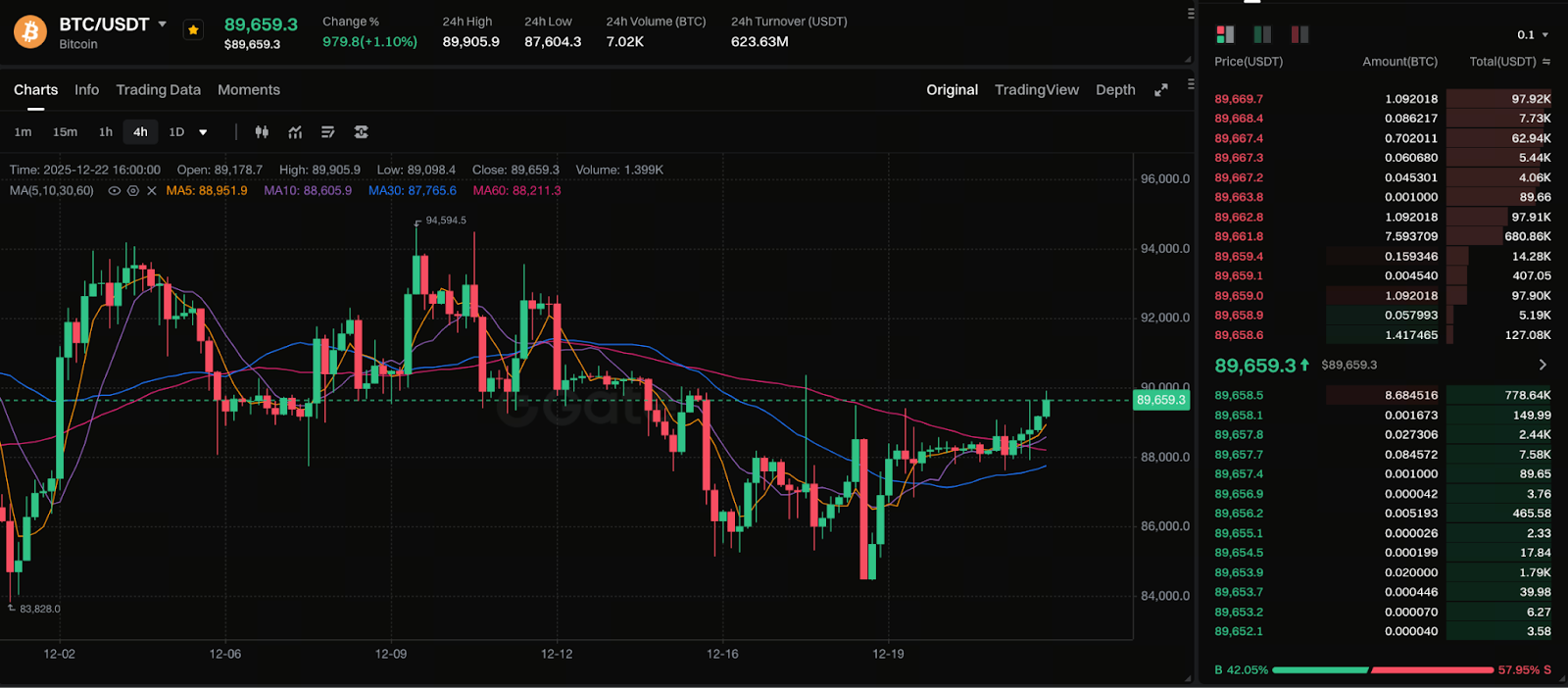

Chart: https://www.gate.com/trade/BTC_USDT

Psychologically, $70,000 is a significant round-number milestone. From a technical perspective, this zone has seen heavy trading volume. If Bitcoin decisively breaks below this level, it could trigger stop-losses or trend-following strategies, amplifying short-term volatility.

When analysts warn that Bitcoin may “dump below $70K,” they are not making a definitive prediction. Instead, they highlight that a break of this level could shift the market structure.

Potential Scenarios Amid Bull-Bear Divergence

Importantly, the market is not universally bearish. Some analysts believe the impact of Japan’s policy shift is already priced in, and that other major economies may take a more gradual approach, providing support for Bitcoin.

In this environment, Bitcoin is more likely to see wide-ranging volatility rather than a one-way decline. The ongoing battle between bulls and bears will focus on macro data and policy expectations.

Key Risk Factors for Investors

At this stage, investors should prioritize risk management over directional bets, focusing on:

  • The pace of macro policy changes
  • Decisive breakouts or breakdowns at key price levels
  • Potential chain reactions from leveraged positions during heightened volatility

In summary, “Bitcoin will dump below $70K thanks to hawkish Japan” is a risk scenario analysis, not a certainty. Understanding this framework can help investors make more rational decisions in times of uncertainty.

Author: Max
Disclaimer
* The information is not intended to be and does not constitute financial advice or any other recommendation of any sort offered or endorsed by Gate.
* This article may not be reproduced, transmitted or copied without referencing Gate. Contravention is an infringement of Copyright Act and may be subject to legal action.

Related Articles

AI-Native Settlement Layers: How United Stables Is Building the Next Financial Rail
Beginner

AI-Native Settlement Layers: How United Stables Is Building the Next Financial Rail

Stablecoins were originally designed as dollar substitutes within exchanges, primarily used for asset pricing and trade settlement. As on-chain financial ecosystems have matured, their role has expanded beyond simple payments to include collateral assets, cross-chain liquidity mediums, and unified settlement units. In particular, as AI systems and automated agents begin to participate directly in economic activity, demand has risen sharply for programmable value units capable of instant settlement. This shift is pushing stablecoins toward the role of foundational financial infrastructure.
2026-03-25 03:16:17
DePIN Identity Network and Real World Applications: How Humanity Protocol Brings on-chain Identity Into the Physical World
Beginner

DePIN Identity Network and Real World Applications: How Humanity Protocol Brings on-chain Identity Into the Physical World

Most Web3 identity systems remain confined to on-chain environments and struggle to achieve meaningful adoption in real world settings. Through a DePIN architecture and physical verification hardware, Humanity Protocol aims to bring decentralized identity into access control systems, hospitality, public services, and offline events, allowing on-chain identity to function not just as a digital credential, but as foundational infrastructure for real world access.
2026-03-25 07:40:53
The ve(3,3) Flywheel Explained: How AERO Tokenomics Powers Aerodrome’s DeFi Economy
Beginner

The ve(3,3) Flywheel Explained: How AERO Tokenomics Powers Aerodrome’s DeFi Economy

In the competition for DeFi liquidity, high-inflation mining alone is no longer enough to build lasting advantages. Aerodrome applies the ve(3,3) economic model to redesign token emissions, voting mechanisms, and revenue distribution, creating a liquidity flywheel centered on governance and cash flow. This article examines AERO tokenomics, the veAERO locking mechanism, and protocol revenue models to explain how Aerodrome builds a sustainable DeFi economic system.
2026-03-25 06:41:58
Aerodrome Tokenomics: How ve(3,3) Powers Base's Most Profitable DEX
Beginner

Aerodrome Tokenomics: How ve(3,3) Powers Base's Most Profitable DEX

AERO is the native token of Aerodrome Finance, a core decentralized exchange and liquidity protocol in the Base ecosystem. It is primarily used for liquidity incentives and ecosystem operations. veAERO is a governance NFT that users receive by locking AERO, representing both voting power and the right to share protocol revenue. Through a dual track structure of AERO as a utility token and veAERO as a governance credential, Aerodrome separates liquidity usage value from long term governance power, allowing participants to act as liquidity providers, governance decision makers, and revenue sharers within the same system.
2026-03-25 06:40:31
Aster vs Hyperliquid: Which Perp DEX Will Prevail?
Beginner

Aster vs Hyperliquid: Which Perp DEX Will Prevail?

Aster and Hyperliquid are the two representative protocols of the "purpose-built L1 path" within the current decentralized perpetual exchange (Perp DEX) sector. As a pioneer in the field, Hyperliquid has built a deep liquidity moat through its highly mature order book architecture and strong community consensus. Conversely, Aster, as a rising challenger, seeks to leapfrog the competition in high-performance trading through more aggressive multi-chain aggregation logic, private transaction modules, and an underlying execution environment optimized for 2026 market demands.
2026-03-24 11:58:33
Gold Price Forecast for the Next Five Years: 2026–2030 Trend Outlook and Investment Implications, Could It Reach $6,000?
Beginner

Gold Price Forecast for the Next Five Years: 2026–2030 Trend Outlook and Investment Implications, Could It Reach $6,000?

Analyze current gold price trends alongside authoritative five-year forecasts, integrating an evaluation of market risks and opportunities. This gives investors insight into the potential trajectory of gold prices and the main drivers expected to shape the market over the next five years.
2026-03-25 18:13:30





