Is Bitcoin Entering a “Long Winter”? Analyzing the Current Market Cycle Through OG Commentary and On-Chain Capital Flows

Last Updated 2026-03-25 02:08:26
Reading Time: 1m
As BTC undergoes a period of volatile correction, OG-linked accounts have made "long winter" remarks, and significant BTC and ETH inflows to exchanges are fueling apprehension. Is the market heading into a crypto winter? This article delivers an objective analysis from the perspectives of price structure, on-chain data, and the broader macro environment.

Why Did the OG’s “Long Winter” Remark Trigger Market Volatility?

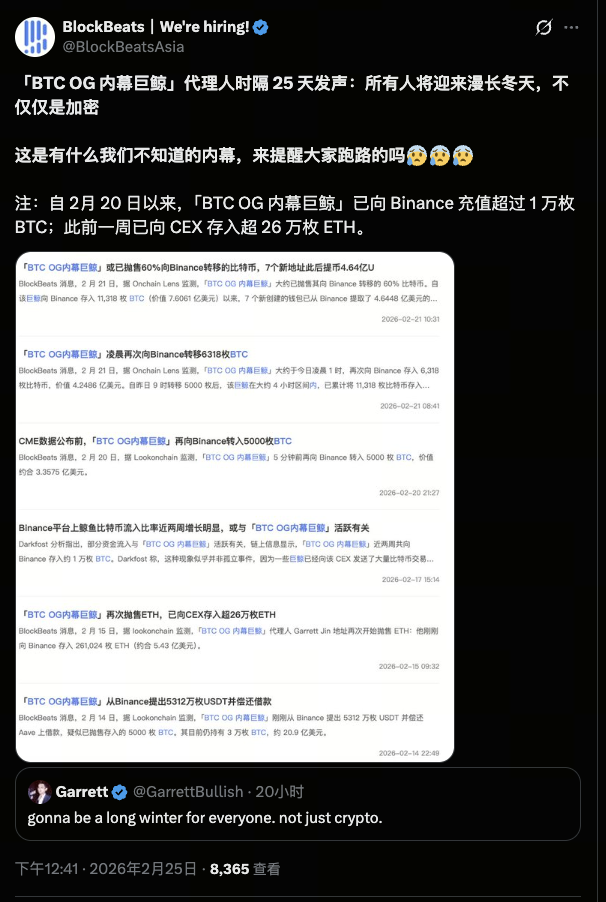
On February 24, 2026, X platform user GarrettBullish posted: “gonna be a long winter for everyone. not just crypto.”

Some market participants have linked this account to a so-called “BTC OG insider whale.” Combined with previous on-chain data showing the associated address consistently transferring large amounts of BTC and ETH to exchanges, the post was quickly interpreted as a pessimistic signal for the market outlook.
OG “漫长寒冬”发言为何引发市场震荡
Source: https://x.com/BlockBeatsAsia/status/2026517945778843949

Media outlets then circulated the post and added the following details:

  • Since February 20, the associated address has deposited over 10,000 BTC to Binance
  • More than 260,000 ETH were deposited to centralized exchanges in the previous week

The combination of these comments and capital flows intensified market anxiety.

However, it is crucial to note:

  • A tweet does not dictate market trends
  • Correlation does not equal actual control
  • Transferring assets to an exchange does not mean a sale has occurred

Heightened sentiment does not equate to structural confirmation.

Do Large Whale Deposits to Exchanges Signal Imminent Selling Pressure?

On-chain data shows a clear uptick in large address transfers to exchanges recently.

Typically, assets moved to exchanges may indicate:

  1. Preparation for spot selling
  2. Collateral for derivatives trading
  3. Hedging or structured strategies
  4. OTC settlements

A genuine crypto winter is usually marked by sustained net inflows over several months, rather than short-term, concentrated transfers.

Current data points more toward “potentially rising selling pressure,” but has not yet produced persistent, structural sell pressure.

BTC Price Structure: Temporary Correction or Trend Reversal?
BTC 当前价格结构:阶段性调整还是趋势反转
Source: https://www.gate.com/trade/BTC_USDT

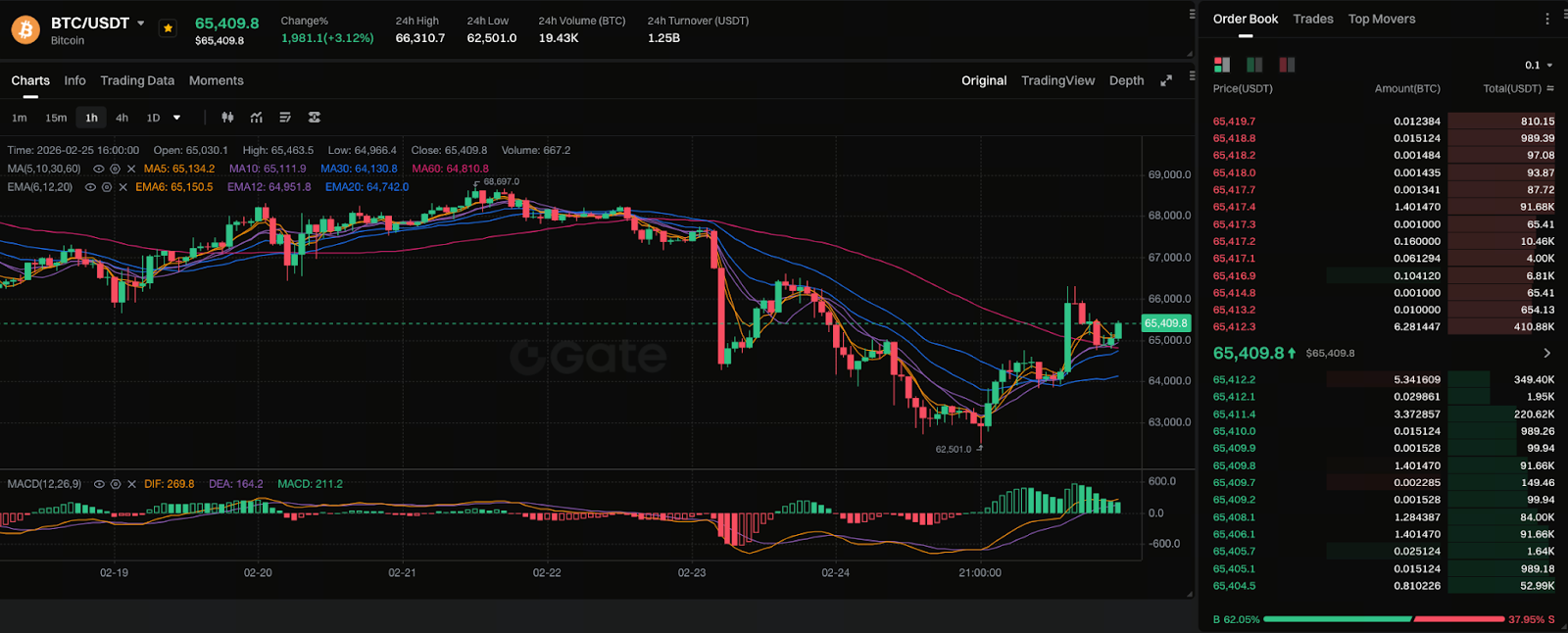
As of February 25, 2026, BTC was trading at approximately $65,400. Technically, BTC is currently exhibiting:

  • A pullback from recent highs
  • Increased volatility
  • No effective breach of long-term key support

Past crypto winters (such as 2018 and 2022) typically involved:

  • Deep corrections of 60%–80%
  • Breakdown of monthly trend structure
  • Weak rebounds and continued new lows
  • Prolonged declines in trading volume

At present, there are no clear signs of a long-term trend breakdown—this phase more closely resembles a post-rally correction.

Exchange Reserve Changes and Long-Term Holder Behavior

Key indicators for identifying a crypto winter include:

  • Whether exchange reserves are continuously rising
  • Whether long-term holders are engaging in concentrated selling
  • Whether on-chain activity is consistently declining
  • Whether liquidity is contracting significantly

While exchange balances have seen a short-term increase, long-term holders have not exhibited large-scale panic selling.

The actions of a single whale are insufficient to determine the overall market trajectory.

Macro Environment’s Impact on the Crypto Market

The OG’s post referenced “not just crypto,” suggesting his outlook may encompass the broader risk asset landscape.

The current macro environment is characterized by:

  • Global risk appetite remains cautious
  • Liquidity has not entered a clear easing cycle
  • Funding costs are still relatively high

As high-volatility risk assets, cryptocurrencies typically experience turbulence and corrections during periods of macroeconomic uncertainty.

However, macro risks have not yet escalated into a systemic crisis.

Classic Crypto Winter: Key Characteristics Compared

A true crypto winter generally displays the following features:

IndicatorHistorical Crypto WinterCurrent Situation
Drawdown60%–80%Not at extreme levels
Trend StructureMonthly breakdownNot yet confirmed
Capital FlowsSustained net inflows to exchangesNot yet sustained
Industry FundamentalsMajor blowups and funding gapsNo systemic events

Based on this comparison, the current situation is more akin to a “cycle cooldown” than a “systemic bear market.”

Conclusion: Market Cooling, Not Yet Frozen

The OG’s “long winter” comment heightened market sentiment at a sensitive time, and the large-scale transfer data quickly spread pessimistic expectations.

Yet, from a data-driven standpoint:

  • There is no confirmation of long-term trend breakdown
  • No persistent structural selling pressure
  • No systemic industry risk has emerged

The market is more likely experiencing a phase of risk repricing, deleveraging, or sentiment cooling within the cycle.

Whether a true crypto winter is beginning will depend on:

  • Whether key long-term support levels are breached
  • Whether net inflows to exchanges become sustained
  • Whether macro liquidity tightens further

Until a structural trend reversal is confirmed, rational analysis and risk management are more important than emotional reactions.

Author: Max
Disclaimer
* The information is not intended to be and does not constitute financial advice or any other recommendation of any sort offered or endorsed by Gate.
* This article may not be reproduced, transmitted or copied without referencing Gate. Contravention is an infringement of Copyright Act and may be subject to legal action.

Related Articles

AI-Native Settlement Layers: How United Stables Is Building the Next Financial Rail
Beginner

AI-Native Settlement Layers: How United Stables Is Building the Next Financial Rail

Stablecoins were originally designed as dollar substitutes within exchanges, primarily used for asset pricing and trade settlement. As on-chain financial ecosystems have matured, their role has expanded beyond simple payments to include collateral assets, cross-chain liquidity mediums, and unified settlement units. In particular, as AI systems and automated agents begin to participate directly in economic activity, demand has risen sharply for programmable value units capable of instant settlement. This shift is pushing stablecoins toward the role of foundational financial infrastructure.
2026-03-25 03:16:17
DePIN Identity Network and Real World Applications: How Humanity Protocol Brings on-chain Identity Into the Physical World
Beginner

DePIN Identity Network and Real World Applications: How Humanity Protocol Brings on-chain Identity Into the Physical World

Most Web3 identity systems remain confined to on-chain environments and struggle to achieve meaningful adoption in real world settings. Through a DePIN architecture and physical verification hardware, Humanity Protocol aims to bring decentralized identity into access control systems, hospitality, public services, and offline events, allowing on-chain identity to function not just as a digital credential, but as foundational infrastructure for real world access.
2026-03-25 07:40:53
Gold Price Forecast for the Next Five Years: 2026–2030 Trend Outlook and Investment Implications, Could It Reach $6,000?
Beginner

Gold Price Forecast for the Next Five Years: 2026–2030 Trend Outlook and Investment Implications, Could It Reach $6,000?

Analyze current gold price trends alongside authoritative five-year forecasts, integrating an evaluation of market risks and opportunities. This gives investors insight into the potential trajectory of gold prices and the main drivers expected to shape the market over the next five years.
2026-03-25 18:13:30
Aster vs Hyperliquid: Which Perp DEX Will Prevail?
Beginner

Aster vs Hyperliquid: Which Perp DEX Will Prevail?

Aster and Hyperliquid are the two representative protocols of the "purpose-built L1 path" within the current decentralized perpetual exchange (Perp DEX) sector. As a pioneer in the field, Hyperliquid has built a deep liquidity moat through its highly mature order book architecture and strong community consensus. Conversely, Aster, as a rising challenger, seeks to leapfrog the competition in high-performance trading through more aggressive multi-chain aggregation logic, private transaction modules, and an underlying execution environment optimized for 2026 market demands.
2026-03-24 11:58:33
Aerodrome Tokenomics: How ve(3,3) Powers Base's Most Profitable DEX
Beginner

Aerodrome Tokenomics: How ve(3,3) Powers Base's Most Profitable DEX

AERO is the native token of Aerodrome Finance, a core decentralized exchange and liquidity protocol in the Base ecosystem. It is primarily used for liquidity incentives and ecosystem operations. veAERO is a governance NFT that users receive by locking AERO, representing both voting power and the right to share protocol revenue. Through a dual track structure of AERO as a utility token and veAERO as a governance credential, Aerodrome separates liquidity usage value from long term governance power, allowing participants to act as liquidity providers, governance decision makers, and revenue sharers within the same system.
2026-03-25 06:40:31
The ve(3,3) Flywheel Explained: How AERO Tokenomics Powers Aerodrome’s DeFi Economy
Beginner

The ve(3,3) Flywheel Explained: How AERO Tokenomics Powers Aerodrome’s DeFi Economy

In the competition for DeFi liquidity, high-inflation mining alone is no longer enough to build lasting advantages. Aerodrome applies the ve(3,3) economic model to redesign token emissions, voting mechanisms, and revenue distribution, creating a liquidity flywheel centered on governance and cash flow. This article examines AERO tokenomics, the veAERO locking mechanism, and protocol revenue models to explain how Aerodrome builds a sustainable DeFi economic system.
2026-03-25 06:41:58





