In-Depth Analysis of Gate ETF Leveraged Tokens: Understanding the Mechanism Matters More Than Chasing Returns

Last Updated 2026-03-26 07:52:18
Reading Time: 1m
Gate ETF leveraged tokens serve as a crypto leverage tool designed for trend trading. This article offers a comprehensive analysis of how Gate ETF leveraged tokens actually work, examining aspects such as product mechanisms, risk factors, and usage logic. Our goal is to help traders make more informed decisions when using this product in highly volatile markets.

ETF Leveraged Tokens Are Not Just “Magnified Spot”
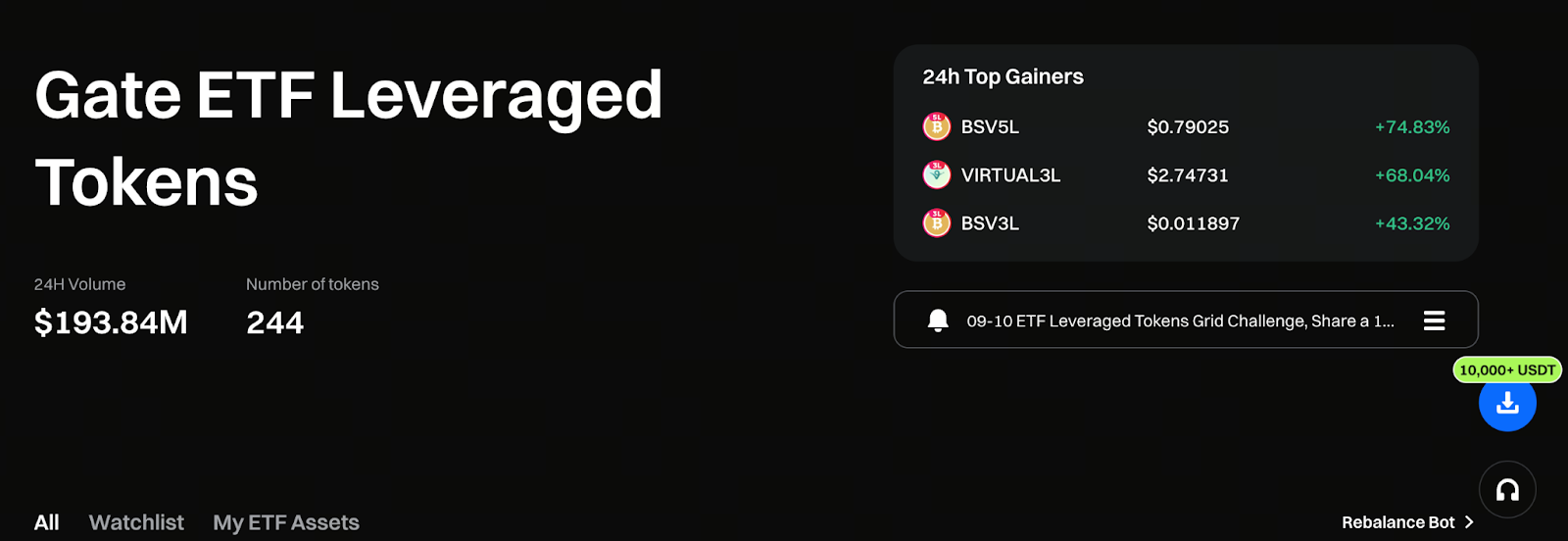

Image source: https://www.gate.com/leveraged-etf

Many traders, when first introduced to Gate ETF Leveraged Tokens, mistakenly believe these products simply multiply price movements. In fact, their underlying mechanisms are far more complex. The net asset value (NAV) of an ETF Leveraged Token is not derived by directly applying the leverage multiple to the underlying asset’s price change. Instead, the system achieves target leverage through dynamic management of underlying contract positions. As a result, the market’s path directly impacts the final returns.

Recognizing this distinction is the first step to avoiding misuse of these products.

How Does Gate ETF Leveraged Token Manage Risk Exposure?

The primary risk control for Gate ETF Leveraged Tokens is not forced liquidation, but automatic rebalancing to manage position risk.

When volatility causes leverage to drift outside the target range, the system proactively adjusts contract positions to reduce excessive risk. This approach enhances token stability during extreme market conditions and helps avoid the sudden liquidation risks common in traditional contracts.

However, rebalancing comes at a cost, which is a central trade-off when using ETF Leveraged Tokens.

Why Are Choppy Markets Challenging for ETF Leveraged Tokens?

In clear trending markets, the rebalancing mechanism of ETF Leveraged Tokens typically enhances returns. In contrast, during sideways or highly volatile markets, this mechanism can erode NAV.

When prices oscillate within a range, the token repeatedly rebalances its positions. This buy-high, sell-low effect can gradually diminish NAV. For this reason, ETF Leveraged Tokens are not ideal for prolonged sideways markets.

Therefore, identifying whether the market has a clear trend is more critical than selecting a specific leverage multiple.

What Trading Strategies Suit Gate ETF Leveraged Tokens?

Practically, Gate ETF Leveraged Tokens work best with the following trading approaches:

  • Enter after the trend is confirmed, not before
  • Favor short- or medium-term holding periods
  • Exit promptly when the trend shows signs of ending

This approach emphasizes following the prevailing trend rather than repeatedly trading minor fluctuations. For traders who prefer frequent buy-high, sell-low strategies, ETF Leveraged Tokens may not be the optimal choice.

How Does the Mindset Differ Between Gate ETF Leveraged Tokens and Contract Trading?

With ETF Leveraged Tokens, the focus shifts from “position management” to “timing and direction management.”

In contract trading, traders primarily focus on leverage ratios, margin requirements, and liquidation prices.

For ETF Leveraged Tokens, the key questions are:

  • Is there a clear trend?
  • Has the market entered an acceleration phase?
  • Is it the right time to exit?

This shift in perspective makes ETF Leveraged Tokens more of a “strategy execution tool.”

Risks and Costs of Long-Term Holding

Although Gate ETF Leveraged Tokens can exist indefinitely, they are not designed for long-term holding. Ongoing management fees and rebalancing losses in sideways markets can make passive, long-term holding without a clear strategy suboptimal.

For traders, the more prudent approach is to use these tokens during well-defined trends and close positions when the trend ends, rather than allocating them as a permanent part of an investment portfolio.

How to Set Proper Expectations for ETF Leveraged Tokens?

Setting realistic expectations is more important than any trading technique. ETF Leveraged Tokens are not designed to deliver stable returns, nor are they “automatic profit products” that eliminate the need for directional judgment.

They are specialized tools that perform best in specific market conditions, provided users understand the rules and are prepared to accept the risks of incorrect market calls.

Conclusion

The true value of Gate ETF Leveraged Tokens lies not in leverage itself, but in how they simplify trend trading execution. Once you grasp the interplay between rebalancing mechanisms, market conditions, and holding periods, you’ll see that using the right tool at the right time is more effective than simply seeking higher leverage. This is the core purpose of ETF Leveraged Tokens.

Author: Max
Disclaimer
* The information is not intended to be and does not constitute financial advice or any other recommendation of any sort offered or endorsed by Gate.
* This article may not be reproduced, transmitted or copied without referencing Gate. Contravention is an infringement of Copyright Act and may be subject to legal action.

Related Articles

AI-Native Settlement Layers: How United Stables Is Building the Next Financial Rail
Beginner

AI-Native Settlement Layers: How United Stables Is Building the Next Financial Rail

Stablecoins were originally designed as dollar substitutes within exchanges, primarily used for asset pricing and trade settlement. As on-chain financial ecosystems have matured, their role has expanded beyond simple payments to include collateral assets, cross-chain liquidity mediums, and unified settlement units. In particular, as AI systems and automated agents begin to participate directly in economic activity, demand has risen sharply for programmable value units capable of instant settlement. This shift is pushing stablecoins toward the role of foundational financial infrastructure.
2026-03-25 03:16:17
DePIN Identity Network and Real World Applications: How Humanity Protocol Brings on-chain Identity Into the Physical World
Beginner

DePIN Identity Network and Real World Applications: How Humanity Protocol Brings on-chain Identity Into the Physical World

Most Web3 identity systems remain confined to on-chain environments and struggle to achieve meaningful adoption in real world settings. Through a DePIN architecture and physical verification hardware, Humanity Protocol aims to bring decentralized identity into access control systems, hospitality, public services, and offline events, allowing on-chain identity to function not just as a digital credential, but as foundational infrastructure for real world access.
2026-03-25 07:40:53
The ve(3,3) Flywheel Explained: How AERO Tokenomics Powers Aerodrome’s DeFi Economy
Beginner

The ve(3,3) Flywheel Explained: How AERO Tokenomics Powers Aerodrome’s DeFi Economy

In the competition for DeFi liquidity, high-inflation mining alone is no longer enough to build lasting advantages. Aerodrome applies the ve(3,3) economic model to redesign token emissions, voting mechanisms, and revenue distribution, creating a liquidity flywheel centered on governance and cash flow. This article examines AERO tokenomics, the veAERO locking mechanism, and protocol revenue models to explain how Aerodrome builds a sustainable DeFi economic system.
2026-03-25 06:41:58
Aerodrome Tokenomics: How ve(3,3) Powers Base's Most Profitable DEX
Beginner

Aerodrome Tokenomics: How ve(3,3) Powers Base's Most Profitable DEX

AERO is the native token of Aerodrome Finance, a core decentralized exchange and liquidity protocol in the Base ecosystem. It is primarily used for liquidity incentives and ecosystem operations. veAERO is a governance NFT that users receive by locking AERO, representing both voting power and the right to share protocol revenue. Through a dual track structure of AERO as a utility token and veAERO as a governance credential, Aerodrome separates liquidity usage value from long term governance power, allowing participants to act as liquidity providers, governance decision makers, and revenue sharers within the same system.
2026-03-25 06:40:31
Aster vs Hyperliquid: Which Perp DEX Will Prevail?
Beginner

Aster vs Hyperliquid: Which Perp DEX Will Prevail?

Aster and Hyperliquid are the two representative protocols of the "purpose-built L1 path" within the current decentralized perpetual exchange (Perp DEX) sector. As a pioneer in the field, Hyperliquid has built a deep liquidity moat through its highly mature order book architecture and strong community consensus. Conversely, Aster, as a rising challenger, seeks to leapfrog the competition in high-performance trading through more aggressive multi-chain aggregation logic, private transaction modules, and an underlying execution environment optimized for 2026 market demands.
2026-03-24 11:58:33
Gold Price Forecast for the Next Five Years: 2026–2030 Trend Outlook and Investment Implications, Could It Reach $6,000?
Beginner

Gold Price Forecast for the Next Five Years: 2026–2030 Trend Outlook and Investment Implications, Could It Reach $6,000?

Analyze current gold price trends alongside authoritative five-year forecasts, integrating an evaluation of market risks and opportunities. This gives investors insight into the potential trajectory of gold prices and the main drivers expected to shape the market over the next five years.
2026-03-25 18:13:30





