How to Implement Risk Control in Futures Trading: A Detailed Guide Using Gate Exchange

Beginner
Quick Reads
Last Updated 2026-03-26 17:27:24
Reading Time: 1m
The essence of contract trading lies not only in generating profits but in mastering risk management. This article uses Gate as a case study to systematically analyze the critical risk control modules within contract trading functions. It aims to help newcomers understand how contract systems limit losses, manage positions, and foster a more rational trading strategy.

Why Risk Management Is the Core of Contract Trading

Among all trading methods, contract trading demands the highest level of risk management. This is because contract trading inherently includes:

  • Trading with margin instead of full capital
  • Rapid profit and loss fluctuations
  • Leverage amplifies price movements

Without a thorough understanding of risk, even the most sophisticated platform features can’t ensure long-term survival.

Sources of Risk in Contract Trading

Risk in contract trading doesn’t just come from misjudging market direction. More often, it results from improper use of platform features:

  • Using excessive leverage, resulting in insufficient margin
  • Taking on positions larger than the account can handle
  • Not understanding liquidation rules
  • Failing to set stop-loss orders

Thus, the features themselves are not the root of risk—misuse is.

Gate Contract Trading: Margin and Risk Ratio Mechanisms
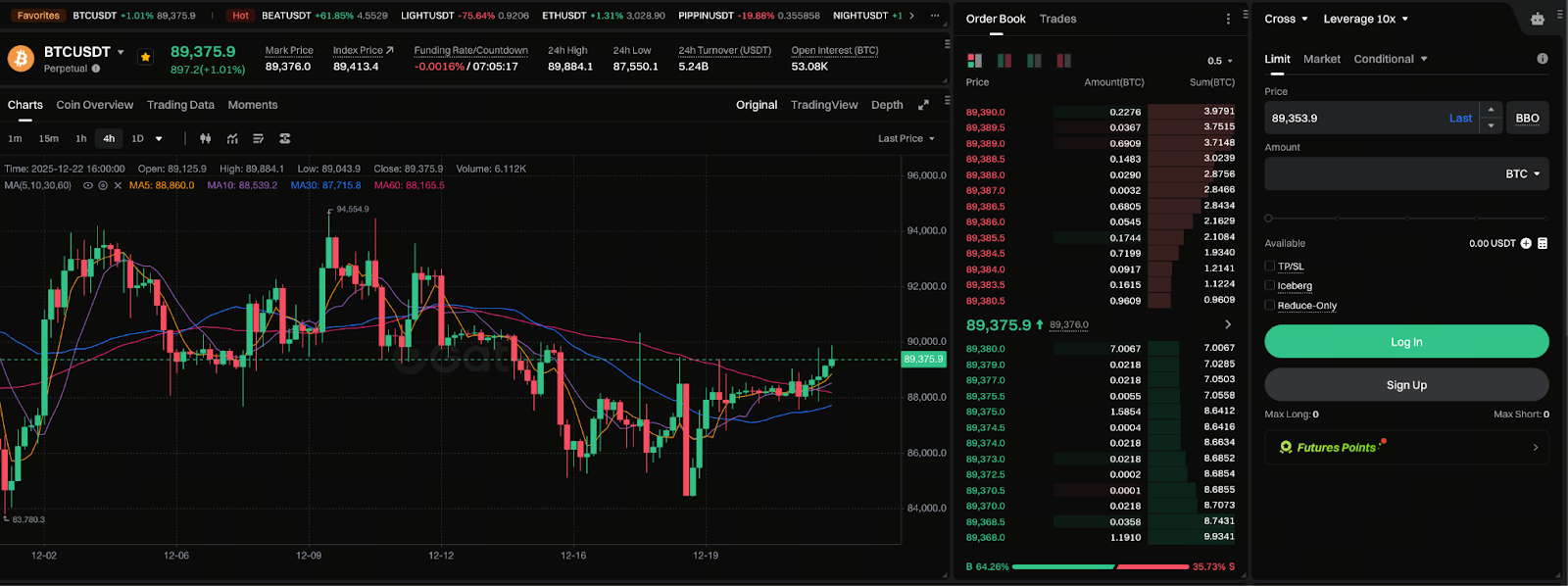

Figure: https://www.gate.com/futures/USDT/BTC_USDT

In Gate’s contract trading system, the risk ratio is a key metric. It measures how close an account or position is to forced liquidation. The risk ratio is influenced by:

  • Position size
  • Current unrealized P&L
  • Leverage multiplier
  • Margin balance

By providing real-time risk ratio data, Gate turns abstract risk into actionable insights, enabling users to adjust their positions promptly.

The Role of Forced Liquidation in Contract Trading Systems

Many new traders misunderstand forced liquidation, thinking it’s an arbitrary platform action. In reality, forced liquidation is one of the most fundamental safeguards in contract trading.

Its primary purposes are to:

  • Prevent negative account balances
  • Protect overall market integrity
  • Ensure stable operation of the contract system

Understanding the forced liquidation mechanism is an essential step in mastering contract trading.

How Take-Profit and Stop-Loss Orders Reduce Trading Risk

In Gate’s contract trading, take-profit and stop-loss orders are not optional extras—they are integral to every position.

Their value lies in:

  • Capping the maximum loss per trade
  • Preventing emotional decision-making
  • Automatically executing strategies during volatile markets

For new traders, setting stop-loss orders before targeting profits is a critical habit for managing risk in contract trading.

Position Tiers: Differences Between Isolated and Cross Margin Modes

Gate offers both isolated and cross margin modes, each with distinct approaches to risk management:

  • Isolated Margin: Risk is limited to a single position, making it ideal for beginners
  • Cross Margin: Multiple positions share margin, increasing capital efficiency

Understanding these differences helps users choose the trading mode that matches their risk tolerance.

How Beginners Can Use Platform Features Instead of Intuition

The riskiest behavior in contract trading is relying solely on personal instinct. Seasoned traders, on the other hand, rely on platform features:

  • Monitoring the risk ratio to determine when to reduce positions
  • Assessing risk boundaries with the liquidation price
  • Securing outcomes with take-profit and stop-loss orders

The real value of Gate’s contract trading features is in turning complex risks into manageable parameters.

Conclusion: True Risk Control Comes from Understanding the Features

Contract trading isn’t a game for the reckless. Instead, it rewards those who respect the rules, understand the system, and use platform features effectively.

On mature platforms like Gate, contract trading features already address most risk management needs. The key is learning to use these features properly, not trying to outsmart the market itself.

Author: Max
Disclaimer
* The information is not intended to be and does not constitute financial advice or any other recommendation of any sort offered or endorsed by Gate.
* This article may not be reproduced, transmitted or copied without referencing Gate. Contravention is an infringement of Copyright Act and may be subject to legal action.

Related Articles

AI-Native Settlement Layers: How United Stables Is Building the Next Financial Rail
Beginner

AI-Native Settlement Layers: How United Stables Is Building the Next Financial Rail

Stablecoins were originally designed as dollar substitutes within exchanges, primarily used for asset pricing and trade settlement. As on-chain financial ecosystems have matured, their role has expanded beyond simple payments to include collateral assets, cross-chain liquidity mediums, and unified settlement units. In particular, as AI systems and automated agents begin to participate directly in economic activity, demand has risen sharply for programmable value units capable of instant settlement. This shift is pushing stablecoins toward the role of foundational financial infrastructure.
2026-03-25 03:16:17
DePIN Identity Network and Real World Applications: How Humanity Protocol Brings on-chain Identity Into the Physical World
Beginner

DePIN Identity Network and Real World Applications: How Humanity Protocol Brings on-chain Identity Into the Physical World

Most Web3 identity systems remain confined to on-chain environments and struggle to achieve meaningful adoption in real world settings. Through a DePIN architecture and physical verification hardware, Humanity Protocol aims to bring decentralized identity into access control systems, hospitality, public services, and offline events, allowing on-chain identity to function not just as a digital credential, but as foundational infrastructure for real world access.
2026-03-25 07:40:53
The ve(3,3) Flywheel Explained: How AERO Tokenomics Powers Aerodrome’s DeFi Economy
Beginner

The ve(3,3) Flywheel Explained: How AERO Tokenomics Powers Aerodrome’s DeFi Economy

In the competition for DeFi liquidity, high-inflation mining alone is no longer enough to build lasting advantages. Aerodrome applies the ve(3,3) economic model to redesign token emissions, voting mechanisms, and revenue distribution, creating a liquidity flywheel centered on governance and cash flow. This article examines AERO tokenomics, the veAERO locking mechanism, and protocol revenue models to explain how Aerodrome builds a sustainable DeFi economic system.
2026-03-25 06:41:58
Aerodrome Tokenomics: How ve(3,3) Powers Base's Most Profitable DEX
Beginner

Aerodrome Tokenomics: How ve(3,3) Powers Base's Most Profitable DEX

AERO is the native token of Aerodrome Finance, a core decentralized exchange and liquidity protocol in the Base ecosystem. It is primarily used for liquidity incentives and ecosystem operations. veAERO is a governance NFT that users receive by locking AERO, representing both voting power and the right to share protocol revenue. Through a dual track structure of AERO as a utility token and veAERO as a governance credential, Aerodrome separates liquidity usage value from long term governance power, allowing participants to act as liquidity providers, governance decision makers, and revenue sharers within the same system.
2026-03-25 06:40:31
Aster vs Hyperliquid: Which Perp DEX Will Prevail?
Beginner

Aster vs Hyperliquid: Which Perp DEX Will Prevail?

Aster and Hyperliquid are the two representative protocols of the "purpose-built L1 path" within the current decentralized perpetual exchange (Perp DEX) sector. As a pioneer in the field, Hyperliquid has built a deep liquidity moat through its highly mature order book architecture and strong community consensus. Conversely, Aster, as a rising challenger, seeks to leapfrog the competition in high-performance trading through more aggressive multi-chain aggregation logic, private transaction modules, and an underlying execution environment optimized for 2026 market demands.
2026-03-24 11:58:33
Gold Price Forecast for the Next Five Years: 2026–2030 Trend Outlook and Investment Implications, Could It Reach $6,000?
Beginner

Gold Price Forecast for the Next Five Years: 2026–2030 Trend Outlook and Investment Implications, Could It Reach $6,000?

Analyze current gold price trends alongside authoritative five-year forecasts, integrating an evaluation of market risks and opportunities. This gives investors insight into the potential trajectory of gold prices and the main drivers expected to shape the market over the next five years.
2026-03-25 18:13:30





