WLFI, short for World Liberty Financial, has emerged as one of the most debated and closely followed DeFi projects in today’s crypto landscape. Developed by the World Liberty Financial team and reportedly linked to the current U.S. President and members of his family, the project blends governance tokens, multi chain financial infrastructure, and stablecoin integration to position itself as an open, community driven financial ecosystem. Since its token became freely tradable in late 2025, WLFI has attracted substantial market attention. It has attracted strong capital interest while also drawing significant criticism and regulatory scrutiny. This article offers a clear, objective examination of WLFI’s operational structure and core mechanisms, helping readers understand how the system is designed to function.
The Overall Operational Framework of the WLFI Project
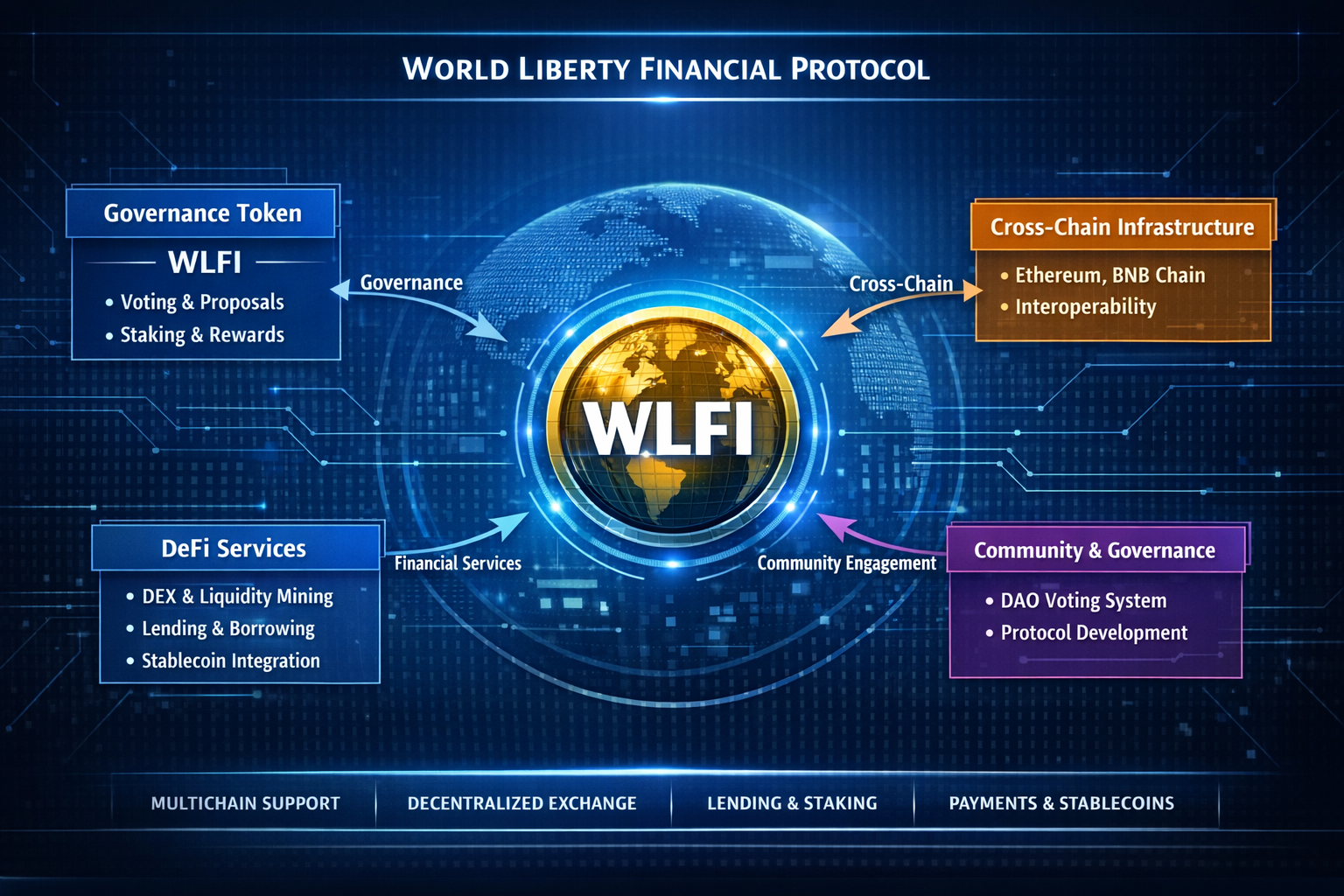
From a structural perspective, WLFI is not just a standalone token. It is part of a broader financial ecosystem built around the World Liberty Financial protocol. WLFI serves as the protocol’s governance and utility token, acting as the central hub within a wider network of assets, smart contracts, and governance processes. The framework can be divided into several core modules:
- Governance token WLFI: Token holders have the right to propose and vote on protocol level decisions. It functions as the primary vehicle for project governance.
- Ecosystem infrastructure: The protocol operates across multiple blockchains, including Ethereum and BNB Chain, enabling cross chain interoperability and scalability.
- Financial service modules: These include decentralized trading, liquidity mining, lending, payment integration, and connections to stablecoin systems.
- Community and governance mechanisms: WLFI holders participate in on chain governance to approve protocol updates and strategic adjustments.
This layered structure means WLFI’s operations extend beyond the token itself. Instead, it aims to establish foundational infrastructure for future DeFi applications and on chain financial services.
How the Core Mechanisms Drive Value
At its core, WLFI is not merely a tradable asset. It functions as an ecosystem token anchored in decentralized governance and collective consensus. Its value circulation model is reflected in several key mechanisms:
Governance and community consensus
WLFI holders can participate in on chain voting related to roadmap updates, treasury allocation, and protocol parameter adjustments. Governance rights directly influence the protocol’s long term development and incentive structure.
Rewards and incentive design
The protocol distributes rewards through liquidity mining and staking programs to encourage participation and maintain ecosystem growth. During certain phases, users can lock or stake WLFI to earn additional returns.
Multi chain scalability
WLFI is designed to support multiple major blockchains, facilitating cross chain asset transfers and broader DeFi integration.
Cross domain asset interaction
In addition to decentralized exchanges and DeFi protocols, WLFI intends to integrate with stablecoin frameworks and elements of traditional payment systems, positioning itself as a cross sector financial tool.
In summary, value within the WLFI ecosystem is driven not only by market supply and demand, but also by user engagement, governance efficiency, and the diversity of on chain applications.
The Roles of Users and Ecosystem Participants
Within the WLFI ecosystem, different participants contribute to consensus formation and value creation in distinct ways:
General participants or investors
Individuals who hold WLFI tokens can stake assets, provide liquidity, and participate in governance votes to share in ecosystem incentives.
Governance participants
Large token holders or representative groups with greater voting weight may submit formal proposals or influence major strategic decisions.
Liquidity providers
By supplying trading pairs or participating in lending markets, liquidity providers earn transaction fees and reward incentives while enhancing overall market liquidity.
Protocol operators and auditors
This group includes smart contract developers, audit teams, and ecosystem partners who help ensure the protocol’s security, performance, and scalability.
Together, these participants form the operational backbone that sustains WLFI’s ecosystem and long term development.
How the Platform Facilitates Capital and Asset Flows
Capital movement within WLFI relies on several interconnected mechanisms:
- Trading and market circulation: WLFI can be traded on decentralized exchanges such as Uniswap and on centralized platforms such as Binance.us, allowing price discovery and broader liquidity.
- Liquidity pools and automated market makers: The protocol supports AMM (Automated Market Maker) based liquidity pools, where users deposit assets to earn fees and rewards.
- Staking and lending: Through staking contracts, assets can be locked to generate yield, and cross chain lending features expand capital efficiency within the ecosystem.
- Internal treasury management: The protocol may maintain funds or insurance mechanisms to support liquidity incentives, token buybacks and burns, or ecosystem development initiatives.
How WLFI Differs from Traditional Finance and Pure DeFi Models
| Comparison Dimension |
Traditional Finance (TradFi) |
Typical DeFi Projects |
WLFI Model |
| Core Control Entity |
Banks, financial institutions, regulatory authorities |
Smart contracts and DAOs |
Protocol team plus WLFI governance token holders |
| Governance Model |
Centralized decision making, such as boards and executive management |
On chain governance through DAO voting |
Primarily on chain governance, though governance power was relatively concentrated in the early stages |
| Asset Custody |
Third party custody, such as banks or brokerages |
User self custody via personal wallets |
User self custody, with certain mechanisms dependent on protocol smart contracts |
| Trading and Settlement |
T+1 or T+2 settlement cycles with relatively complex procedures |
Real time on chain settlement |
On chain settlement with cross chain and multi protocol coordination |
| Access Threshold |
Clear KYC requirements and geographic restrictions |
Permissionless, no prior approval required |
Largely permissionless, though subject to heightened policy scrutiny |
| Transparency |
Limited financial disclosures and information asymmetry |
On chain data is publicly verifiable |
Core contracts are transparent, though governance structure and affiliations attract scrutiny |
| Sources of Yield |
Interest rate spreads, service fees, financial product returns |
Trading fees, mining incentives, protocol revenue |
Trading fees, staking rewards, and ecosystem incentive mechanisms |
| Risk Bearing |
Many risks covered by institutions or insurance frameworks |
Users bear smart contract and protocol risks themselves |
Users bear on chain risks, alongside potential governance concentration risks |
| Regulatory Profile |
Strong regulation with mature compliance systems |
Regulatory boundaries remain unclear |
Positioned between TradFi and DeFi, with compliance pathways still evolving |
| Speed of Innovation |
Relatively slow |
Rapid, with frequent iteration |
Faster than traditional finance, but influenced by public opinion and regulatory pressure |
| Market Drivers |
Macroeconomic conditions and policy interest rates |
Market sentiment and on chain liquidity |
Market sentiment, policy discourse, and governance structure |
Mechanically, WLFI is neither a traditional financial product nor a fully decentralized DeFi protocol. In terms of asset self custody, on-chain settlement, and token based incentives, it closely resembles DeFi. However, its governance structure, branding influence, and regulatory positioning introduce elements of “partial centralization” and real world financial integration. This hybrid model may increase visibility and institutional interest, but it also introduces a more complex risk profile.
Current Development Status and Key Milestones
As of early 2026, WLFI has passed through several important stages:
- 2024 token issuance: WLFI raised hundreds of millions of dollars through a presale, attracting large scale investment.
- 2025 mainnet launch: WLFI officially went live on the Ethereum mainnet and became tradable on several exchanges.
- Governance token transferability: Following a community vote, WLFI tokens transitioned from non transferable to tradable status.
- Exchange listings and liquidity expansion: Multiple mainstream exchanges opened WLFI trading pairs, increasing market liquidity.
Potential Challenges Facing the WLFI Mechanism
In practice, WLFI faces several notable challenges:
Security and vulnerability risks
Reports have indicated that WLFI experienced security incidents involving token freezes or reallocations. Although the team attributed the issue to third party vulnerabilities rather than flaws in its smart contracts, investor concerns have increased.
Governance concentration
On-chain data suggests that a small number of wallets control a significant share of governance power, raising concerns that nominally “democratic” governance could result in “centralized decision making”.
Regulatory and political scrutiny
Given its reported connections to political figures, the project faces dual pressure from regulators and public opinion.
Market skepticism and criticism
Some community members view WLFI as “speculative” or “high risk”, prompting calls for greater transparency and clearer risk disclosures.
Future Mechanism Upgrades and Development Directions
Looking ahead, WLFI may evolve in several ways:
- More refined decentralized governance: Introducing more granular governance frameworks and mechanisms to reduce the influence of large holders could help balance ecosystem participation.
- Expanded cross chain integration: Supporting additional mainnets and Layer2 networks would broaden asset mobility and application deployment.
- Regulatory alignment: Engaging with traditional regulatory frameworks, such as exploring trust licenses, could strengthen compliance for stablecoins and related assets.
- Deeper ecosystem product development: Expanding financial tools, including derivatives, payment solutions, and lending markets, may enhance WLFI’s practical financial utility.
In the long run, whether WLFI can transition from a high profile project to a sustainable financial protocol will depend on how effectively it decentralizes governance, scales across chains, and implements meaningful compliance mechanisms.







