1. What Is Gate for AI?
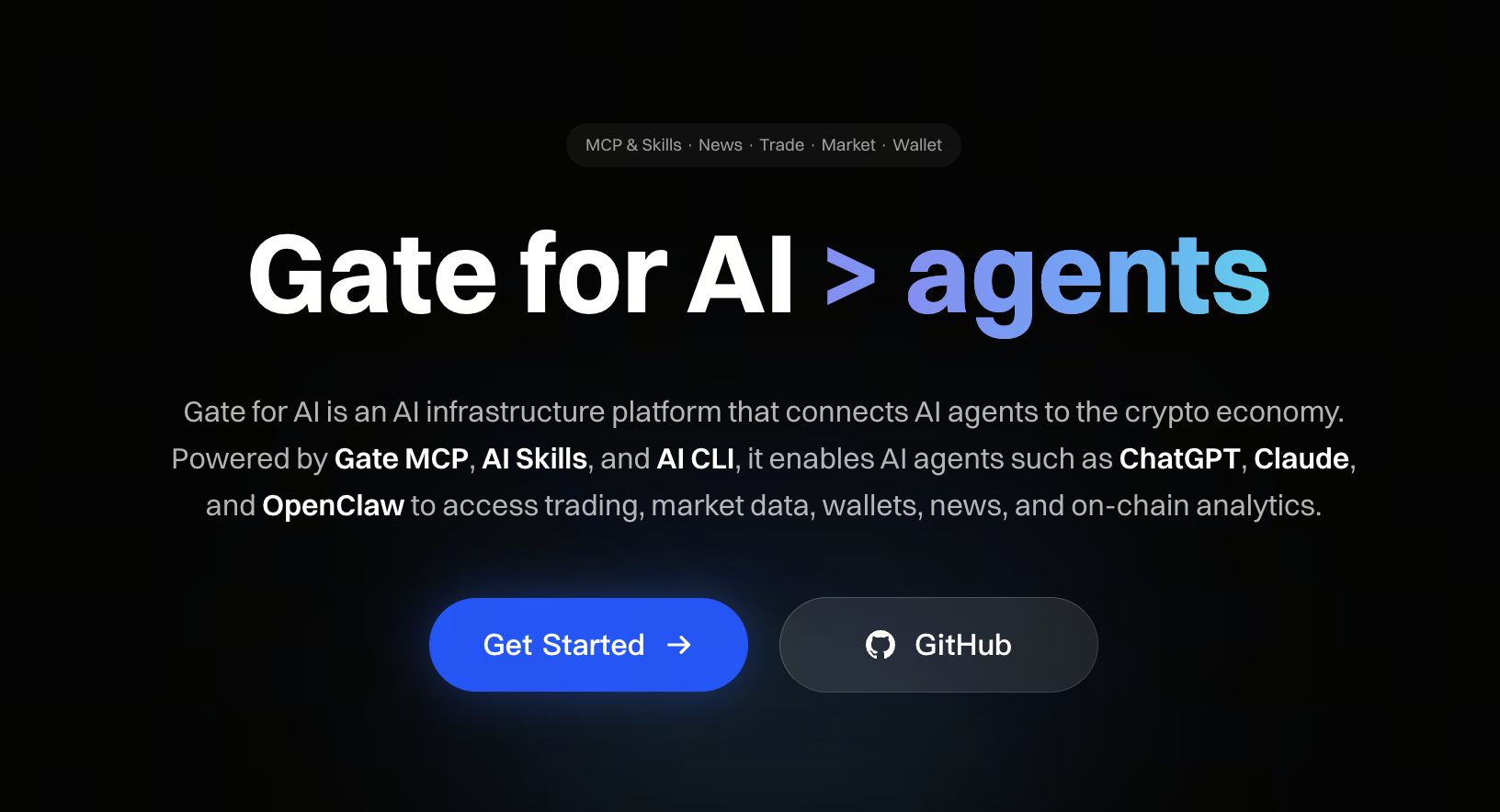 Image Source: Gate for AI Official Website
Gate for AI is a next-generation intelligent trading infrastructure developed by Gate, designed to elevate the exchange’s core capabilities from a “user interface product” to an “AI-accessible infrastructure layer.” Far more than a trading tool, Gate for AI seamlessly integrates five key domains—centralized exchange (CEX), on-chain trading (DEX), wallet interaction, real-time information, and on-chain data—empowering AI agents to perform comprehensive market research, strategy evaluation, trade execution, and monitoring. This enables a fully automated process from data analysis to decision-making and execution.
2. The Five Core Domains of Gate for AI
-
Full CEX Capability Access: Gate for AI offers complete integration with Gate’s core trading products, including spot, futures, wealth management, and token launches, enabling AI to participate directly in live market trading. Leveraging a robust matching engine, AI can execute precise orders and implement sophisticated trading strategies.
-
On-Chain DEX Trading Capability: Beyond CEX trading, Gate for AI incorporates on-chain trading capabilities, allowing AI to execute swaps, perpetual contracts, and meme coin trades on decentralized exchanges (DEX), fully tapping into the liquidity and depth of decentralized markets.
-
Wallet and Signature System: Gate for AI supports wallet creation, private key management, and on-chain authorization. With user consent, AI can automatically conduct on-chain transactions such as asset transfers and contract execution, delivering a secure and seamless on-chain experience.
-
Real-Time Information and Sentiment Data System: AI can access and process real-time market intelligence in addition to executing trades. Gate for AI provides structured market news and event analysis, significantly enhancing AI’s ability to respond to market developments. This ensures rapid, intelligent decision-making in volatile environments.
-
Comprehensive On-Chain Data Query: Gate for AI integrates a powerful on-chain data query system, enabling users and AI to deeply analyze token, project, and address data. With extensive data support, AI can conduct in-depth market analysis, generate strategy reports, and execute targeted actions.
3. Skills Hub: Effortless, Code-Free Trading Strategy Configuration
A standout innovation of Gate for AI is the Skills Hub, a dedicated module for configuring pre-arranged trading strategies for AI agents. Skills Hub allows users and developers to equip AI with a wide range of trading skills—such as market scanning, entry range evaluation, arbitrage detection, and risk analysis—without writing a single line of code. This empowers AI to both analyze market data and participate in trade execution based on strategic logic.
Skills Hub’s main advantage is its modular approach to complex trading strategies, enabling users to combine different skills through an intuitive interface and build comprehensive trading logic. This modular design lets users quickly adapt strategies to their needs while maintaining the simplicity of no-code configuration. AI can then autonomously complete the full trading cycle—research, evaluation, execution, and monitoring—based on these preset strategies, achieving true automation.
In practice, Skills Hub enables AI to continuously monitor market dynamics. For instance, when an ETH liquidation signal is detected, AI assesses short-term price volatility for arbitrage opportunities and, with user authorization, automatically opens futures positions and sets stop-losses. If funding rates deviate from the norm, AI can coordinate spot and futures markets to execute arbitrage strategies.
Users can also issue natural language commands directly to AI, such as “analyze whether it’s a good time to build a BTC position.” AI will generate a structured report based on real-time market conditions, liquidity, and risk, and execute trades immediately upon user confirmation.
4. MCP + Skills: Dual-Layer Capability Architecture
Gate for AI employs a dual-layer architecture—MCP (standardized tool interface) and Skills (advanced strategy modules). MCP delivers a broad suite of foundational interfaces, including market data, account management, order execution, and on-chain data queries, facilitating rapid integration with various AI systems. The Skills layer encapsulates advanced capabilities, integrating multiple data sources and logic models into strategy modules that enable AI to perform complex tasks such as arbitrage analysis, risk assessment, and strategy generation.
This dual-layer approach provides Gate for AI with both broad market compatibility and deep technical sophistication, supporting everything from basic operations to advanced strategic execution.
5. Industry Impact and Future Development of Gate for AI
The launch of Gate for AI signifies a major leap in the intelligent evolution of crypto trading platforms. By seamlessly integrating five core capabilities and lowering the entry barrier through Skills Hub, Gate for AI not only enhances trading efficiency but also expands the possibilities for AI applications in financial markets. The platform evolves from a mere trading tool to a smart infrastructure layer, allowing AI to play a central role in market decision-making and trade execution.
Looking ahead, Gate plans to further optimize Skills Hub, introduce more advanced strategy modules, and accelerate innovation in intelligent trading tools. Gate for AI will continue to drive the crypto market toward greater efficiency and automation, delivering a smarter, more streamlined trading experience for users.







