Gate ETF Leveraged Tokens Explained: A Smart Trading Tool for Maximizing Gains in Trending Markets

Last Updated 2026-03-26 22:01:01
Reading Time: 4m
As crypto market volatility intensifies, Gate ETF leveraged tokens have become a prominent trading tool in trending markets. This article offers a comprehensive analysis of the mechanism, advantages, and use cases of Gate ETF leveraged tokens, enabling investors to understand how to magnify market returns without the need for margin.


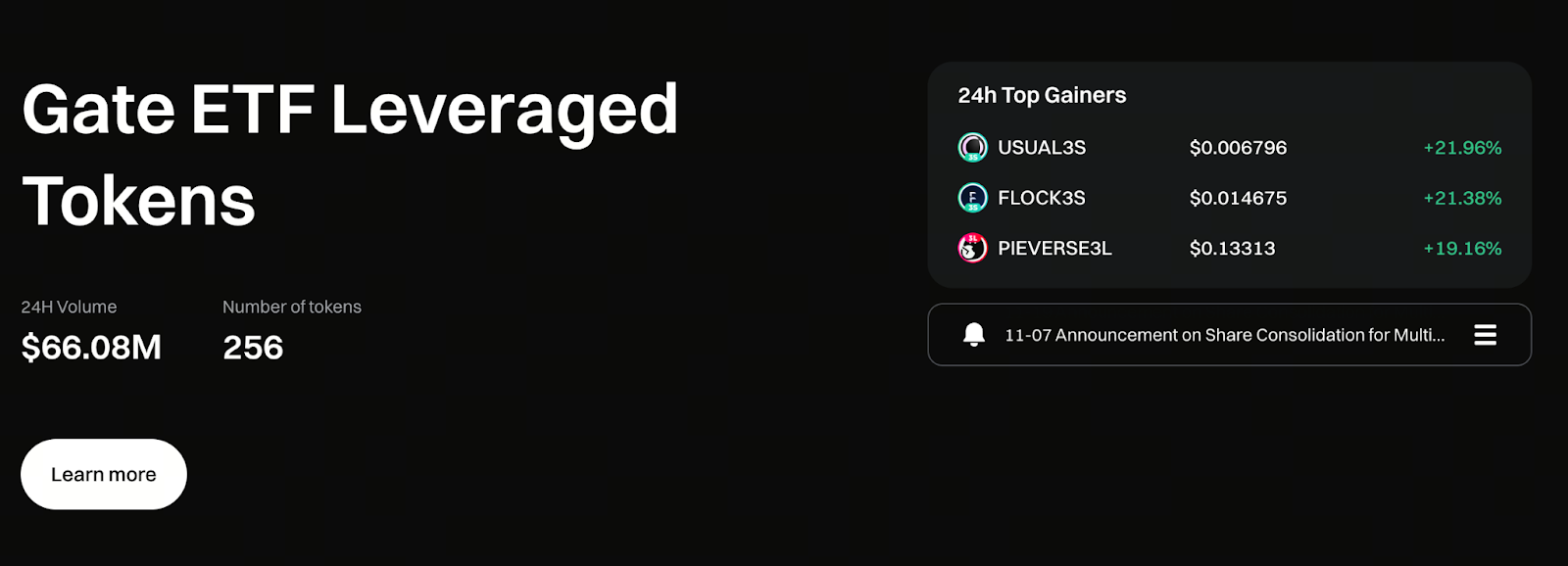
Image: https://www.gate.com/leveraged-etf

Why Are More Traders Focusing on Gate ETF Leveraged Tokens?

As the cryptocurrency market matures, investors have shifted their focus from simply asking "Can I trade?" to prioritizing efficiency and risk management. In this context, Gate's ETF leveraged tokens have emerged as a preferred choice for trend traders.

Unlike traditional contract trading, ETF leveraged tokens serve as structured leverage instruments, bundling complex contract mechanisms into directly tradable tokens. This approach enables everyday users to participate in highly volatile markets.

Particularly during strong uptrends or downtrends, the leverage effect of Gate ETF leveraged tokens makes them a core component of many short-term and swing trading strategies.

What Are Gate ETF Leveraged Tokens?

Gate ETF leveraged tokens are tokenized products that track the price movements of crypto assets while automatically maintaining a fixed leverage ratio.

  • For example, BTC3L provides 3x long exposure to Bitcoin's price;
  • When Bitcoin rises, BTC3L's net asset value changes by approximately three times the rate of Bitcoin's movement;
  • If Bitcoin falls, the corresponding BTC3S (3x short) may generate returns.

All leveraged exposure is automatically managed by the platform through perpetual contracts, so users do not need to engage in contract trading directly.

How Do ETF Leveraged Tokens Implement a "No Forced Liquidation" Mechanism?

This is one of the most frequently cited advantages of Gate ETF leveraged tokens. In traditional contract trading, sharp price swings can trigger forced liquidations. ETF leveraged tokens, however, use an automatic rebalancing mechanism that dynamically adjusts contract positions as prices fluctuate, ensuring the tokens maintain their target leverage ratio.

This means:

  • No margin calls
  • No forced liquidations
  • The user's maximum loss is limited to their initial investment

This structure significantly reduces the "uncontrollable risk" associated with leveraged trading and better aligns with the risk tolerance of mainstream investors.

Compounding Effect of ETF Leveraged Tokens in Trending Markets

In strong trending markets, Gate ETF leveraged tokens exhibit a pronounced compounding effect. As the market continues to rise or fall, leveraged tokens accumulate returns based on daily net asset value changes, often resulting in total gains that exceed simple multiple calculations.

This is why ETF leveraged tokens are often called "amplifiers in trending markets."

However, this compounding effect is most effective in clear trends and is significantly diminished in sideways or highly volatile markets.

Which Trading Scenarios Are Best for Gate ETF Leveraged Tokens?

Gate ETF leveraged tokens are not a "one-size-fits-all" solution, but they offer distinct advantages in certain scenarios.

They are most suitable for:

  • Clear market direction, with a strong uptrend or downtrend
  • Desire to amplify returns without trading contracts
  • Preference to avoid liquidation risk
  • Short-term or medium-term swing trading

In choppy markets, frequent price swings can erode net asset value, so holding these tokens long-term without a clear strategy is not recommended.

Management Fees and Risk Awareness: Key Points Before Investing

While Gate ETF leveraged tokens are easy to access, they are not free of cost.

These tokens typically charge a daily management fee to cover contract rebalancing and risk management expenses. This fee is reflected in the net asset value and may impact returns if held long-term.

Additionally, leverage means:

  • Amplified profits
  • Amplified risks

Therefore, prudent position sizing and a clearly defined trading period are essential principles when using ETF leveraged tokens.

The Role of Gate ETF Leveraged Tokens in Today's Market

As crypto ETFs gain recognition within traditional financial systems, the market's understanding of "ETF structure" continues to deepen.

Although Gate ETF leveraged tokens are not traditional securities ETFs, their "ETF-like" product design makes leveraged trading more intuitive and accessible.

With tighter regulations and increasing barriers to contract trading, these products offer traders a more flexible alternative.

Conclusion: Turning Leverage into a Tool, Not a Risk

The core value of Gate ETF leveraged tokens is not to enable "unlimited leverage," but to transform complex leveraged trading into a controllable tool through structured design.

  • In trending markets, they can effectively amplify returns from accurate predictions;
  • For risk management, their no forced liquidation mechanism reduces extreme risk.

When used appropriately, Gate ETF leveraged tokens can be a vital part of a trend trading strategy—serving as a tool for opportunity, not a risk multiplier.

Author: Max
Disclaimer
* The information is not intended to be and does not constitute financial advice or any other recommendation of any sort offered or endorsed by Gate.
* This article may not be reproduced, transmitted or copied without referencing Gate. Contravention is an infringement of Copyright Act and may be subject to legal action.

Share

sign up guide logosign up guide logo
sign up guide content imgsign up guide content img
Sign Up

Related Articles

AI-Native Settlement Layers: How United Stables Is Building the Next Financial Rail
Beginner

AI-Native Settlement Layers: How United Stables Is Building the Next Financial Rail

Stablecoins were originally designed as dollar substitutes within exchanges, primarily used for asset pricing and trade settlement. As on-chain financial ecosystems have matured, their role has expanded beyond simple payments to include collateral assets, cross-chain liquidity mediums, and unified settlement units. In particular, as AI systems and automated agents begin to participate directly in economic activity, demand has risen sharply for programmable value units capable of instant settlement. This shift is pushing stablecoins toward the role of foundational financial infrastructure.
2026-03-25 03:16:17
DePIN Identity Network and Real World Applications: How Humanity Protocol Brings on-chain Identity Into the Physical World
Beginner

DePIN Identity Network and Real World Applications: How Humanity Protocol Brings on-chain Identity Into the Physical World

Most Web3 identity systems remain confined to on-chain environments and struggle to achieve meaningful adoption in real world settings. Through a DePIN architecture and physical verification hardware, Humanity Protocol aims to bring decentralized identity into access control systems, hospitality, public services, and offline events, allowing on-chain identity to function not just as a digital credential, but as foundational infrastructure for real world access.
2026-03-25 07:40:53
The ve(3,3) Flywheel Explained: How AERO Tokenomics Powers Aerodrome’s DeFi Economy
Beginner

The ve(3,3) Flywheel Explained: How AERO Tokenomics Powers Aerodrome’s DeFi Economy

In the competition for DeFi liquidity, high-inflation mining alone is no longer enough to build lasting advantages. Aerodrome applies the ve(3,3) economic model to redesign token emissions, voting mechanisms, and revenue distribution, creating a liquidity flywheel centered on governance and cash flow. This article examines AERO tokenomics, the veAERO locking mechanism, and protocol revenue models to explain how Aerodrome builds a sustainable DeFi economic system.
2026-03-25 06:41:58
Aerodrome Tokenomics: How ve(3,3) Powers Base's Most Profitable DEX
Beginner

Aerodrome Tokenomics: How ve(3,3) Powers Base's Most Profitable DEX

AERO is the native token of Aerodrome Finance, a core decentralized exchange and liquidity protocol in the Base ecosystem. It is primarily used for liquidity incentives and ecosystem operations. veAERO is a governance NFT that users receive by locking AERO, representing both voting power and the right to share protocol revenue. Through a dual track structure of AERO as a utility token and veAERO as a governance credential, Aerodrome separates liquidity usage value from long term governance power, allowing participants to act as liquidity providers, governance decision makers, and revenue sharers within the same system.
2026-03-25 06:40:31
Aster vs Hyperliquid: Which Perp DEX Will Prevail?
Beginner

Aster vs Hyperliquid: Which Perp DEX Will Prevail?

Aster and Hyperliquid are the two representative protocols of the "purpose-built L1 path" within the current decentralized perpetual exchange (Perp DEX) sector. As a pioneer in the field, Hyperliquid has built a deep liquidity moat through its highly mature order book architecture and strong community consensus. Conversely, Aster, as a rising challenger, seeks to leapfrog the competition in high-performance trading through more aggressive multi-chain aggregation logic, private transaction modules, and an underlying execution environment optimized for 2026 market demands.
2026-03-24 11:58:33
Gold Price Forecast for the Next Five Years: 2026–2030 Trend Outlook and Investment Implications, Could It Reach $6,000?
Beginner

Gold Price Forecast for the Next Five Years: 2026–2030 Trend Outlook and Investment Implications, Could It Reach $6,000?

Analyze current gold price trends alongside authoritative five-year forecasts, integrating an evaluation of market risks and opportunities. This gives investors insight into the potential trajectory of gold prices and the main drivers expected to shape the market over the next five years.
2026-03-25 18:13:30





