Gate ETF Leveraged Tokens: A Trend-Based Trading Option Between Spot and Futures

Last Updated 2026-03-26 18:30:24
Reading Time: 1m
Gate ETF leveraged tokens are crypto ETF trading products that eliminate the need for margin and remove liquidation risk. They are designed to magnify gains during market trends. This article explores Gate ETF leveraged tokens in terms of product positioning, operational mechanics, and market applications, highlighting why they serve as a key supplement between spot and futures trading.

Gate ETF Leveraged Tokens: Product Positioning
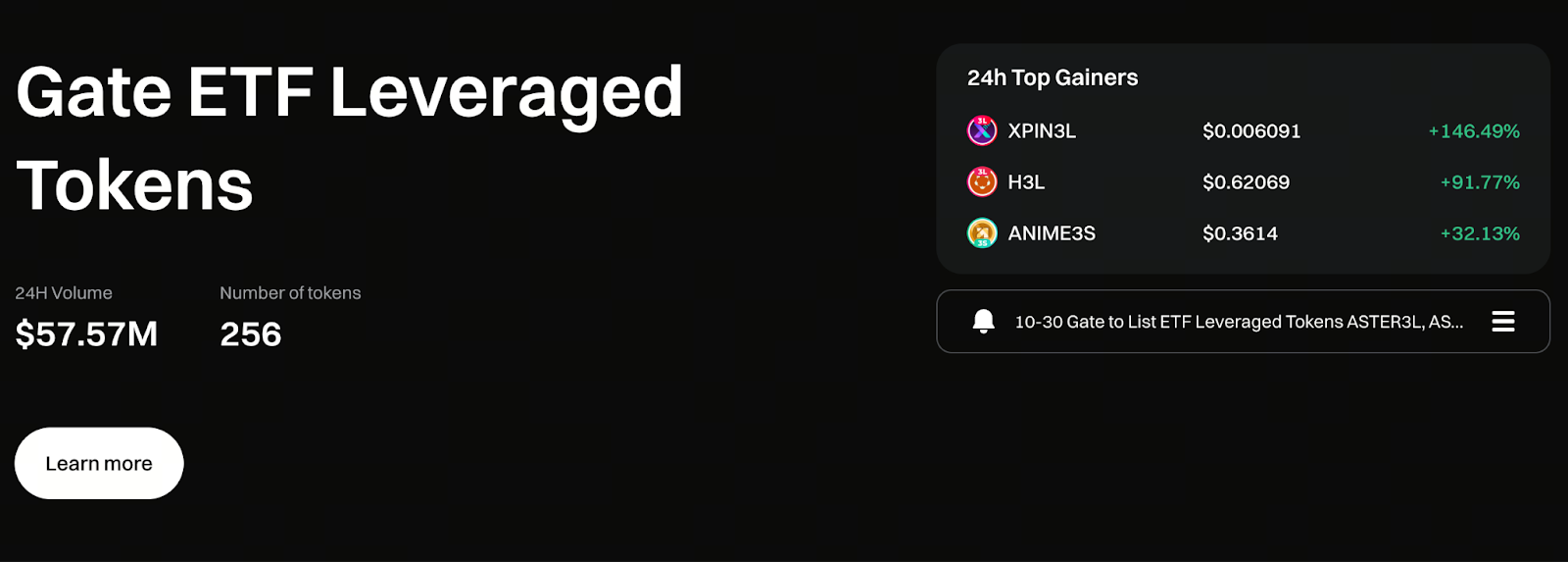

Image: https://www.gate.com/leveraged-etf

Within the crypto trading ecosystem, spot, futures, and options each serve distinct purposes. Yet for most retail traders, these instruments are either inefficient or carry excessive risk and complexity. Gate’s ETF Leveraged Tokens bridge the gap between spot trading and futures contracts.

These tokens are not intended to replace futures. Instead, they deliver a trend-following tool that is more efficient than spot, easier to use than futures, and features a transparent risk structure.

Users don’t need to grasp concepts like margin ratios, liquidation thresholds, or funding rates. They simply determine market direction to participate in leveraged price movements.

ETF-Like Design Philosophy of ETF Leveraged Tokens

Gate ETF Leveraged Tokens are not ETFs in the traditional financial sense. However, their design draws inspiration from several core ETF features:

  • Independent net asset value (NAV) structure
  • Automated position management
  • Investors only need to buy or sell the token directly
  • Complex operations are managed internally

This structure transforms sophisticated leveraged futures strategies into straightforward tokens, sharply lowering the barrier to entry for users.

That’s why many traders consider ETF Leveraged Tokens as “exchange-traded funds for the crypto market.”

How Gate ETF Leveraged Tokens Operate

Each Gate ETF Leveraged Token provides fixed-direction, fixed-multiplier exposure, such as 3x long or 3x short.

When market prices move:

  • The token’s NAV adjusts according to the target leverage ratio
  • The system automatically rebalances underlying positions
  • This maintains stable overall leverage

For users, only two actions matter: buy and sell.

This makes ETF Leveraged Tokens functionally similar to spot trading, rather than traditional derivatives trading.

Why Do ETF Leveraged Tokens Appear “Milder”?

Many first-time users notice that Gate ETF Leveraged Tokens do not trigger extreme risk events as frequently as futures contracts.

This is because:

  • There is no margin requirement
  • No forced liquidation threshold
  • Risk is reflected through changes in NAV

As a result, even during sharp market swings, risk is “gradually reflected” in the token’s price, rather than being abruptly released via forced liquidations.

This design makes ETF Leveraged Tokens psychologically more approachable for everyday traders.

Practical Value of Gate ETF Leveraged Tokens in Trending Markets

Gate ETF Leveraged Tokens perform best in clearly trending markets.

Their advantages stand out in scenarios such as:

  • Accelerated price action following key technical breakouts
  • Sustained moves driven by news or macro events
  • Strong and weak sector rotation dynamics

In these conditions, ETF Leveraged Tokens enable traders to capture larger price swings with fewer trades.

Why Exercise Caution in Sideways Markets?

Unlike trending markets, ETF Leveraged Tokens often underperform during sideways or highly volatile periods.

This is due to:

  • Automated rebalancing causing NAV erosion during repeated reversals
  • Price oscillations may lead to a gradual decline in NAV

Therefore, ETF Leveraged Tokens are best used as trading tools, not long-term holdings.

Typical Usage Scenarios for Gate ETF Leveraged Tokens

In practice, users typically deploy ETF Leveraged Tokens with these strategies:

  • Trend-following after confirmation
  • Short-term swing trading
  • Event-driven market participation
  • Temporary hedging for spot positions

No complex trading systems are required—success depends on accurate market direction calls.

Significance in Today’s Market Environment

As regulatory scrutiny of high-risk derivatives intensifies, more traders are seeking “milder” leveraged trading options.

Gate ETF Leveraged Tokens offer a balanced solution in this context:

  • Preserve leverage efficiency
  • Simplify trading operations
  • Eliminate forced liquidation mechanisms

This gives them enduring relevance in the fast-moving, volatile crypto market.

Conclusion

Gate ETF Leveraged Tokens are not designed for unlimited leverage. Instead, they provide a transparent, easily understood way to participate in trending markets.

  • When the market trend is clear, these tokens are highly effective tools.
  • When markets become choppy, they serve as a reminder to reduce risk exposure.

Understanding product positioning and respecting market conditions are essential for effective use of Gate ETF Leveraged Tokens.

Author: Max
Disclaimer
* The information is not intended to be and does not constitute financial advice or any other recommendation of any sort offered or endorsed by Gate.
* This article may not be reproduced, transmitted or copied without referencing Gate. Contravention is an infringement of Copyright Act and may be subject to legal action.

Related Articles

AI-Native Settlement Layers: How United Stables Is Building the Next Financial Rail
Beginner

AI-Native Settlement Layers: How United Stables Is Building the Next Financial Rail

Stablecoins were originally designed as dollar substitutes within exchanges, primarily used for asset pricing and trade settlement. As on-chain financial ecosystems have matured, their role has expanded beyond simple payments to include collateral assets, cross-chain liquidity mediums, and unified settlement units. In particular, as AI systems and automated agents begin to participate directly in economic activity, demand has risen sharply for programmable value units capable of instant settlement. This shift is pushing stablecoins toward the role of foundational financial infrastructure.
2026-03-25 03:16:17
DePIN Identity Network and Real World Applications: How Humanity Protocol Brings on-chain Identity Into the Physical World
Beginner

DePIN Identity Network and Real World Applications: How Humanity Protocol Brings on-chain Identity Into the Physical World

Most Web3 identity systems remain confined to on-chain environments and struggle to achieve meaningful adoption in real world settings. Through a DePIN architecture and physical verification hardware, Humanity Protocol aims to bring decentralized identity into access control systems, hospitality, public services, and offline events, allowing on-chain identity to function not just as a digital credential, but as foundational infrastructure for real world access.
2026-03-25 07:40:53
Gold Price Forecast for the Next Five Years: 2026–2030 Trend Outlook and Investment Implications, Could It Reach $6,000?
Beginner

Gold Price Forecast for the Next Five Years: 2026–2030 Trend Outlook and Investment Implications, Could It Reach $6,000?

Analyze current gold price trends alongside authoritative five-year forecasts, integrating an evaluation of market risks and opportunities. This gives investors insight into the potential trajectory of gold prices and the main drivers expected to shape the market over the next five years.
2026-03-25 18:13:30
Aster vs Hyperliquid: Which Perp DEX Will Prevail?
Beginner

Aster vs Hyperliquid: Which Perp DEX Will Prevail?

Aster and Hyperliquid are the two representative protocols of the "purpose-built L1 path" within the current decentralized perpetual exchange (Perp DEX) sector. As a pioneer in the field, Hyperliquid has built a deep liquidity moat through its highly mature order book architecture and strong community consensus. Conversely, Aster, as a rising challenger, seeks to leapfrog the competition in high-performance trading through more aggressive multi-chain aggregation logic, private transaction modules, and an underlying execution environment optimized for 2026 market demands.
2026-03-24 11:58:33
Aerodrome Tokenomics: How ve(3,3) Powers Base's Most Profitable DEX
Beginner

Aerodrome Tokenomics: How ve(3,3) Powers Base's Most Profitable DEX

AERO is the native token of Aerodrome Finance, a core decentralized exchange and liquidity protocol in the Base ecosystem. It is primarily used for liquidity incentives and ecosystem operations. veAERO is a governance NFT that users receive by locking AERO, representing both voting power and the right to share protocol revenue. Through a dual track structure of AERO as a utility token and veAERO as a governance credential, Aerodrome separates liquidity usage value from long term governance power, allowing participants to act as liquidity providers, governance decision makers, and revenue sharers within the same system.
2026-03-25 06:40:31
The ve(3,3) Flywheel Explained: How AERO Tokenomics Powers Aerodrome’s DeFi Economy
Beginner

The ve(3,3) Flywheel Explained: How AERO Tokenomics Powers Aerodrome’s DeFi Economy

In the competition for DeFi liquidity, high-inflation mining alone is no longer enough to build lasting advantages. Aerodrome applies the ve(3,3) economic model to redesign token emissions, voting mechanisms, and revenue distribution, creating a liquidity flywheel centered on governance and cash flow. This article examines AERO tokenomics, the veAERO locking mechanism, and protocol revenue models to explain how Aerodrome builds a sustainable DeFi economic system.
2026-03-25 06:41:58





