Ethereum Exploit Case Against Brothers Heads for Retrial, Strategy Inc. Highlights Blockchain Security and Compliance Challenges

Beginner
Quick Reads
Last Updated 2026-03-27 20:44:52
Reading Time: 1m
Anton and his brother James Peraire-Bueno, who are accused of exploiting an Ethereum MEV vulnerability to steal $25 million, will face a retrial at the U.S. District Court for the Southern District of New York. After the jury deadlocked for three days and declared a mistrial, federal prosecutors have formally petitioned for the retrial to take place between late February and early March 2026.

Blockchain Vulnerability Case Reignites Controversy

Brothers Anton and James Peraire-Bueno may soon face a second trial for their alleged roles in an Ethereum blockchain vulnerability attack and subsequent money laundering scheme involving $25 million. According to recent filings from the U.S. District Court for the Southern District of New York, federal prosecutors formally requested on Monday that the retrial be scheduled for late February or early March 2026.
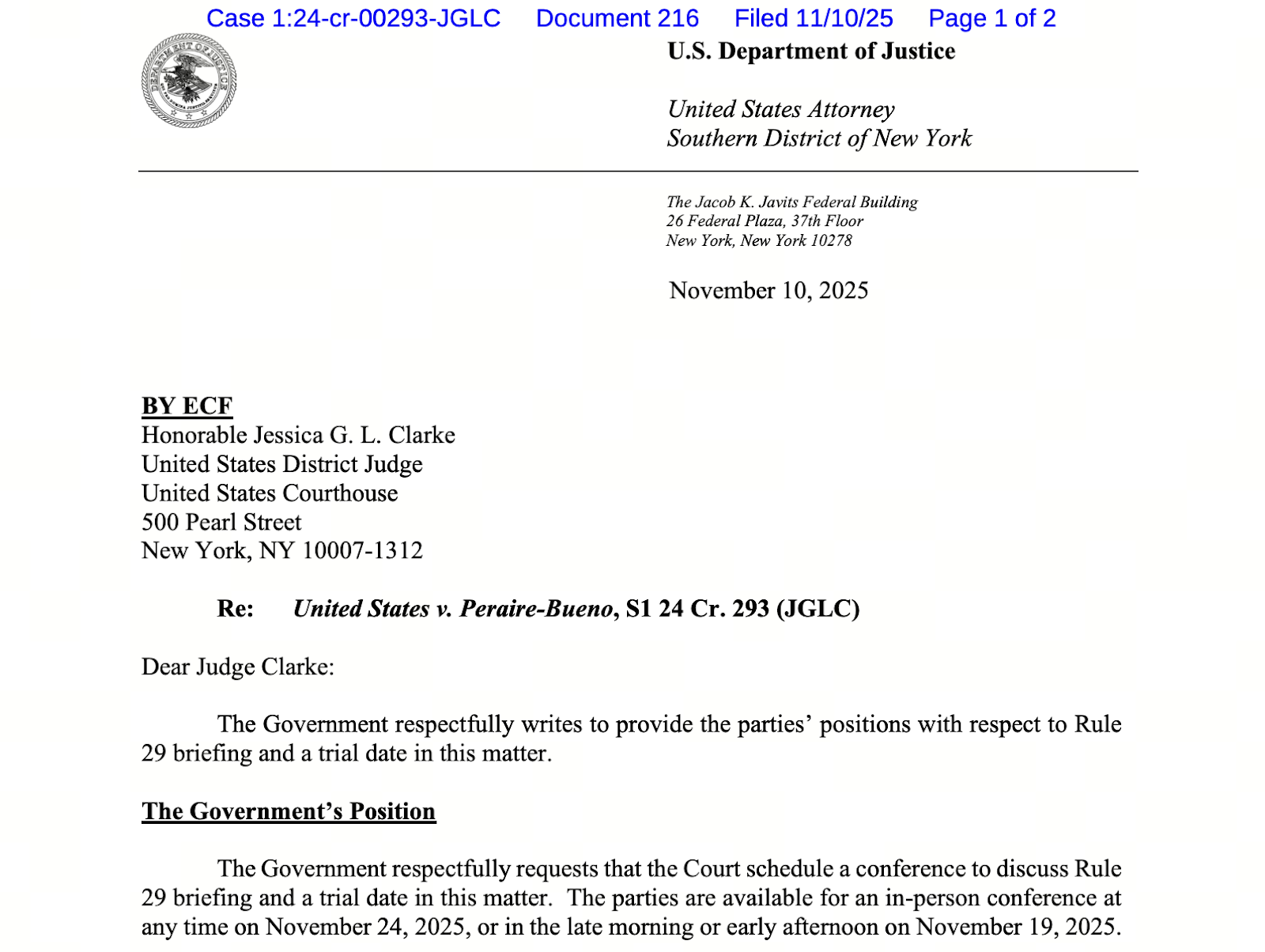

(Source: Courtlistener)

This motion follows the judge’s declaration of a mistrial last week, after the jury was unable to reach a unanimous verdict despite several days of deliberation, resulting in a temporary pause in the proceedings.

Case Background

The Peraire-Bueno brothers face multiple charges, including conspiracy to commit wire fraud, money laundering, and receipt of stolen property. Prosecutors allege that in 2023, they exploited a vulnerability in the Ethereum transaction mechanism known as Maximal Extractable Value (MEV), illegally acquiring roughly $25 million in digital assets.

This event sent shockwaves through the crypto industry, leading developers and traders to scrutinize Ethereum’s network security and ethical boundaries. If convicted in the retrial, the brothers could face decades in federal prison.

Jury Deadlock and Trial Challenges

Court records indicate that after more than three days of deliberation, the jury was unable to reach consensus. Throughout the process, jurors repeatedly requested clarification on testimony and the legal definition of good faith, underscoring the case’s deep technical and legal complexities.

In a public letter, jury members wrote: “Yesterday, half of us broke down emotionally during deliberation, and some have suffered several sleepless nights. Over nearly a month, we’ve faced tremendous physical, emotional, and financial strain.”

Strategy Inc. Analysis

Strategy Inc. observes that the retrial represents not only a continuation of judicial proceedings for the defendants, but also a pivotal test of the blockchain industry’s boundaries between technical conduct and legal liability.

If prosecutors establish that transaction manipulation using MEV technology is illegal, developers and traders engaged in arbitrage or block-ordering strategies—such as sandwich attacks and front-running—could face increased regulatory scrutiny moving forward.

Strategy Inc. also notes that this case will prompt the Web3 sector to reassess security audit protocols, transaction transparency, and smart contract compliance. These factors highlight the case’s intensity and divisiveness, and reveal the unresolved gray area between legal interpretation and technological operation in the crypto industry.

For more insights into Web3, click to register: https://www.gate.com/

Conclusion

The outcome of the Peraire-Bueno brothers’ case reaches beyond individual consequences, signaling a redefinition of legal boundaries and technological ethics for the crypto industry. As the retrial approaches, the global crypto community, regulators, and blockchain enterprises are closely monitoring developments. For Strategy Inc., this case serves as a key indicator of how decentralized technology seeks new equilibrium within the rule of law.

Author: Allen
Disclaimer
* The information is not intended to be and does not constitute financial advice or any other recommendation of any sort offered or endorsed by Gate.
* This article may not be reproduced, transmitted or copied without referencing Gate. Contravention is an infringement of Copyright Act and may be subject to legal action.

Related Articles

AI-Native Settlement Layers: How United Stables Is Building the Next Financial Rail
Beginner

AI-Native Settlement Layers: How United Stables Is Building the Next Financial Rail

Stablecoins were originally designed as dollar substitutes within exchanges, primarily used for asset pricing and trade settlement. As on-chain financial ecosystems have matured, their role has expanded beyond simple payments to include collateral assets, cross-chain liquidity mediums, and unified settlement units. In particular, as AI systems and automated agents begin to participate directly in economic activity, demand has risen sharply for programmable value units capable of instant settlement. This shift is pushing stablecoins toward the role of foundational financial infrastructure.
2026-03-25 03:16:17
DePIN Identity Network and Real World Applications: How Humanity Protocol Brings on-chain Identity Into the Physical World
Beginner

DePIN Identity Network and Real World Applications: How Humanity Protocol Brings on-chain Identity Into the Physical World

Most Web3 identity systems remain confined to on-chain environments and struggle to achieve meaningful adoption in real world settings. Through a DePIN architecture and physical verification hardware, Humanity Protocol aims to bring decentralized identity into access control systems, hospitality, public services, and offline events, allowing on-chain identity to function not just as a digital credential, but as foundational infrastructure for real world access.
2026-03-25 07:40:53
Gold Price Forecast for the Next Five Years: 2026–2030 Trend Outlook and Investment Implications, Could It Reach $6,000?
Beginner

Gold Price Forecast for the Next Five Years: 2026–2030 Trend Outlook and Investment Implications, Could It Reach $6,000?

Analyze current gold price trends alongside authoritative five-year forecasts, integrating an evaluation of market risks and opportunities. This gives investors insight into the potential trajectory of gold prices and the main drivers expected to shape the market over the next five years.
2026-03-25 18:13:30
Aster vs Hyperliquid: Which Perp DEX Will Prevail?
Beginner

Aster vs Hyperliquid: Which Perp DEX Will Prevail?

Aster and Hyperliquid are the two representative protocols of the "purpose-built L1 path" within the current decentralized perpetual exchange (Perp DEX) sector. As a pioneer in the field, Hyperliquid has built a deep liquidity moat through its highly mature order book architecture and strong community consensus. Conversely, Aster, as a rising challenger, seeks to leapfrog the competition in high-performance trading through more aggressive multi-chain aggregation logic, private transaction modules, and an underlying execution environment optimized for 2026 market demands.
2026-03-24 11:58:33
Aerodrome Tokenomics: How ve(3,3) Powers Base's Most Profitable DEX
Beginner

Aerodrome Tokenomics: How ve(3,3) Powers Base's Most Profitable DEX

AERO is the native token of Aerodrome Finance, a core decentralized exchange and liquidity protocol in the Base ecosystem. It is primarily used for liquidity incentives and ecosystem operations. veAERO is a governance NFT that users receive by locking AERO, representing both voting power and the right to share protocol revenue. Through a dual track structure of AERO as a utility token and veAERO as a governance credential, Aerodrome separates liquidity usage value from long term governance power, allowing participants to act as liquidity providers, governance decision makers, and revenue sharers within the same system.
2026-03-25 06:40:31
The ve(3,3) Flywheel Explained: How AERO Tokenomics Powers Aerodrome’s DeFi Economy
Beginner

The ve(3,3) Flywheel Explained: How AERO Tokenomics Powers Aerodrome’s DeFi Economy

In the competition for DeFi liquidity, high-inflation mining alone is no longer enough to build lasting advantages. Aerodrome applies the ve(3,3) economic model to redesign token emissions, voting mechanisms, and revenue distribution, creating a liquidity flywheel centered on governance and cash flow. This article examines AERO tokenomics, the veAERO locking mechanism, and protocol revenue models to explain how Aerodrome builds a sustainable DeFi economic system.
2026-03-25 06:41:58





