Event Overview: Signals from the Strawmap Roadmap
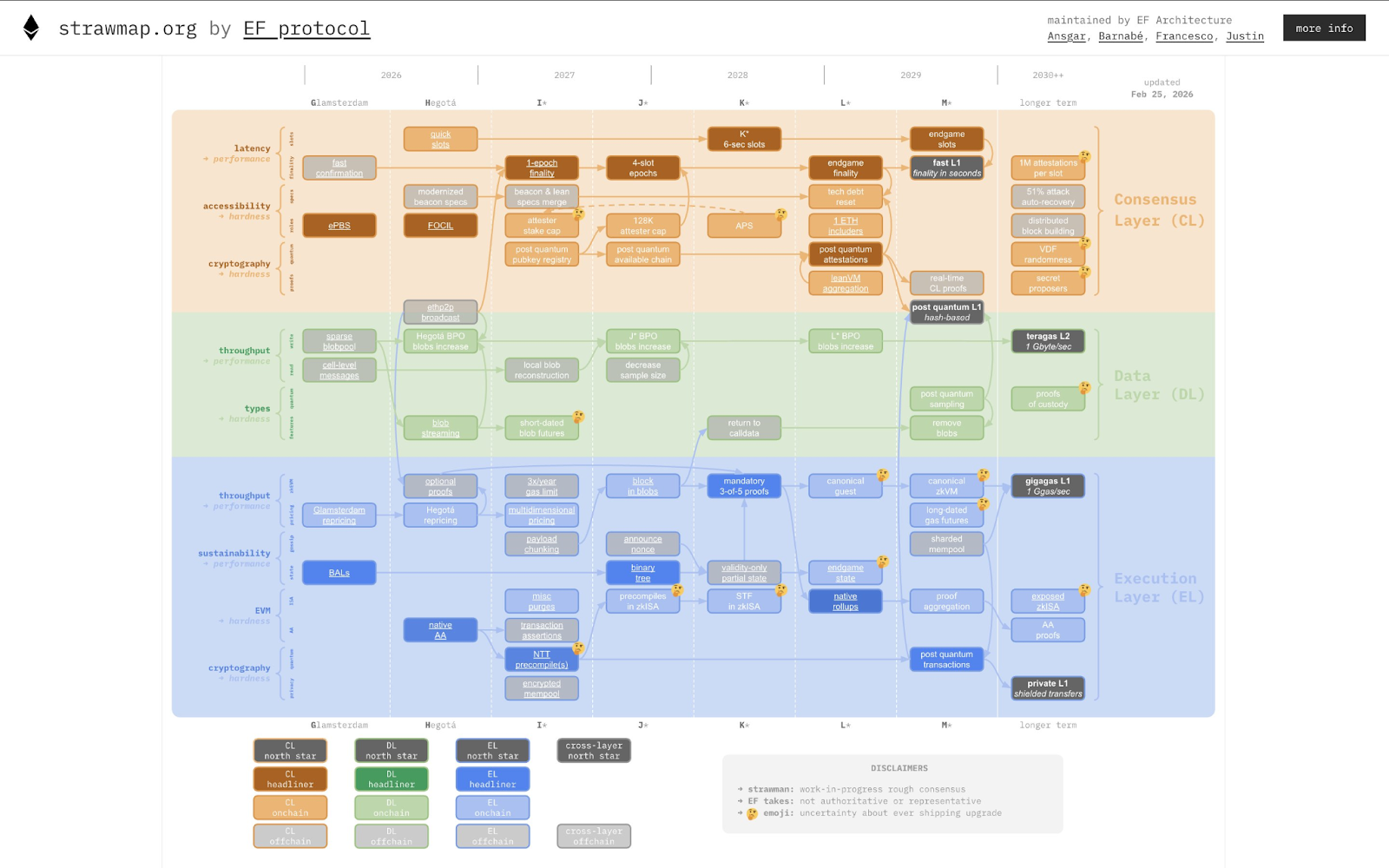
Image source: https://x.com/drakefjustin/status/2026755969540108659
On February 26, 2026, Ethereum Foundation researcher Justin Drake unveiled a mid- to long-term roadmap titled “strawmap.” This plan outlines seven protocol forks to be completed by the end of 2029, targeting an upgrade cadence of once every six months.
Unlike previous major one-off upgrades—such as the Merge or Dencun—this roadmap establishes a “continuous engineering iteration framework.” Rather than aiming for a single, explosive leap, it sets a sustained rhythm for long-term technical advancement.
The five primary objectives are:
- Rapid L1 finality
- 10,000 TPS gigagas L1 enabled by zkEVM
- Teragas-scale L2 through data availability sampling
- Post-quantum cryptography support
- Native L1 privacy (shielded ETH transfers)
This is more than a technical checklist—it is a declaration of architectural vision.
Upgrade Cadence Analysis: Why Target a Fork Every 6 Months?
A fixed upgrade cadence signals a shift in both governance and engineering paradigms. Previous upgrades typically had long cycles, concentrated narratives, and sharp market swings. By contrast, a six-month cadence means:
- Protocol evolution becomes institutionalized
- Developer expectations stabilize
- Upgrade risks are distributed across multiple phases
This approach aligns more closely with mature software engineering iteration rather than “revolution by stages.” However, frequent upgrades also bring challenges:
- Increased pressure on client software
- Higher adaptation costs for the ecosystem
- Greater risk of technical coordination issues
It is a balance between efficiency and complexity.
Deconstructing the Five Objectives: Technical Logic and Implementation Paths
1. Rapid L1 Finality
Ethereum’s economic finality currently relies on the PoS consensus cycle. Shortening final confirmation times would:
- Enhance large-value settlement efficiency
- Reduce risk windows for cross-chain bridges
- Strengthen institutional adoption confidence
If finality is significantly shortened, the mainnet will become even more foundational as financial infrastructure.
2. Gigagas L1: 10,000 TPS Mainnet Vision
Optimizing execution and verification with zkEVM increases per-block gas capacity, enabling throughput at the 10,000 TPS level.
This challenges the long-standing notion that “the mainnet is for security, not scale.”
With higher mainnet throughput:
- Some applications may migrate back to L1
- Gas burn volume could increase
- L2 cost structures may be further optimized
3. Teragas L2: Data Availability Sampling
Data availability sampling (DAS) allows nodes to verify data availability without downloading all data, supporting much greater data publication volumes.
This means:
- Rollups can support much larger user bases
- The blob mechanism may further evolve
- L2 scaling could reach new orders of magnitude
The modular architecture will be reinforced:
- L1 → Security and settlement
- L2 → Execution and interaction
4. Post-Quantum Cryptography
Quantum computing is not yet an immediate threat, but the protocol layer must prepare in advance.
Upgrading signature algorithms early will:
- Reduce long-term security debt
- Avoid forced hard forks in the future
- Strengthen resilience over a 10–20 year horizon
This is a “long-term defensive strategy.”
5. Native L1 Privacy
If native privacy transfers are achieved, ETH’s programmable privacy will be fundamentally enhanced.
Potential impacts include:
- Improved on-chain financial privacy
- New regulatory discussions
- Greater protocol complexity
Privacy design must balance technical innovation and regulatory compliance.
Strengthening Modular Architecture: Redefining L1 and L2 Roles
If gigagas L1 and teragas L2 advance together, Ethereum could develop a more clearly layered structure:
- L1 delivers high-speed, secure settlement
- L2 handles scalable execution
- zk technology underpins the entire verification process
This will further establish Ethereum as modular infrastructure.
Risks and Execution Variables
The roadmap’s success hinges on execution.
- Extremely high technical complexity
- Increased coordination challenges among diverse clients
- Uncertainty around privacy and regulatory dynamics
- Potential shifts in market conditions over the multi-year timeline
Strawmap is a directional document, not a finalized EIP list.
Impact on the Competitive Landscape
Currently, high-performance public blockchains emphasize:
- High TPS
- Low fees
- Single-chain architecture
If Ethereum mainnet throughput rises sharply, the competitive narrative will shift from “security vs. performance” to “modular high performance vs. single-chain high performance.”
Value Capture Logic: How ETH Supply and Demand May Shift
Rising Gas Consumption → Increased Burn
Mainnet throughput gains and L2 scaling could drive total gas consumption higher. Under EIP-1559, more usage leads to more ETH burned.
Changing Staking Demand
If network value increases, staking yield stability may improve. ETH could become more akin to:
- A digital commodity
- A network yield asset
- A settlement-layer asset
Price Projections
1. Current Price Performance
As of February 26, 2026, ETH trades near $2,050, with recent fluctuations between $1,880–$2,130. This range reflects market caution toward upward momentum and the influence of both macro and crypto sentiment on risk assets.
2. Short-Term Price Projection (0–3 Months)
ETH is currently consolidating in the $1,900–$2,200 band. The roadmap announcement primarily reinforces sentiment, but:
- Price remains closely linked to BTC performance
- Macro liquidity is still the main driver
- Technical upgrades are not yet realized
In the short term, ETH is likely to remain range-bound; the roadmap alone is unlikely to trigger a trend reversal.
3. Mid-Term Price Projection (3–12 Months)
If the following materialize:
- Rapid finality or throughput improvements are delivered
- L2 usage grows significantly
- Gas consumption rebounds
The market may start to reprice ETH’s “execution premium.” This could result in:
- A higher volatility baseline
- A move from the $2,000 range to higher levels
However, this depends on real growth in on-chain usage.
4. Long-Term Price Projection (1–3 Years)
If seven forks proceed largely as planned and the ecosystem continues to expand, ETH’s valuation logic may shift from narrative-driven to that of a high-performance settlement-layer asset. At that stage, price drivers will focus more on:
- Network cash flow (burn mechanism)
- Staking lock-up ratio
- Scale of real economic activity
Long-term appreciation will depend not on the roadmap itself, but on technical delivery, usage growth, and governance stability.
Conclusion: An Engineering Blueprint, Not a Sentiment Catalyst
Ethereum’s 2029 roadmap is a structural engineering declaration.
It communicates three key signals:
- The protocol is entering an institutionalized upgrade cycle
- Modular architecture is being further reinforced
- Long-term security and privacy are core agenda items
This is a long-term technical roadmap, not a short-term price lever. The real question is whether the first round of upgrades will be delivered on schedule within the next two years. Execution will determine whether this blueprint marks a historic turning point or remains an idealistic vision.







