Dragonfly’s 2026 Outlook: Crypto Enters a Phase of Concentration and Maturity

Beginner
Quick Reads
Last Updated 2026-03-26 12:53:02
Reading Time: 1m
Dragonfly Managing Partner Haseeb offered his outlook on the crypto market for 2026, addressing Bitcoin trends, public blockchain competition, stablecoin structures, derivatives, regulation, and AI applications. He envisions a new, highly consolidated stage for crypto, led by mature infrastructure.

Bitcoin’s Dominance Is No Longer a One-Way Expansion

(Source: hosseeb)

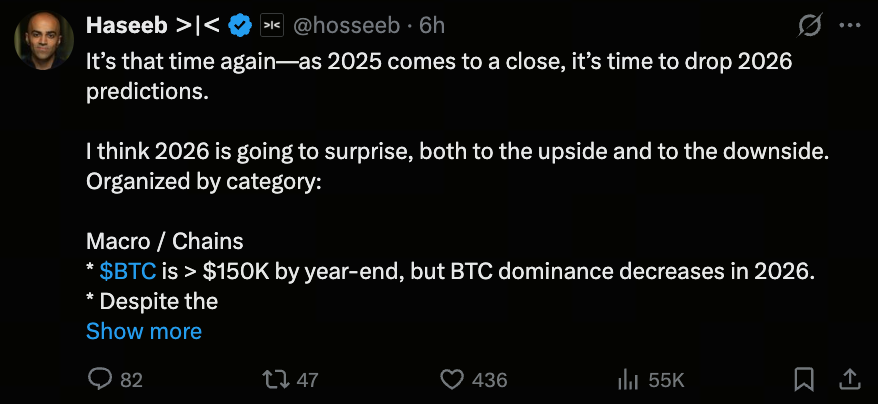
Haseeb projects that Bitcoin could reach $150,000 by the end of 2026, maintaining its position as the primary asset in the crypto market. However, record-high prices do not guarantee a corresponding increase in market dominance. As various blockchain ecosystems mature, capital allocation is becoming more diversified. Bitcoin’s market share may stabilize or even experience a structural decline.

Public Chain Competition Returns to Neutral Infrastructure

In the public chain sector, some new chains built around financial narratives or application-centric strategies may struggle to deliver on early market expectations. By contrast, Ethereum and Solana remain strong candidates for outperforming consensus. Their success stems from a consistent focus on neutral infrastructure, which continues to attract top developers and support the launch of critical applications.

Tech Giants Entering the Wallet Market Is Only a Matter of Time

Haseeb expects that by 2026, at least one major technology company will either launch its own crypto wallet or enter the market via acquisition. This development goes beyond expanding a single product line—it signals that mainstream tech industries now view crypto assets and on-chain identities as essential long-term strategic assets.

Perp DEX: Highly Concentrated Competitive Landscape

In the perpetual contract decentralized exchange (Perp DEX) space, competition will intensify rapidly. Ultimately, three leading platforms could control roughly 90% of the market. Other projects will be relegated to marginal niches, indicating that the derivatives sector has entered a mature phase dominated by top performers.

DeFi Investment Logic Undergoes Structural Shift

Haseeb highlights that equity-based investments will account for a much larger share in DeFi, potentially exceeding 20% of total investment by late 2026. This trend shows that capital markets are shifting focus from short-term token narratives to long-term value rooted in governance rights, cash flow, and corporate structure.

Stablecoin Supply Expands, US Dollar Remains Central

Stablecoin supply is expected to grow by approximately 60%. US dollar stablecoins will maintain near-total dominance, representing nearly 99% of the market. Although USDT will continue to play a pivotal role in liquidity, its market share may decrease slightly to around 55%, reflecting a gradual shift toward other US dollar stablecoin alternatives.

Regulatory Legislation Advances, But the Game Continues

Haseeb anticipates that the “Clarity” legislation will eventually be enacted. However, the passage of such bills will involve several rounds of political and industry negotiation. Regulatory implementation marks clearer rules, but uncertainty will persist in the short term.

Prediction Markets: Rapid Growth, Rapid Attrition

Prediction markets will continue to grow quickly in 2026, but will also face intense market attrition. Haseeb foresees around 90% of prediction market products exiting by year-end due to insufficient liquidity and weak demand.

AI and Crypto Integration Remains in Early Exploration

At the intersection of AI and crypto, real-world applications are still largely limited to software engineering and security. Most other use cases remain in proof-of-concept or prototype phases, with significant barriers to widespread adoption.

To learn more about Web3, click to register: https://www.gate.com/

Summary

Haseeb’s 2026 outlook presents a more mature and pragmatic vision of the crypto market. While price highs and technological innovation continue, the most significant changes are structural—capital concentration, infrastructure leadership, and a renewed focus on sustainable business models. For the crypto industry, 2026 may not only be a year of ongoing growth, but also a pivotal step toward long-term stability.

Author: Allen
Disclaimer
* The information is not intended to be and does not constitute financial advice or any other recommendation of any sort offered or endorsed by Gate.
* This article may not be reproduced, transmitted or copied without referencing Gate. Contravention is an infringement of Copyright Act and may be subject to legal action.

Related Articles

AI-Native Settlement Layers: How United Stables Is Building the Next Financial Rail
Beginner

AI-Native Settlement Layers: How United Stables Is Building the Next Financial Rail

Stablecoins were originally designed as dollar substitutes within exchanges, primarily used for asset pricing and trade settlement. As on-chain financial ecosystems have matured, their role has expanded beyond simple payments to include collateral assets, cross-chain liquidity mediums, and unified settlement units. In particular, as AI systems and automated agents begin to participate directly in economic activity, demand has risen sharply for programmable value units capable of instant settlement. This shift is pushing stablecoins toward the role of foundational financial infrastructure.
2026-03-25 03:16:17
DePIN Identity Network and Real World Applications: How Humanity Protocol Brings on-chain Identity Into the Physical World
Beginner

DePIN Identity Network and Real World Applications: How Humanity Protocol Brings on-chain Identity Into the Physical World

Most Web3 identity systems remain confined to on-chain environments and struggle to achieve meaningful adoption in real world settings. Through a DePIN architecture and physical verification hardware, Humanity Protocol aims to bring decentralized identity into access control systems, hospitality, public services, and offline events, allowing on-chain identity to function not just as a digital credential, but as foundational infrastructure for real world access.
2026-03-25 07:40:53
Gold Price Forecast for the Next Five Years: 2026–2030 Trend Outlook and Investment Implications, Could It Reach $6,000?
Beginner

Gold Price Forecast for the Next Five Years: 2026–2030 Trend Outlook and Investment Implications, Could It Reach $6,000?

Analyze current gold price trends alongside authoritative five-year forecasts, integrating an evaluation of market risks and opportunities. This gives investors insight into the potential trajectory of gold prices and the main drivers expected to shape the market over the next five years.
2026-03-25 18:13:30
Aster vs Hyperliquid: Which Perp DEX Will Prevail?
Beginner

Aster vs Hyperliquid: Which Perp DEX Will Prevail?

Aster and Hyperliquid are the two representative protocols of the "purpose-built L1 path" within the current decentralized perpetual exchange (Perp DEX) sector. As a pioneer in the field, Hyperliquid has built a deep liquidity moat through its highly mature order book architecture and strong community consensus. Conversely, Aster, as a rising challenger, seeks to leapfrog the competition in high-performance trading through more aggressive multi-chain aggregation logic, private transaction modules, and an underlying execution environment optimized for 2026 market demands.
2026-03-24 11:58:33
Aerodrome Tokenomics: How ve(3,3) Powers Base's Most Profitable DEX
Beginner

Aerodrome Tokenomics: How ve(3,3) Powers Base's Most Profitable DEX

AERO is the native token of Aerodrome Finance, a core decentralized exchange and liquidity protocol in the Base ecosystem. It is primarily used for liquidity incentives and ecosystem operations. veAERO is a governance NFT that users receive by locking AERO, representing both voting power and the right to share protocol revenue. Through a dual track structure of AERO as a utility token and veAERO as a governance credential, Aerodrome separates liquidity usage value from long term governance power, allowing participants to act as liquidity providers, governance decision makers, and revenue sharers within the same system.
2026-03-25 06:40:31
The ve(3,3) Flywheel Explained: How AERO Tokenomics Powers Aerodrome’s DeFi Economy
Beginner

The ve(3,3) Flywheel Explained: How AERO Tokenomics Powers Aerodrome’s DeFi Economy

In the competition for DeFi liquidity, high-inflation mining alone is no longer enough to build lasting advantages. Aerodrome applies the ve(3,3) economic model to redesign token emissions, voting mechanisms, and revenue distribution, creating a liquidity flywheel centered on governance and cash flow. This article examines AERO tokenomics, the veAERO locking mechanism, and protocol revenue models to explain how Aerodrome builds a sustainable DeFi economic system.
2026-03-25 06:41:58





