Comprehensive Guide to the Gate Contract Points System: How to Boost Trading Efficiency Through Rewards

Beginner
Quick Reads
Last Updated 2026-03-27 09:05:25
Reading Time: 1m
The Gate Contract Points System offers users various reward points through futures contract trading, account balance management, and a referral program. Users can improve their overall trading experience and efficiency through these features.

Gate Futures Points System Overview
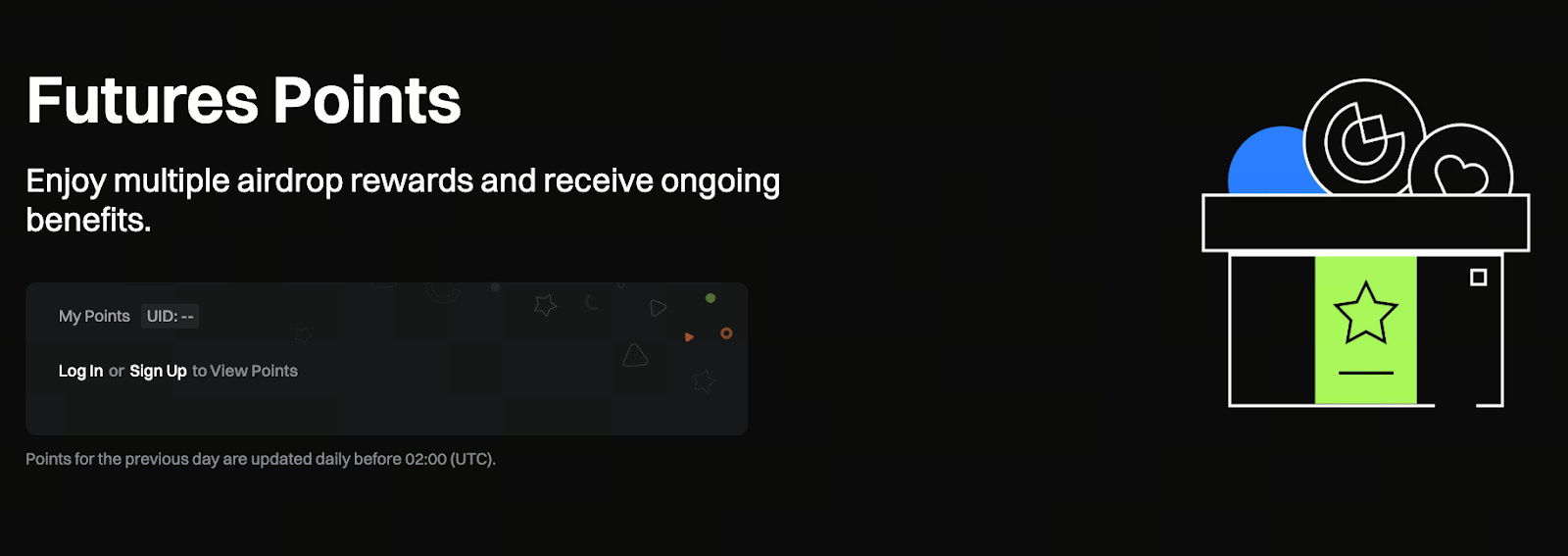

Image: https://www.gate.com/futures/points

The Gate Futures Points System is an exclusive benefit program designed for futures traders on the Gate platform. By encouraging users to participate in futures trading, manage their asset balances, and refer new users, the system rewards users for their activity while driving greater engagement and platform loyalty.

Gate introduced Futures Points to incentivize trading participation, lower trading costs, and enhance the overall trading experience. The system officially launches on October 14, 2025, and will serve as an essential reward mechanism for futures traders’ daily activities.

Three Ways to Earn Gate Futures Points

There are three primary ways to earn Gate Futures Points, each tailored to different user profiles:

  • Futures Trading Points: This is the most straightforward way to earn points. Every time a user executes a qualifying futures trade—whether opening or closing a position—the system awards points based on trading volume. The system grants points on a tiered scale: as your trading volume increases, you earn more points. For example, a trading volume of 400 USDT earns 1 point, while a volume of 204,800 USDT earns 10 points.
  • Account Balance Points: Each trading day, the system snapshots users’ USDT and BTC balances in their futures accounts and issues fixed points based on the balance. For instance, a balance between 100 and 1,000 USDT earns 1 point per day; a balance exceeding 100,000 USDT earns 4 points per day.
  • Referral Points: By referring new users who begin futures trading on Gate, existing users earn referral points. Each successful referral earns 1 point, up to a maximum of 3 points. This approach encourages user referrals and supports platform growth.

Maximizing Use of Gate Futures Points

Once users accumulate enough points, they can redeem them for platform rewards to enhance their trading experience. Gate Futures Points can be used in the following ways:

  • Redeem for Fee Offset Tokens: Points can be exchanged for fee offset tokens, which offset trading fees and reduce overall trading costs.
  • Redeem for Demo Vouchers: These vouchers allow users to experiment with higher leverage trades, simulate larger positions, and increase trading flexibility.
  • Redeem for Practice Funds: Practice funds enable users to test different futures trading strategies and improve their trading skills.

How to Maximize Points Earning Efficiency?

  • Increase Trading Volume: Execute more frequent and higher-volume futures trades to reach higher points tiers and earn greater rewards.
  • Maintain Higher Balances: Keep a substantial asset balance on the platform to secure consistent daily points—large-balance accounts receive even more generous rewards.
  • Refer New Users: Grow the trading community by referring friends to join. This not only boosts platform activity but also increases your points earnings.

Futures Points Validity and Usage Rules

Gate Futures Points are valid for 15 days. Users must utilize their points within this period; any unused points will automatically expire. To ensure fairness, the system always applies the earliest expiring points first.

This validity management helps users avoid accumulating unused points and maintains system fairness and activity. Use your points within the validity period to avoid losing them.

Summary

The Gate Futures Points System increases the flexibility and earning potential of futures trading while offering a diverse range of rewards. By trading futures, managing asset balances, and referring new users, users can earn points and redeem them for fee offset tokens, demo vouchers, and practice funds to optimize trading results.

This points system not only drives higher engagement on the platform but also generates more value for users. As the system continues to evolve, Gate Futures Points will become an integral part of futures trading, delivering even greater incentives and rewards.

Author: Max
Disclaimer
* The information is not intended to be and does not constitute financial advice or any other recommendation of any sort offered or endorsed by Gate.
* This article may not be reproduced, transmitted or copied without referencing Gate. Contravention is an infringement of Copyright Act and may be subject to legal action.

Related Articles

AI-Native Settlement Layers: How United Stables Is Building the Next Financial Rail
Beginner

AI-Native Settlement Layers: How United Stables Is Building the Next Financial Rail

Stablecoins were originally designed as dollar substitutes within exchanges, primarily used for asset pricing and trade settlement. As on-chain financial ecosystems have matured, their role has expanded beyond simple payments to include collateral assets, cross-chain liquidity mediums, and unified settlement units. In particular, as AI systems and automated agents begin to participate directly in economic activity, demand has risen sharply for programmable value units capable of instant settlement. This shift is pushing stablecoins toward the role of foundational financial infrastructure.
2026-03-25 03:16:17
Gold Price Forecast for the Next Five Years: 2026–2030 Trend Outlook and Investment Implications, Could It Reach $6,000?
Beginner

Gold Price Forecast for the Next Five Years: 2026–2030 Trend Outlook and Investment Implications, Could It Reach $6,000?

Analyze current gold price trends alongside authoritative five-year forecasts, integrating an evaluation of market risks and opportunities. This gives investors insight into the potential trajectory of gold prices and the main drivers expected to shape the market over the next five years.
2026-03-25 18:13:30
Aster vs Hyperliquid: Which Perp DEX Will Prevail?
Beginner

Aster vs Hyperliquid: Which Perp DEX Will Prevail?

Aster and Hyperliquid are the two representative protocols of the "purpose-built L1 path" within the current decentralized perpetual exchange (Perp DEX) sector. As a pioneer in the field, Hyperliquid has built a deep liquidity moat through its highly mature order book architecture and strong community consensus. Conversely, Aster, as a rising challenger, seeks to leapfrog the competition in high-performance trading through more aggressive multi-chain aggregation logic, private transaction modules, and an underlying execution environment optimized for 2026 market demands.
2026-03-24 11:58:33
DePIN Identity Network and Real World Applications: How Humanity Protocol Brings on-chain Identity Into the Physical World
Beginner

DePIN Identity Network and Real World Applications: How Humanity Protocol Brings on-chain Identity Into the Physical World

Most Web3 identity systems remain confined to on-chain environments and struggle to achieve meaningful adoption in real world settings. Through a DePIN architecture and physical verification hardware, Humanity Protocol aims to bring decentralized identity into access control systems, hospitality, public services, and offline events, allowing on-chain identity to function not just as a digital credential, but as foundational infrastructure for real world access.
2026-03-25 07:40:53
Aerodrome Tokenomics: How ve(3,3) Powers Base's Most Profitable DEX
Beginner

Aerodrome Tokenomics: How ve(3,3) Powers Base's Most Profitable DEX

AERO is the native token of Aerodrome Finance, a core decentralized exchange and liquidity protocol in the Base ecosystem. It is primarily used for liquidity incentives and ecosystem operations. veAERO is a governance NFT that users receive by locking AERO, representing both voting power and the right to share protocol revenue. Through a dual track structure of AERO as a utility token and veAERO as a governance credential, Aerodrome separates liquidity usage value from long term governance power, allowing participants to act as liquidity providers, governance decision makers, and revenue sharers within the same system.
2026-03-25 06:40:31
The ve(3,3) Flywheel Explained: How AERO Tokenomics Powers Aerodrome’s DeFi Economy
Beginner

The ve(3,3) Flywheel Explained: How AERO Tokenomics Powers Aerodrome’s DeFi Economy

In the competition for DeFi liquidity, high-inflation mining alone is no longer enough to build lasting advantages. Aerodrome applies the ve(3,3) economic model to redesign token emissions, voting mechanisms, and revenue distribution, creating a liquidity flywheel centered on governance and cash flow. This article examines AERO tokenomics, the veAERO locking mechanism, and protocol revenue models to explain how Aerodrome builds a sustainable DeFi economic system.
2026-03-25 06:41:58





