COAI (BNB Chain Meme) Surges: Why the Price Suddenly Strengthened

Beginner
Quick Reads
Last Updated 2026-03-28 16:52:41
Reading Time: 1m
COAI, a meme token on BNB Chain, experienced a dramatic spike in early October 2025, with both trading volume and market capitalization soaring. This article covers market catalysts affecting price, FOMO-related market behavior, short-term trading tactics, and risk management strategies. It provides a concise introduction for new market participants.

Key Events Driving COAI’s Recent Rally
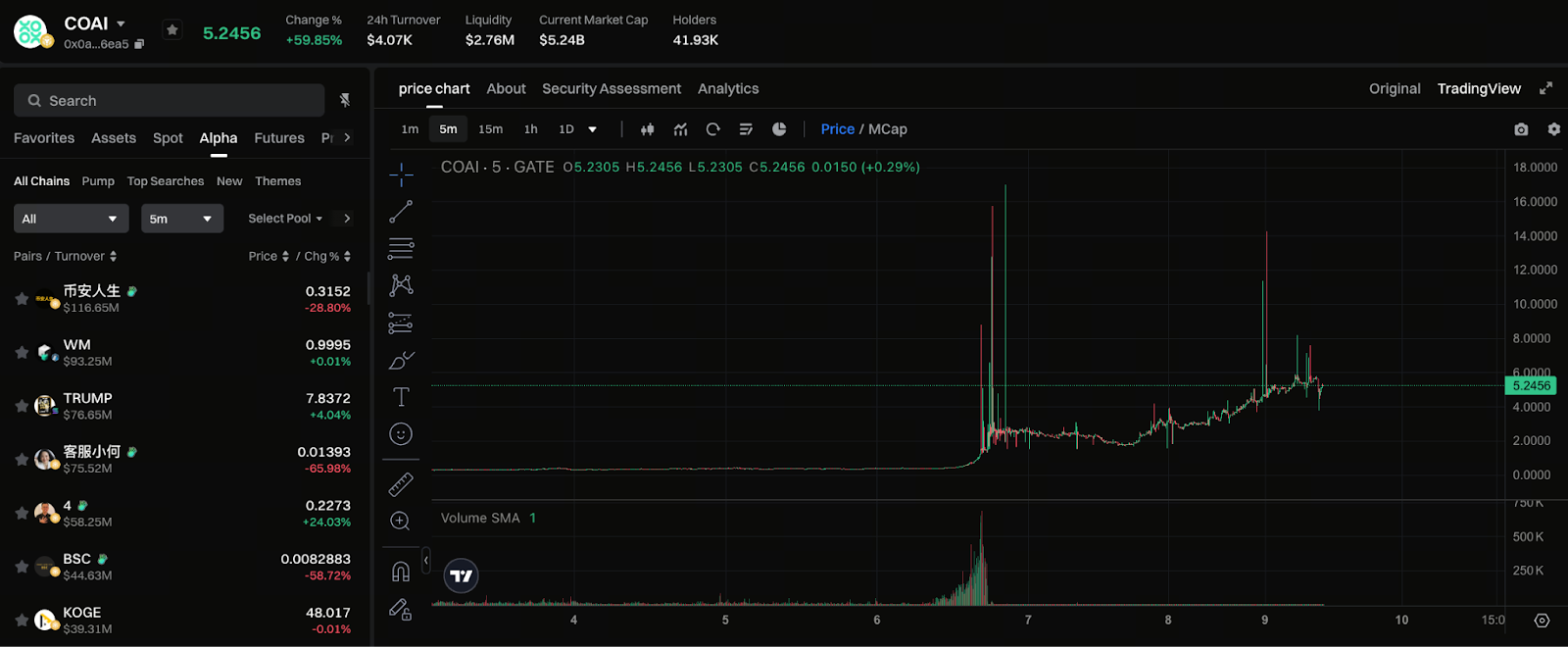

Chart: https://www.gate.com/alpha/bsc-0x0a8d6c86e1bce73fe4d0bd531e1a567306836ea5

COAI (BNB Chain meme) saw its latest surge largely triggered by progressive listings on external exchanges and platforms, alongside the rollout of leveraged trading tools. Media coverage and official exchange announcements sparked a wave of short-term buying, with trading volume soaring and prices climbing sharply within a brief window. Market reports indicate that COAI experienced a short-lived spike of several hundred percent and explosive trading activity in early October 2025.

Technical and Capital Signal Analysis

From a capital flow perspective, this rally was marked by a dramatic increase in 24-hour trading volume, suggesting that short-term capital was aggressively targeting quick gains. The introduction of higher leverage and derivatives on select platforms amplified upward momentum, creating a feedback loop between volume and price that drew in retail investors and fueled widespread FOMO (fear of missing out). Multiple media sources reported significant surges in both daily trading volume and market capitalization throughout this uptrend.

Common Behaviors and Risks Amid FOMO Sentiment

On the technical front, short-term charts typically display a “parabolic spike followed by rapid correction”: prices soar to a sharp peak in moments, then quickly face selling pressure and consolidation. For newcomers, witnessing rapid price appreciation often triggers impulsive buying, but the risk of swift pullbacks remains high. Without a clear stop-loss strategy, traders can easily end up buying at the top. Key technical indicators—like RSI and volume—can become extremely volatile in such market conditions, signaling the need for heightened caution.

Beginner Strategies and Risk Management

Typical FOMO-driven actions include chasing price rallies, adding positions without stop-losses, scaling up positions with high leverage, neglecting project fundamentals, and reacting emotionally to trending community posts or short videos. The best defense is to establish a trading plan in advance: set clear entry points, stop-loss levels, profit targets, and position limits; never trade with essential living funds; and if leveraging, define your maximum tolerable drawdown.

Practical tips for beginners:

  • Limit your position size to a small fraction of your total assets (e.g., 1–3%);
  • Before entering, determine whether the event is a “short-term catalyst” (such as listing, airdrop, celebrity mention, or leverage activation);
  • Strictly implement stop-losses to avoid emotional trades;
  • If you lack a profit-taking strategy, consider scaling in and out of positions;
  • Monitor liquidity and contract leverage rules, and avoid trading during periods of low liquidity.

Conclusion: COAI’s (BNB Chain meme) recent surge exemplifies a “catalyst event + community FOMO + leverage amplification” dynamic. While short-term arbitrage opportunities exist, they come with elevated volatility and risk. Newcomers should prioritize risk management and carefully assess the sustainability of the rally’s core drivers.

Author: Max
Disclaimer
* The information is not intended to be and does not constitute financial advice or any other recommendation of any sort offered or endorsed by Gate.
* This article may not be reproduced, transmitted or copied without referencing Gate. Contravention is an infringement of Copyright Act and may be subject to legal action.

Related Articles

AI-Native Settlement Layers: How United Stables Is Building the Next Financial Rail
Beginner

AI-Native Settlement Layers: How United Stables Is Building the Next Financial Rail

Stablecoins were originally designed as dollar substitutes within exchanges, primarily used for asset pricing and trade settlement. As on-chain financial ecosystems have matured, their role has expanded beyond simple payments to include collateral assets, cross-chain liquidity mediums, and unified settlement units. In particular, as AI systems and automated agents begin to participate directly in economic activity, demand has risen sharply for programmable value units capable of instant settlement. This shift is pushing stablecoins toward the role of foundational financial infrastructure.
2026-03-25 03:16:17
DePIN Identity Network and Real World Applications: How Humanity Protocol Brings on-chain Identity Into the Physical World
Beginner

DePIN Identity Network and Real World Applications: How Humanity Protocol Brings on-chain Identity Into the Physical World

Most Web3 identity systems remain confined to on-chain environments and struggle to achieve meaningful adoption in real world settings. Through a DePIN architecture and physical verification hardware, Humanity Protocol aims to bring decentralized identity into access control systems, hospitality, public services, and offline events, allowing on-chain identity to function not just as a digital credential, but as foundational infrastructure for real world access.
2026-03-25 07:40:53
The ve(3,3) Flywheel Explained: How AERO Tokenomics Powers Aerodrome’s DeFi Economy
Beginner

The ve(3,3) Flywheel Explained: How AERO Tokenomics Powers Aerodrome’s DeFi Economy

In the competition for DeFi liquidity, high-inflation mining alone is no longer enough to build lasting advantages. Aerodrome applies the ve(3,3) economic model to redesign token emissions, voting mechanisms, and revenue distribution, creating a liquidity flywheel centered on governance and cash flow. This article examines AERO tokenomics, the veAERO locking mechanism, and protocol revenue models to explain how Aerodrome builds a sustainable DeFi economic system.
2026-03-25 06:41:58
Aerodrome Tokenomics: How ve(3,3) Powers Base's Most Profitable DEX
Beginner

Aerodrome Tokenomics: How ve(3,3) Powers Base's Most Profitable DEX

AERO is the native token of Aerodrome Finance, a core decentralized exchange and liquidity protocol in the Base ecosystem. It is primarily used for liquidity incentives and ecosystem operations. veAERO is a governance NFT that users receive by locking AERO, representing both voting power and the right to share protocol revenue. Through a dual track structure of AERO as a utility token and veAERO as a governance credential, Aerodrome separates liquidity usage value from long term governance power, allowing participants to act as liquidity providers, governance decision makers, and revenue sharers within the same system.
2026-03-25 06:40:31
Aster vs Hyperliquid: Which Perp DEX Will Prevail?
Beginner

Aster vs Hyperliquid: Which Perp DEX Will Prevail?

Aster and Hyperliquid are the two representative protocols of the "purpose-built L1 path" within the current decentralized perpetual exchange (Perp DEX) sector. As a pioneer in the field, Hyperliquid has built a deep liquidity moat through its highly mature order book architecture and strong community consensus. Conversely, Aster, as a rising challenger, seeks to leapfrog the competition in high-performance trading through more aggressive multi-chain aggregation logic, private transaction modules, and an underlying execution environment optimized for 2026 market demands.
2026-03-24 11:58:33
Gold Price Forecast for the Next Five Years: 2026–2030 Trend Outlook and Investment Implications, Could It Reach $6,000?
Beginner

Gold Price Forecast for the Next Five Years: 2026–2030 Trend Outlook and Investment Implications, Could It Reach $6,000?

Analyze current gold price trends alongside authoritative five-year forecasts, integrating an evaluation of market risks and opportunities. This gives investors insight into the potential trajectory of gold prices and the main drivers expected to shape the market over the next five years.
2026-03-25 18:13:30





