Breaking the Market Cycle? Tom Lee Says the Crypto “Supercycle” Has Arrived, With Ethereum Potentially Targeting $62,000

Beginner
Quick Reads
Last Updated 2026-03-27 03:34:56
Reading Time: 1m
Wall Street analyst Tom Lee believes the cryptocurrency market has reached its lowest point and that a supercycle is set to begin. Ethereum may soar from its current low all the way to $62,000. This article thoroughly examines his logic and the potential risks involved.

Tom Lee: Crypto Market Breaks the “Four-Year Cycle” as Ethereum Advances Toward Financial Infrastructure Leadership

At Binance Blockchain Week in December 2025, prominent Wall Street strategist and Fundstrat founder Tom Lee declared that the cryptocurrency market has moved beyond the traditional “four-year cycle.” The previous model—driven by halving events, retail sentiment, and alternating bull and bear phases—is now giving way to new structural forces.

Lee believes the market has already bottomed out, and a new growth cycle that will shape the next decade is just beginning.

He points out that the market’s current momentum is fueled not by short-term speculation or rotating themes, but by three decisive, long-term drivers: sustained institutional capital inflows, larger-scale portfolio allocations, and the rapid tokenization of real-world assets. These forces are fundamentally reshaping the way the crypto market operates.

Why Ethereum Is Considered “Next-Generation Financial Infrastructure”

In Lee’s view, Ethereum’s significance goes far beyond its identity as a crypto asset. It is the foundational layer powering the next wave of financial infrastructure, including smart contracts, DeFi, stablecoin settlement, and real-world asset tokenization (RWA).

As traditional assets—such as securities, real estate, fund shares, bonds, and various financial rights—are increasingly represented and managed on-chain, demand for ETH is shifting from speculative trading to essential settlement needs. Lee also highlights a critical but often overlooked fact: most traditional institutions currently have zero exposure to crypto assets. If their allocation rises from 0 to 1% or 2%, the influx of new capital would be transformative for the entire market.

ETH’s Path to $62,000: What Must Happen First?
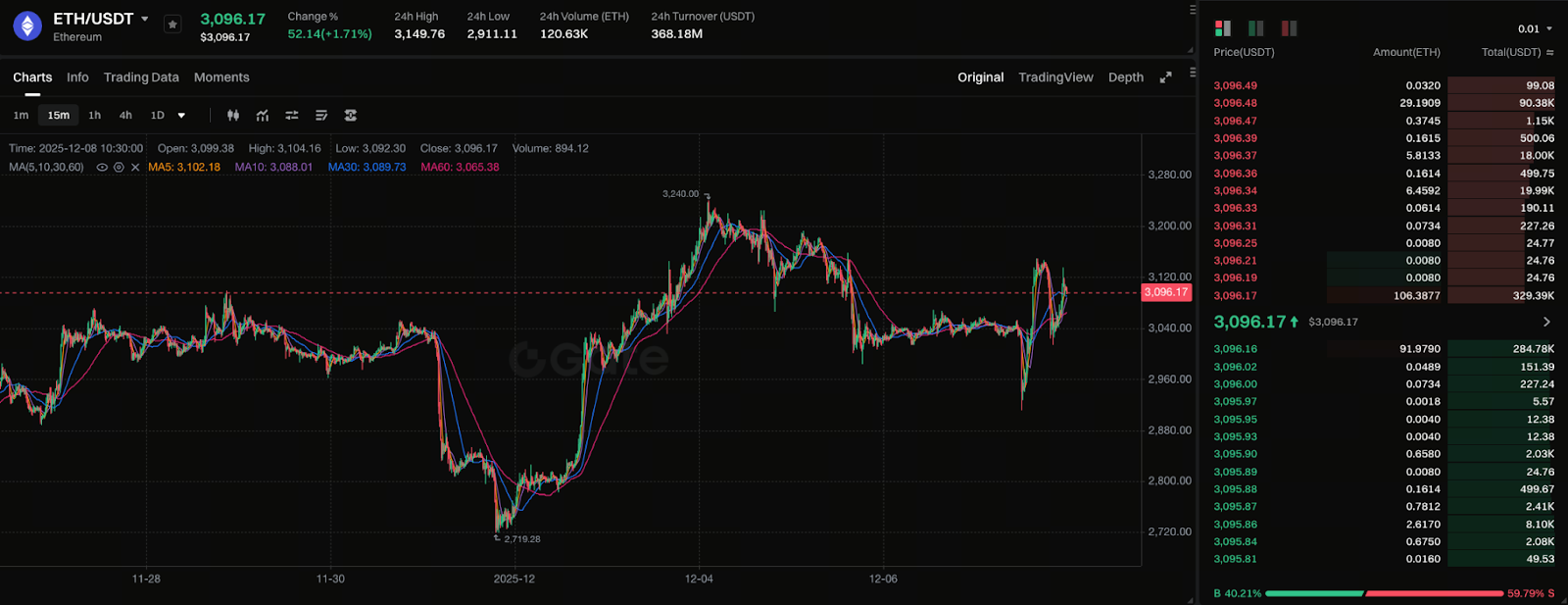

Chart: https://www.gate.com/trade/ETH_USDT

Regarding the much-anticipated ETH price target of $62,000, Lee lays out specific prerequisites. This isn’t a speculative guess; it’s a projection founded on several critical variables coming together:

First, the market must enter a genuine “supercycle.” This involves not only continuous institutional inflows but potentially sovereign wealth participation, making crypto assets a core part of global investment portfolios.

Second, Ethereum’s network fundamentals need to show sustained improvement. Factors such as on-chain transaction volume, DeFi application growth, stablecoin settlement activity, and the pace of real-world asset tokenization must all rise in tandem to drive ETH’s intrinsic value.

Third, this rally should not hinge on a single catalyst. Unlike past cycles driven by halving events or retail sentiment, the current cycle is rooted in institutional reform, asset structure transformation, and upgrades to financial infrastructure.

Lee believes ETH could move from its current multi-thousand-dollar range toward the ambitious $62,000 mark only if all these conditions are met.

Market Skepticism and Real Risks That Can’t Be Ignored

Of course, not everyone is convinced. Many analysts argue that the $62,000 target is more of an ideal scenario, contingent on:

  • Large-scale adoption of real-world asset tokenization
  • Widespread institutional integration of crypto assets
  • Structural migration within the global financial system

If any of these elements fall behind, the target could be delayed or even rendered unattainable.

Macro conditions also play a crucial role. Interest rate shifts, liquidity constraints, regulatory policy changes, and geopolitical risks can all have systemic effects on the crypto market. Even Tom Lee repeatedly stresses that crypto assets never operate in isolation—they are always subject to the broader global macro cycle.

In reality, the current scale of ETH’s on-chain transactions, application activity, and progress with RWA adoption remains far from the vision of a “global financial infrastructure.” Achieving multi-trillion-dollar valuations in the short term is still limited by practical constraints.

How Should Investors Approach This Forecast Rationally?

For most investors, Tom Lee’s perspective should be treated as an extremely optimistic long-term framework, not as a short-term price guarantee.

The real focus for long-term tracking isn’t a single price target, but whether these key trends continue to unfold:

  • Is real-world asset tokenization entering a phase of meaningful scale?
  • Are institutional and traditional capital flows consistently increasing?
  • Is genuine demand for Ethereum network usage growing in step?

If you’re considering ETH, the prudent approach is to view it as one of several high-volatility, high-potential long-term allocations—not as an all-in bet.

Maintaining a diversified portfolio, managing positions wisely, setting clear profit-taking and stop-loss levels, and closely monitoring macro policy and liquidity developments remain essential for successfully navigating market cycles.

Author: Max
Disclaimer
* The information is not intended to be and does not constitute financial advice or any other recommendation of any sort offered or endorsed by Gate.
* This article may not be reproduced, transmitted or copied without referencing Gate. Contravention is an infringement of Copyright Act and may be subject to legal action.

Related Articles

AI-Native Settlement Layers: How United Stables Is Building the Next Financial Rail
Beginner

AI-Native Settlement Layers: How United Stables Is Building the Next Financial Rail

Stablecoins were originally designed as dollar substitutes within exchanges, primarily used for asset pricing and trade settlement. As on-chain financial ecosystems have matured, their role has expanded beyond simple payments to include collateral assets, cross-chain liquidity mediums, and unified settlement units. In particular, as AI systems and automated agents begin to participate directly in economic activity, demand has risen sharply for programmable value units capable of instant settlement. This shift is pushing stablecoins toward the role of foundational financial infrastructure.
2026-03-25 03:16:17
DePIN Identity Network and Real World Applications: How Humanity Protocol Brings on-chain Identity Into the Physical World
Beginner

DePIN Identity Network and Real World Applications: How Humanity Protocol Brings on-chain Identity Into the Physical World

Most Web3 identity systems remain confined to on-chain environments and struggle to achieve meaningful adoption in real world settings. Through a DePIN architecture and physical verification hardware, Humanity Protocol aims to bring decentralized identity into access control systems, hospitality, public services, and offline events, allowing on-chain identity to function not just as a digital credential, but as foundational infrastructure for real world access.
2026-03-25 07:40:53
The ve(3,3) Flywheel Explained: How AERO Tokenomics Powers Aerodrome’s DeFi Economy
Beginner

The ve(3,3) Flywheel Explained: How AERO Tokenomics Powers Aerodrome’s DeFi Economy

In the competition for DeFi liquidity, high-inflation mining alone is no longer enough to build lasting advantages. Aerodrome applies the ve(3,3) economic model to redesign token emissions, voting mechanisms, and revenue distribution, creating a liquidity flywheel centered on governance and cash flow. This article examines AERO tokenomics, the veAERO locking mechanism, and protocol revenue models to explain how Aerodrome builds a sustainable DeFi economic system.
2026-03-25 06:41:58
Aerodrome Tokenomics: How ve(3,3) Powers Base's Most Profitable DEX
Beginner

Aerodrome Tokenomics: How ve(3,3) Powers Base's Most Profitable DEX

AERO is the native token of Aerodrome Finance, a core decentralized exchange and liquidity protocol in the Base ecosystem. It is primarily used for liquidity incentives and ecosystem operations. veAERO is a governance NFT that users receive by locking AERO, representing both voting power and the right to share protocol revenue. Through a dual track structure of AERO as a utility token and veAERO as a governance credential, Aerodrome separates liquidity usage value from long term governance power, allowing participants to act as liquidity providers, governance decision makers, and revenue sharers within the same system.
2026-03-25 06:40:31
Aster vs Hyperliquid: Which Perp DEX Will Prevail?
Beginner

Aster vs Hyperliquid: Which Perp DEX Will Prevail?

Aster and Hyperliquid are the two representative protocols of the "purpose-built L1 path" within the current decentralized perpetual exchange (Perp DEX) sector. As a pioneer in the field, Hyperliquid has built a deep liquidity moat through its highly mature order book architecture and strong community consensus. Conversely, Aster, as a rising challenger, seeks to leapfrog the competition in high-performance trading through more aggressive multi-chain aggregation logic, private transaction modules, and an underlying execution environment optimized for 2026 market demands.
2026-03-24 11:58:33
Gold Price Forecast for the Next Five Years: 2026–2030 Trend Outlook and Investment Implications, Could It Reach $6,000?
Beginner

Gold Price Forecast for the Next Five Years: 2026–2030 Trend Outlook and Investment Implications, Could It Reach $6,000?

Analyze current gold price trends alongside authoritative five-year forecasts, integrating an evaluation of market risks and opportunities. This gives investors insight into the potential trajectory of gold prices and the main drivers expected to shape the market over the next five years.
2026-03-25 18:13:30





