BlackRock’s $400 Million Bitcoin Purchase Sparks Market Liquidity Concerns

Beginner
Quick Reads
Last Updated 2026-03-27 10:40:03
Reading Time: 1m
BlackRock invested around $400 million to acquire Bitcoin and transferred 4,471 BTC to Coinbase, sparking industry concerns about shrinking liquidity in the U.S. crypto market. The move has prompted analysis of market participants' strategies and the potential implications for the future.

BlackRock’s Ongoing Expansion in Crypto Assets

Over the last two years, BlackRock has steadily deepened its involvement in the cryptocurrency market. Since the approval of spot Bitcoin ETFs, BlackRock’s iShares Bitcoin Trust (IBIT) has emerged as one of the fastest-growing products in the sector. As the world’s largest asset manager, BlackRock’s decisions often set the tone for market sentiment.

From an institutional strategy standpoint, BlackRock has long considered Bitcoin a viable asset class for long-term allocation, holding a strategic position alongside gold, bonds, and equities. As a result, regardless of short-term market swings, BlackRock continues to expand its footprint in the crypto space.

The Implications Behind a $400 Million Bitcoin Transfer
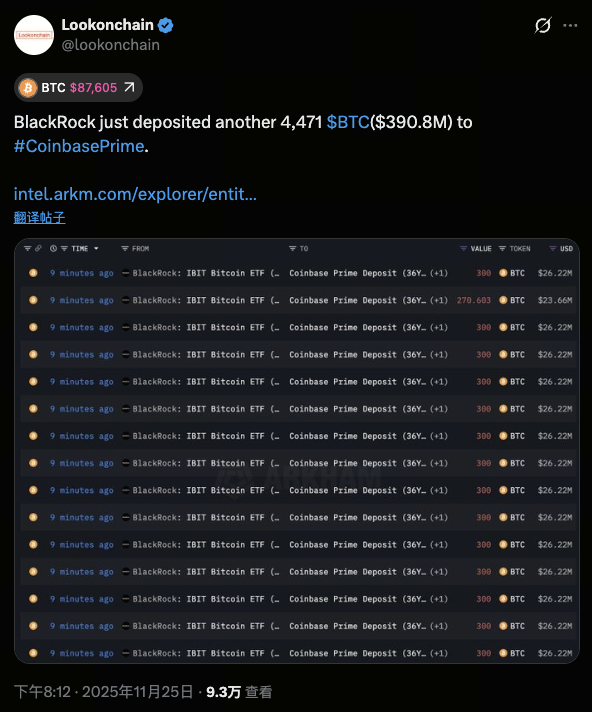

Source: https://x.com/lookonchain/status/1993291699356155926

On November 25, 2025, BlackRock transferred over 4,471 Bitcoins—worth roughly $400 million—to its Coinbase Prime custody account. This move has fueled speculation about whether it was intended to rebalance ETF holdings, reserve liquidity for potential market volatility, or adjust portfolio positions.

No matter the underlying motive, asset transfers of this magnitude reflect an institution’s unique perspective on market trends. For individual investors, large-scale institutional rebalancing often signals early strategic positioning and warrants close attention.

Why Is the Market on Liquidity Alert?

This move by BlackRock is being called a liquidity alert for three key reasons:

1. Large Transfer Size and Noticeable Impact

Moving over 4,000 Bitcoins in one transaction is seen as a hedging or rebalancing action. Given Bitcoin’s limited spot liquidity, transfers of this scale often trigger price movements.

2. Coincides with Significant ETF Redemptions

IBIT recently experienced record outflows. As institutional capital exited the ETF, a major transfer occurred, raising questions about whether even larger rebalancing actions are underway.

3. Institutional Moves Seen as Market Trend Indicators

Investors often interpret BlackRock’s actions as signals of a looming market downturn, which can amplify panic and drive further liquidity tightening.

Bitcoin Price Volatility After the Event

Following the announcement, Bitcoin prices faced temporary downward pressure. Some traders believe the sudden drop in liquidity could lead to a test of support levels. Meanwhile, there was a marked shift in the long-short leverage ratio in the derivatives market, underscoring rising uncertainty about future price direction.

Still, Bitcoin’s long-term structural demand remains intact, with institutional buying showing resilience.

Potential Risks of Liquidity Tightening

If large-scale institutional rebalancing continues, several risks could emerge:

  • Heightened short-term price swings: When liquidity is thin, trading thousands of Bitcoins can cause sharp price movements.
  • Increased panic selling: Retail investors may misread the situation as “institutional exit,” leading to panic selling.
  • Greater passive selling pressure from ETFs: Ongoing redemptions could force more Bitcoin sales.
  • Risk of a negative feedback loop: Declining liquidity, falling prices, and further selling can trigger a chain reaction across the market.

How Should Investors Respond?

Given the current environment, investors should consider the following:

  1. Do not overanalyze a single institution’s actions
    Major moves by institutions are usually part of broader strategies and don’t necessarily signal a bearish outlook.
  2. Monitor ETF flows closely
    Ongoing ETF inflows or outflows are critical indicators of market trends.
  3. Avoid excessive leverage
    High leverage is especially vulnerable during periods of tight liquidity.
  4. Adopt medium-term and long-term strategies
    If you believe in Bitcoin’s long-term value, periods characterized by market panic may present strategic entry points.
Author: Max
Disclaimer
* The information is not intended to be and does not constitute financial advice or any other recommendation of any sort offered or endorsed by Gate.
* This article may not be reproduced, transmitted or copied without referencing Gate. Contravention is an infringement of Copyright Act and may be subject to legal action.

Related Articles

AI-Native Settlement Layers: How United Stables Is Building the Next Financial Rail
Beginner

AI-Native Settlement Layers: How United Stables Is Building the Next Financial Rail

Stablecoins were originally designed as dollar substitutes within exchanges, primarily used for asset pricing and trade settlement. As on-chain financial ecosystems have matured, their role has expanded beyond simple payments to include collateral assets, cross-chain liquidity mediums, and unified settlement units. In particular, as AI systems and automated agents begin to participate directly in economic activity, demand has risen sharply for programmable value units capable of instant settlement. This shift is pushing stablecoins toward the role of foundational financial infrastructure.
2026-03-25 03:16:17
DePIN Identity Network and Real World Applications: How Humanity Protocol Brings on-chain Identity Into the Physical World
Beginner

DePIN Identity Network and Real World Applications: How Humanity Protocol Brings on-chain Identity Into the Physical World

Most Web3 identity systems remain confined to on-chain environments and struggle to achieve meaningful adoption in real world settings. Through a DePIN architecture and physical verification hardware, Humanity Protocol aims to bring decentralized identity into access control systems, hospitality, public services, and offline events, allowing on-chain identity to function not just as a digital credential, but as foundational infrastructure for real world access.
2026-03-25 07:40:53
The ve(3,3) Flywheel Explained: How AERO Tokenomics Powers Aerodrome’s DeFi Economy
Beginner

The ve(3,3) Flywheel Explained: How AERO Tokenomics Powers Aerodrome’s DeFi Economy

In the competition for DeFi liquidity, high-inflation mining alone is no longer enough to build lasting advantages. Aerodrome applies the ve(3,3) economic model to redesign token emissions, voting mechanisms, and revenue distribution, creating a liquidity flywheel centered on governance and cash flow. This article examines AERO tokenomics, the veAERO locking mechanism, and protocol revenue models to explain how Aerodrome builds a sustainable DeFi economic system.
2026-03-25 06:41:58
Aerodrome Tokenomics: How ve(3,3) Powers Base's Most Profitable DEX
Beginner

Aerodrome Tokenomics: How ve(3,3) Powers Base's Most Profitable DEX

AERO is the native token of Aerodrome Finance, a core decentralized exchange and liquidity protocol in the Base ecosystem. It is primarily used for liquidity incentives and ecosystem operations. veAERO is a governance NFT that users receive by locking AERO, representing both voting power and the right to share protocol revenue. Through a dual track structure of AERO as a utility token and veAERO as a governance credential, Aerodrome separates liquidity usage value from long term governance power, allowing participants to act as liquidity providers, governance decision makers, and revenue sharers within the same system.
2026-03-25 06:40:31
Aster vs Hyperliquid: Which Perp DEX Will Prevail?
Beginner

Aster vs Hyperliquid: Which Perp DEX Will Prevail?

Aster and Hyperliquid are the two representative protocols of the "purpose-built L1 path" within the current decentralized perpetual exchange (Perp DEX) sector. As a pioneer in the field, Hyperliquid has built a deep liquidity moat through its highly mature order book architecture and strong community consensus. Conversely, Aster, as a rising challenger, seeks to leapfrog the competition in high-performance trading through more aggressive multi-chain aggregation logic, private transaction modules, and an underlying execution environment optimized for 2026 market demands.
2026-03-24 11:58:33
Gold Price Forecast for the Next Five Years: 2026–2030 Trend Outlook and Investment Implications, Could It Reach $6,000?
Beginner

Gold Price Forecast for the Next Five Years: 2026–2030 Trend Outlook and Investment Implications, Could It Reach $6,000?

Analyze current gold price trends alongside authoritative five-year forecasts, integrating an evaluation of market risks and opportunities. This gives investors insight into the potential trajectory of gold prices and the main drivers expected to shape the market over the next five years.
2026-03-25 18:13:30





