Bitmine Surpasses 4.47 Million ETH Holdings as Total Assets Reach $9.9 Billion

Last Updated 2026-03-24 22:14:50
Reading Time: 1m
Bitmine has published its latest asset report, revealing a total value of $9.9 billion in cryptocurrencies, cash, and strategic investments. The company holds 4.47 million ETH, accounting for 3.71% of the total Ethereum supply. Bitmine is also developing its proprietary staking infrastructure, MAVAN, with plans to launch in the first quarter of 2026.

Bitmine Asset Portfolio Expansion

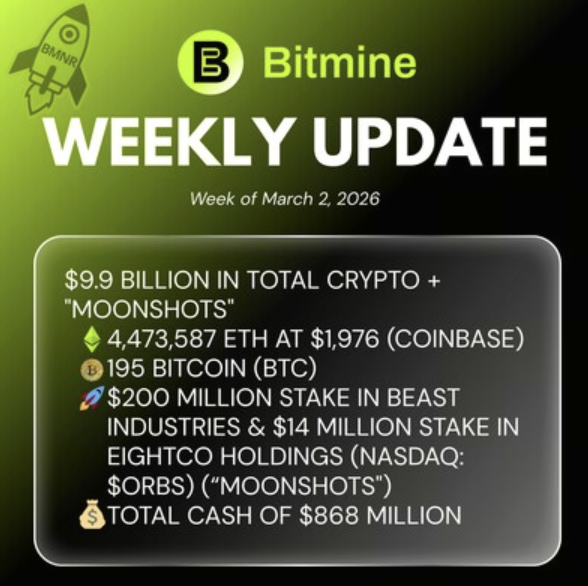
Bitmine Immersion Technologies, headquartered in Las Vegas (NYSE American: BMNR), announced that as of March 2026, its combined crypto assets, cash, and strategic investments have reached $9.9 billion.

The company’s current asset composition includes:

  • 4,473,587 ETH (valued at $1,976 per ETH)
  • 193 Bitcoin
  • $200 million equity stake in Beast Industries (@MrBeast)
  • $14 million equity in Eightco Holdings (NASDAQ: $ORBS), classified as a “moonshots” project
  • Total cash holdings of $868 million

Bitmine 资产版图扩张
(Source: BitMNR)

In total, Bitmine’s ETH holdings now account for 3.71% of the entire Ethereum supply (approximately 120.7 million ETH).

Targeting 5%: 70% Progress Achieved in Eight Months

With its long-term “Alchemy of 5%” strategy, the company aims to accumulate 5% of the total Ethereum supply. Progress has already surpassed 74%, achieved in just eight months.

Chairman Thomas Lee noted that the company has steadily increased its ETH holdings during market corrections, adding 50,928 ETH in the past week alone. He emphasized that current prices do not reflect Ethereum’s real-world utility or its long-term role as a financial infrastructure.

Global Leader in Staking Scale

As of this report, Bitmine has staked 3,040,483 ETH—about $6 billion at current market prices—representing approximately 68% of its total ETH holdings.

Key staking metrics include:

  • Annualized staking revenue: approximately $172 million
  • 7-day annualized yield: 2.86%
  • CESR (Comprehensive Ethereum Staking Rate): 2.83%
  • If all ETH were staked, projected annual revenue could reach $253 million

The company currently collaborates with three staking service providers and is advancing its proprietary validator network.

MAVAN Initiative: Launching in 2026

MAVAN 计画:2026 年登场
(Source: threepillarzz)

Bitmine is developing the MAVAN (Made in America Validator Network) staking infrastructure, with an official launch planned for Q1 2026. This system will serve as a dedicated validator network for company assets, prioritizing security and scalable operations. Going forward, Bitmine will leverage MAVAN to integrate staking and protocol-level yields, further optimizing ETH asset returns.

Global Reserve Rankings and Market Liquidity
全球储备排名与市场流动性
(Source: coingecko)

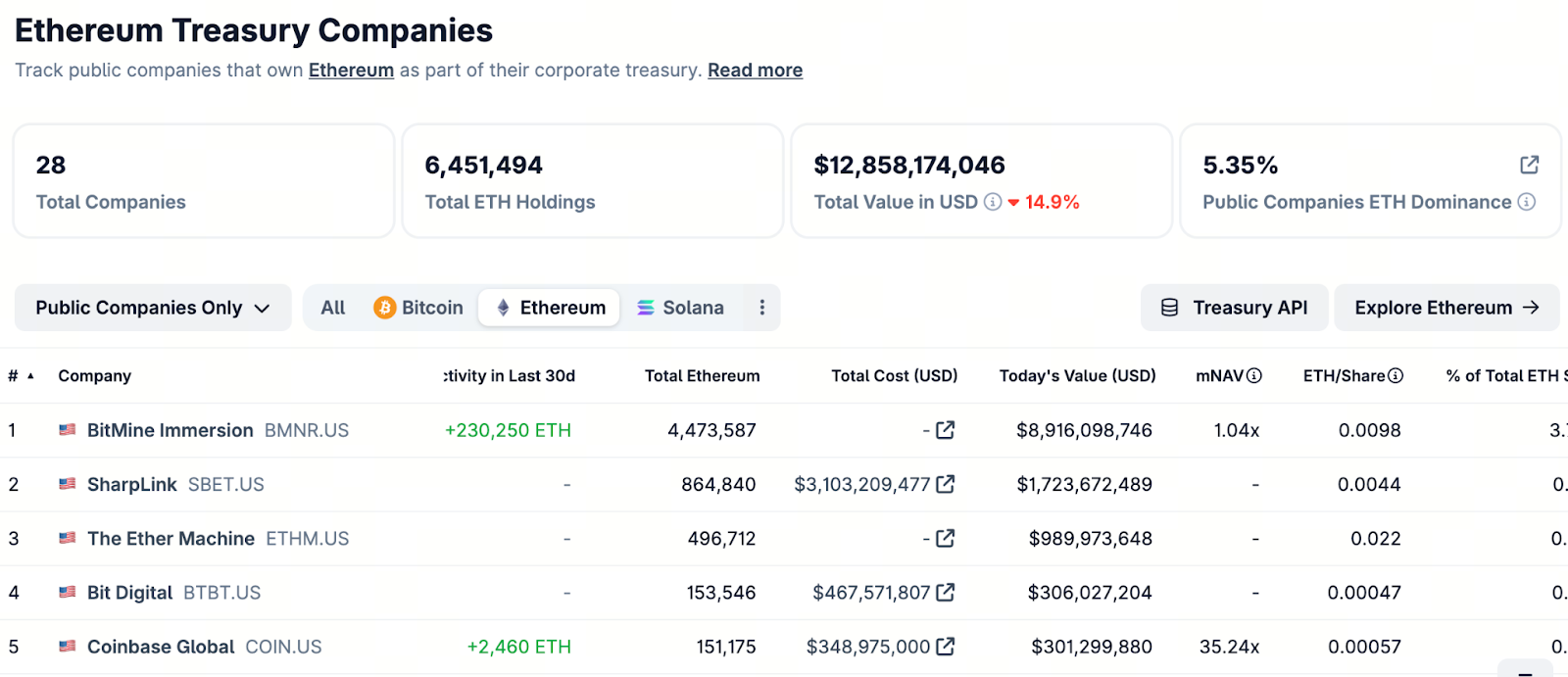
Among corporate crypto reserves, Bitmine currently stands as:

  • The world’s largest corporate holder of Ethereum reserves
  • Second globally in total corporate crypto reserves

Its holdings are second only to Strategy Inc. (NASDAQ: MSTR), which owns 717,722 BTC.

Institutional Reform and Industry Perspectives

Management believes that the US GENIUS Act, set to launch in 2025, together with the Securities and Exchange Commission’s (SEC) Project Crypto, will have a transformative impact on the financial system—comparable to the US ending the Bretton Woods system on August 15, 1971. Bitmine will continue to use ETH as its primary reserve asset, driving long-term value growth through staking and decentralized finance mechanisms.

Conclusion

Throughout periods of market volatility and industry adjustment, Bitmine has continued to expand its Ethereum holdings and increase its staking ratio, resulting in simultaneous growth in both asset scale and liquidity. As the company advances toward its 5% supply target, the MAVAN initiative further strengthens its infrastructure—demonstrating a focus on not only asset accumulation, but also long-term returns and operational efficiency. Whether Bitmine can maintain its accumulation pace and yield stability in a volatile environment will remain a key focus for the market.

Author: Allen
Disclaimer
* The information is not intended to be and does not constitute financial advice or any other recommendation of any sort offered or endorsed by Gate.
* This article may not be reproduced, transmitted or copied without referencing Gate. Contravention is an infringement of Copyright Act and may be subject to legal action.

Related Articles

AI-Native Settlement Layers: How United Stables Is Building the Next Financial Rail
Beginner

AI-Native Settlement Layers: How United Stables Is Building the Next Financial Rail

Stablecoins were originally designed as dollar substitutes within exchanges, primarily used for asset pricing and trade settlement. As on-chain financial ecosystems have matured, their role has expanded beyond simple payments to include collateral assets, cross-chain liquidity mediums, and unified settlement units. In particular, as AI systems and automated agents begin to participate directly in economic activity, demand has risen sharply for programmable value units capable of instant settlement. This shift is pushing stablecoins toward the role of foundational financial infrastructure.
2026-03-25 03:16:17
DePIN Identity Network and Real World Applications: How Humanity Protocol Brings on-chain Identity Into the Physical World
Beginner

DePIN Identity Network and Real World Applications: How Humanity Protocol Brings on-chain Identity Into the Physical World

Most Web3 identity systems remain confined to on-chain environments and struggle to achieve meaningful adoption in real world settings. Through a DePIN architecture and physical verification hardware, Humanity Protocol aims to bring decentralized identity into access control systems, hospitality, public services, and offline events, allowing on-chain identity to function not just as a digital credential, but as foundational infrastructure for real world access.
2026-03-25 07:40:53
Aster vs Hyperliquid: Which Perp DEX Will Prevail?
Beginner

Aster vs Hyperliquid: Which Perp DEX Will Prevail?

Aster and Hyperliquid are the two representative protocols of the "purpose-built L1 path" within the current decentralized perpetual exchange (Perp DEX) sector. As a pioneer in the field, Hyperliquid has built a deep liquidity moat through its highly mature order book architecture and strong community consensus. Conversely, Aster, as a rising challenger, seeks to leapfrog the competition in high-performance trading through more aggressive multi-chain aggregation logic, private transaction modules, and an underlying execution environment optimized for 2026 market demands.
2026-03-24 11:58:33
Gold Price Forecast for the Next Five Years: 2026–2030 Trend Outlook and Investment Implications, Could It Reach $6,000?
Beginner

Gold Price Forecast for the Next Five Years: 2026–2030 Trend Outlook and Investment Implications, Could It Reach $6,000?

Analyze current gold price trends alongside authoritative five-year forecasts, integrating an evaluation of market risks and opportunities. This gives investors insight into the potential trajectory of gold prices and the main drivers expected to shape the market over the next five years.
2026-03-25 18:13:30
Aerodrome Tokenomics: How ve(3,3) Powers Base's Most Profitable DEX
Beginner

Aerodrome Tokenomics: How ve(3,3) Powers Base's Most Profitable DEX

AERO is the native token of Aerodrome Finance, a core decentralized exchange and liquidity protocol in the Base ecosystem. It is primarily used for liquidity incentives and ecosystem operations. veAERO is a governance NFT that users receive by locking AERO, representing both voting power and the right to share protocol revenue. Through a dual track structure of AERO as a utility token and veAERO as a governance credential, Aerodrome separates liquidity usage value from long term governance power, allowing participants to act as liquidity providers, governance decision makers, and revenue sharers within the same system.
2026-03-25 06:40:31
The ve(3,3) Flywheel Explained: How AERO Tokenomics Powers Aerodrome’s DeFi Economy
Beginner

The ve(3,3) Flywheel Explained: How AERO Tokenomics Powers Aerodrome’s DeFi Economy

In the competition for DeFi liquidity, high-inflation mining alone is no longer enough to build lasting advantages. Aerodrome applies the ve(3,3) economic model to redesign token emissions, voting mechanisms, and revenue distribution, creating a liquidity flywheel centered on governance and cash flow. This article examines AERO tokenomics, the veAERO locking mechanism, and protocol revenue models to explain how Aerodrome builds a sustainable DeFi economic system.
2026-03-25 06:41:58