Bitcoin Crash Sparks Caution in Tech Stocks: Why Is the Market “Watching” Nvidia’s Outlook?

Beginner
Quick Reads
Last Updated 2026-03-27 16:56:20
Reading Time: 1m
A recent sharp drop in Bitcoin has sparked a wave of risk aversion. Futures for the Dow Jones Industrial Average, S&P 500, and Nasdaq Composite are declining simultaneously. Investors now view Nvidia Corporation (NVDA), the leading AI chip maker, as a key market indicator. This article explores why investors are cautious about Nvidia's future prospects.

Bitcoin’s Plunge Signals a Market Shift
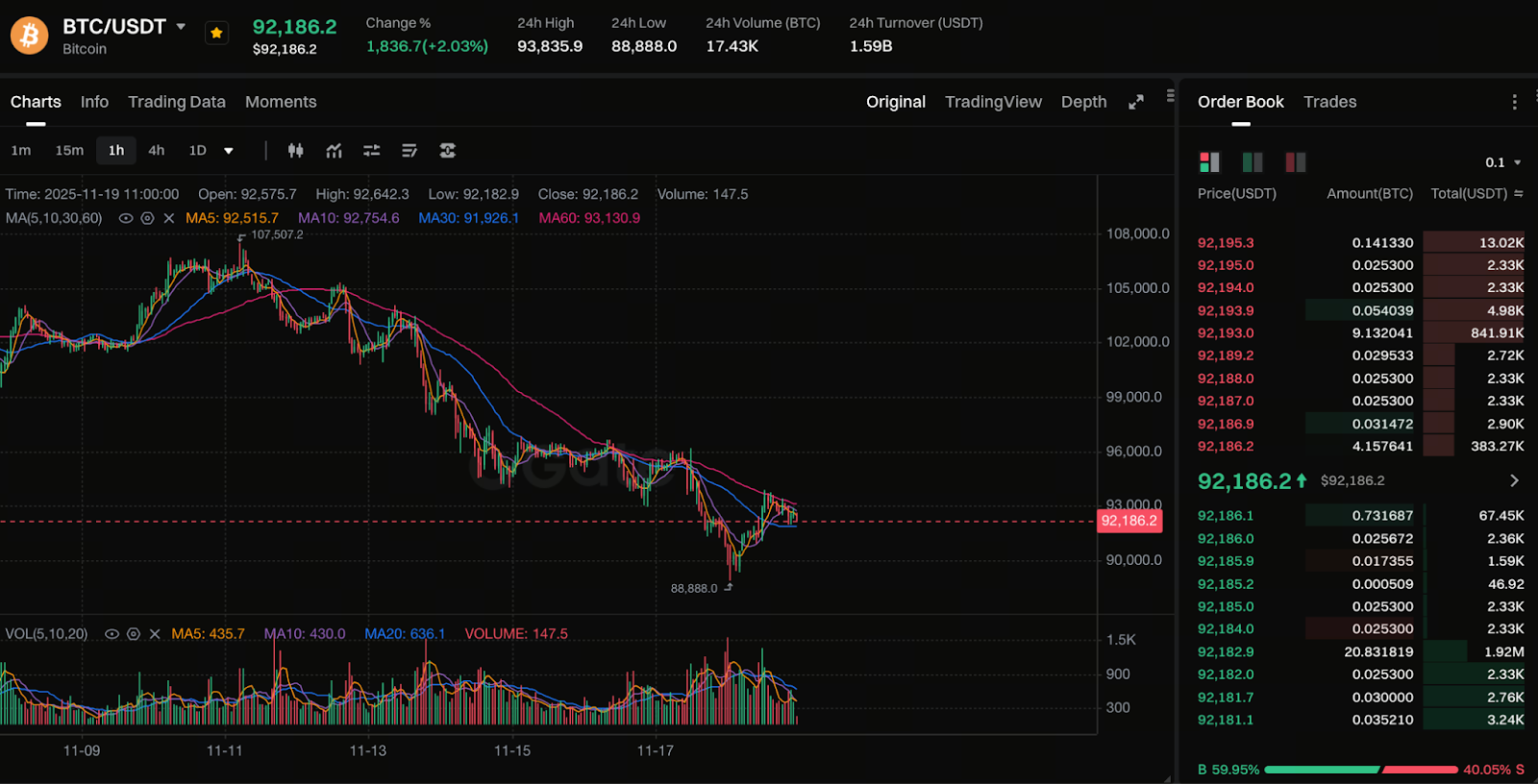

Chart: https://www.gate.com/trade/BTC_USDT

Recently, the correlation between cryptocurrency and traditional financial markets has steadily increased, and Bitcoin’s sharp decline has become a critical warning sign. Multiple reports indicate that Bitcoin dropped below $90,000, significantly dampening risk appetite among investors.

Major Index Futures Drop in Unison: Cautious Sentiment Takes Hold

At the same time, futures for the three major U.S. stock indexes—the Dow Jones Industrial Average, S&P 500, and Nasdaq Composite—have all moved downward. Economic Times data shows Dow futures fell about 0.3%, while S&P 500 futures slipped roughly 0.4%.

NVIDIA Becomes the Focal Point: Overvaluation or Profit-Taking Pressure?

As risk appetite wanes and tech valuations face scrutiny, investors now view NVIDIA Corporation as the market’s key bellwether. The reason is twofold: NVIDIA holds an undisputed lead in AI chips, and its market cap and growth outlook already price in years of rapid expansion. Yet, in today’s environment, investors are increasingly questioning whether that growth is sustainable. Will earnings growth justify NVIDIA’s lofty valuation? Are chip prices and data center demand at risk of slowing? According to Investing, NVIDIA shares dropped 2.8% as investors grow cautious ahead of its upcoming earnings release.

Widening Market Chain Reactions: Pressure on Tech Leaders Signals Sector Slowdown?

Bitcoin’s plunge and weakening overall sentiment have further fueled caution toward high-valuation tech stocks. As AP observes, when market heavyweights like NVIDIA—companies with massive market caps and broad influence—come under pressure, their ecosystem is often the first to experience a slowdown.

Investor Strategies: Prioritize Risk Control Over Aggressive Buying

How should everyday investors respond? Consider these key strategies:

  • Prioritize risk management and watch the data: Before NVIDIA’s earnings and macroeconomic indicators such as jobs, inflation, and interest rate trends become clear, investors should take a patient, wait-and-see approach as the safest move.
  • Separate growth expectations from valuation risk: For high-valuation stocks like NVIDIA, the realization of future growth is critical. Investors should weigh the risk of valuation pullbacks if growth slows.
  • Plan for scenarios: If data improves and risk appetite returns, high-growth stocks may rebound quickly. But if numbers stay weak or policy tightens, a defensive strategy is essential.

Conclusion: Caution Isn’t Bearishness—It’s Strategic Patience

In short, the current cautious approach toward NVIDIA is a rational response to Bitcoin’s decline, falling index futures, and elevated tech valuations. Caution doesn’t mean pessimism—but timing and patience are crucial. For investors, waiting for confirmation and avoiding premature moves can provide a stronger footing for whatever the market brings next.

Disclaimer
* The information is not intended to be and does not constitute financial advice or any other recommendation of any sort offered or endorsed by Gate.
* This article may not be reproduced, transmitted or copied without referencing Gate. Contravention is an infringement of Copyright Act and may be subject to legal action.

Related Articles

AI-Native Settlement Layers: How United Stables Is Building the Next Financial Rail
Beginner

AI-Native Settlement Layers: How United Stables Is Building the Next Financial Rail

Stablecoins were originally designed as dollar substitutes within exchanges, primarily used for asset pricing and trade settlement. As on-chain financial ecosystems have matured, their role has expanded beyond simple payments to include collateral assets, cross-chain liquidity mediums, and unified settlement units. In particular, as AI systems and automated agents begin to participate directly in economic activity, demand has risen sharply for programmable value units capable of instant settlement. This shift is pushing stablecoins toward the role of foundational financial infrastructure.
2026-03-25 03:16:17
DePIN Identity Network and Real World Applications: How Humanity Protocol Brings on-chain Identity Into the Physical World
Beginner

DePIN Identity Network and Real World Applications: How Humanity Protocol Brings on-chain Identity Into the Physical World

Most Web3 identity systems remain confined to on-chain environments and struggle to achieve meaningful adoption in real world settings. Through a DePIN architecture and physical verification hardware, Humanity Protocol aims to bring decentralized identity into access control systems, hospitality, public services, and offline events, allowing on-chain identity to function not just as a digital credential, but as foundational infrastructure for real world access.
2026-03-25 07:40:53
The ve(3,3) Flywheel Explained: How AERO Tokenomics Powers Aerodrome’s DeFi Economy
Beginner

The ve(3,3) Flywheel Explained: How AERO Tokenomics Powers Aerodrome’s DeFi Economy

In the competition for DeFi liquidity, high-inflation mining alone is no longer enough to build lasting advantages. Aerodrome applies the ve(3,3) economic model to redesign token emissions, voting mechanisms, and revenue distribution, creating a liquidity flywheel centered on governance and cash flow. This article examines AERO tokenomics, the veAERO locking mechanism, and protocol revenue models to explain how Aerodrome builds a sustainable DeFi economic system.
2026-03-25 06:41:58
Aerodrome Tokenomics: How ve(3,3) Powers Base's Most Profitable DEX
Beginner

Aerodrome Tokenomics: How ve(3,3) Powers Base's Most Profitable DEX

AERO is the native token of Aerodrome Finance, a core decentralized exchange and liquidity protocol in the Base ecosystem. It is primarily used for liquidity incentives and ecosystem operations. veAERO is a governance NFT that users receive by locking AERO, representing both voting power and the right to share protocol revenue. Through a dual track structure of AERO as a utility token and veAERO as a governance credential, Aerodrome separates liquidity usage value from long term governance power, allowing participants to act as liquidity providers, governance decision makers, and revenue sharers within the same system.
2026-03-25 06:40:31
Aster vs Hyperliquid: Which Perp DEX Will Prevail?
Beginner

Aster vs Hyperliquid: Which Perp DEX Will Prevail?

Aster and Hyperliquid are the two representative protocols of the "purpose-built L1 path" within the current decentralized perpetual exchange (Perp DEX) sector. As a pioneer in the field, Hyperliquid has built a deep liquidity moat through its highly mature order book architecture and strong community consensus. Conversely, Aster, as a rising challenger, seeks to leapfrog the competition in high-performance trading through more aggressive multi-chain aggregation logic, private transaction modules, and an underlying execution environment optimized for 2026 market demands.
2026-03-24 11:58:33
Gold Price Forecast for the Next Five Years: 2026–2030 Trend Outlook and Investment Implications, Could It Reach $6,000?
Beginner

Gold Price Forecast for the Next Five Years: 2026–2030 Trend Outlook and Investment Implications, Could It Reach $6,000?

Analyze current gold price trends alongside authoritative five-year forecasts, integrating an evaluation of market risks and opportunities. This gives investors insight into the potential trajectory of gold prices and the main drivers expected to shape the market over the next five years.
2026-03-25 18:13:30





