 In recent years, artificial intelligence has rapidly expanded across the financial sector. Initially, AI was used primarily to organize market data or provide analytical support. However, as algorithmic models and computing power have advanced, AI’s role is undergoing a fundamental shift.
Within digital asset markets, AI now analyzes price movements and market sentiment, builds data-driven trading strategies, and can even execute trades automatically. This marks a transition from AI serving as a mere analytical tool to becoming an active market participant.
As AI begins to interact directly with markets, trading platform design must evolve. Future platforms will need to serve both human users and provide technical environments where AI systems can operate autonomously.
Gate for AI: Building Infrastructure for Intelligent Trading
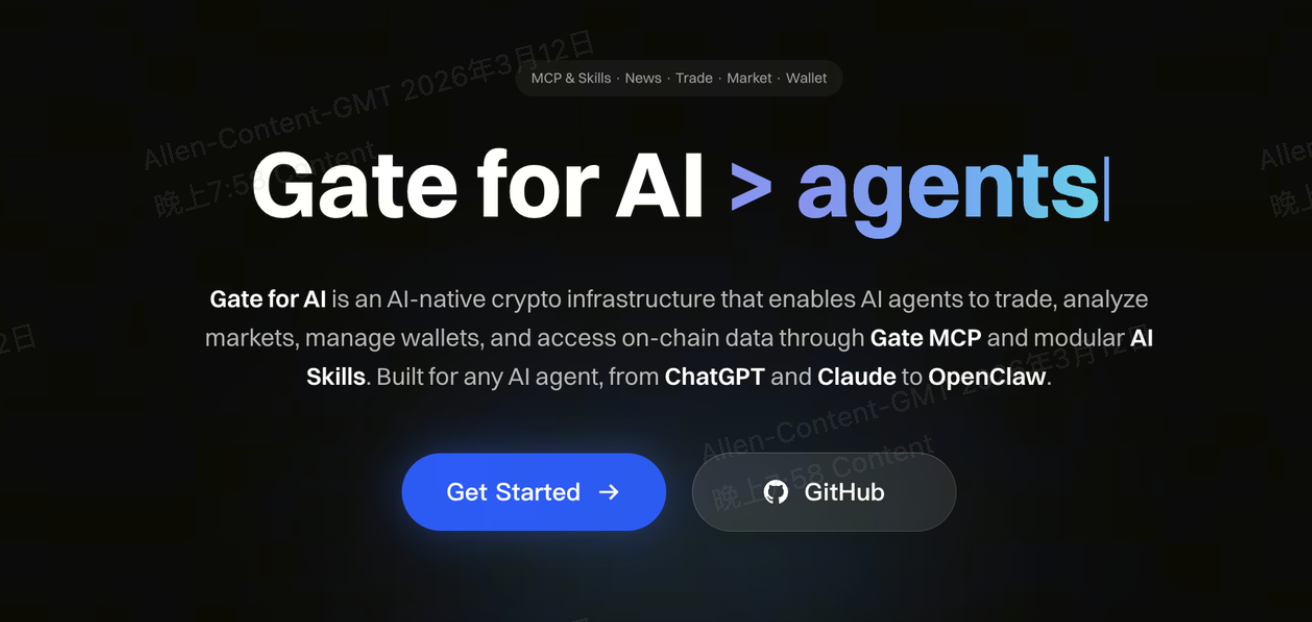
As AI technology becomes increasingly integrated into trading processes, Gate has launched Gate for AI—an infrastructure purpose-built for artificial intelligence applications in trading.
Unlike traditional platforms, Gate for AI consolidates multiple core functions within a single system. This allows AI to complete the entire trading workflow in one environment, including:
-
Real-time market data access
-
Strategy analysis and model-based decision-making
-
Trade execution and asset management
This integrated design enables developers to deploy AI trading strategies more efficiently, while minimizing the technical challenges of multi-platform integration.
Core Functional Modules Create a Comprehensive Trading Environment
To support AI systems across diverse market scenarios, Gate for AI features multiple functional modules, forming a robust intelligent trading framework.
- Centralized Trading Capabilities
The platform supports spot and derivative trading, allowing AI systems to place orders, manage positions, and adjust strategies directly. With high-speed trading interfaces, AI can respond rapidly to market changes.
- Decentralized Trading Integration
Beyond centralized markets, Gate for AI also supports on-chain trading environments. AI Agents can participate in the DeFi ecosystem for asset swaps and other on-chain operations.
- Wallet and Security Approval Mechanism
The system includes built-in wallet management and signature approval, ensuring AI operates in a secure and controlled environment during on-chain interactions and reducing asset management risk.
- Real-Time Market Data System
The platform provides high-frequency market data updates and event monitoring, enabling AI to stay on top of market movements and adjust strategies in real time.
- On-Chain Data Analysis
By analyzing on-chain fund flows and address activity, AI can extract market signals from a broader range of data, enhancing strategy development and decision-making.
These integrated modules empower AI to access data, analyze markets, and execute trades all within a unified environment.
Dual-Layer Architecture for Greater System Flexibility
To maximize scalability, Gate for AI adopts a dual-layer architecture, separating foundational operations from strategy applications.
MCP: Standardized Interface Layer
The MCP layer offers a unified set of interfaces, allowing AI to quickly access core platform functions such as:
This standardized approach makes it easier for various AI models to connect with the platform.
Skills: Strategy and Application Layer
Above the MCP layer, the Skills layer delivers advanced strategy capabilities, including:
-
Trading strategy integration
-
Market opportunity identification
-
Auto-generating trading recommendations
This enables AI to not only execute instructions but also conduct complex market analysis and strategic decision-making.
AI Agents Are Entering Real-World Trading Scenarios
Gate for AI’s core value lies in transforming exchange functions into infrastructure that AI can access directly.
In this system, AI Agents can:
-
Analyze trends across multiple markets
-
Generate trading strategies from data
-
Execute trades in real time
With a highly integrated platform architecture, AI no longer needs to rely on disparate tools or services to complete the trading process.
This shift signals that automated trading is evolving from a support tool into a primary operating model in digital asset markets.
Gate AI: Enhancing the Smart User Experience for All
Beyond Gate for AI’s developer-centered architecture, Gate has also introduced Gate AI—enabling general users to access AI-powered services more conveniently.
Currently, Gate AI provides several practical features, such as:
-
Account and asset information queries
-
Viewing activities and promotions
-
Participating in earn products
-
Tracking returns and asset changes
With AI support, users can find the information they need faster and enjoy a more intuitive experience.
The Convergence of AI and the Web3 Ecosystem
As AI technology and blockchain ecosystems converge, a new trading paradigm is emerging. In the future, AI could play a major role in areas such as:
-
Automated portfolio management
-
Intelligent trading strategy generation
-
Cross-market asset allocation
Gate also plans to continue expanding Gate for AI’s functional modules, adding more strategy tools and risk management features to meet the diverse needs of developers and investors.
Get involved now and learn more about Gate for AI: https://www.gate.com/gate-for-ai
Summary
Artificial intelligence is steadily reshaping trading in the digital asset market. Evolving from a data analysis tool to a system capable of generating strategies and executing trades, AI is now a driving force in market operations. Gate’s Gate for AI brings together trading functions, on-chain capabilities, and market data to create an infrastructure tailored for AI. Powered by the MCP and Skills architecture, AI Agents can execute trades, analyze strategies, and make decisions. As AI technology advances, this intelligent system-driven trading model could become a defining trend for digital asset markets, accelerating the Web3 ecosystem toward greater automation and intelligence.







