Ahead of the Fed Decision, Bitcoin Nears $92,500: Hype, Uncertainty, or Opportunity?

Beginner
Quick Reads
Last Updated 2026-03-27 00:32:34
Reading Time: 1m
Expectations for a Federal Reserve rate cut are heating up, pushing Bitcoin’s price close to $92,500. With policy decisions on the horizon, the cryptocurrency market is feeling uneasy: Is this the start of a year-end rebound, or just the onset of short-term volatility?

Federal Reserve Rate Decision Nears, Market Sentiment Intensifies

As the Federal Reserve prepares to announce its latest interest rate decision on December 10 (New York time), global financial markets are on high alert. Many institutions anticipate a 25 basis point rate cut. Investors are adjusting their positions in anticipation of a potential shift in monetary policy. This has led to noticeable changes in capital allocation, spanning from traditional finance to crypto assets.

In this environment, Bitcoin has emerged as a key market focus. Expectations in the crypto market for “zero-yield assets, accommodative monetary policy, and inflation hedging” have reignited strong interest in Bitcoin.

Recent Bitcoin Price Trends
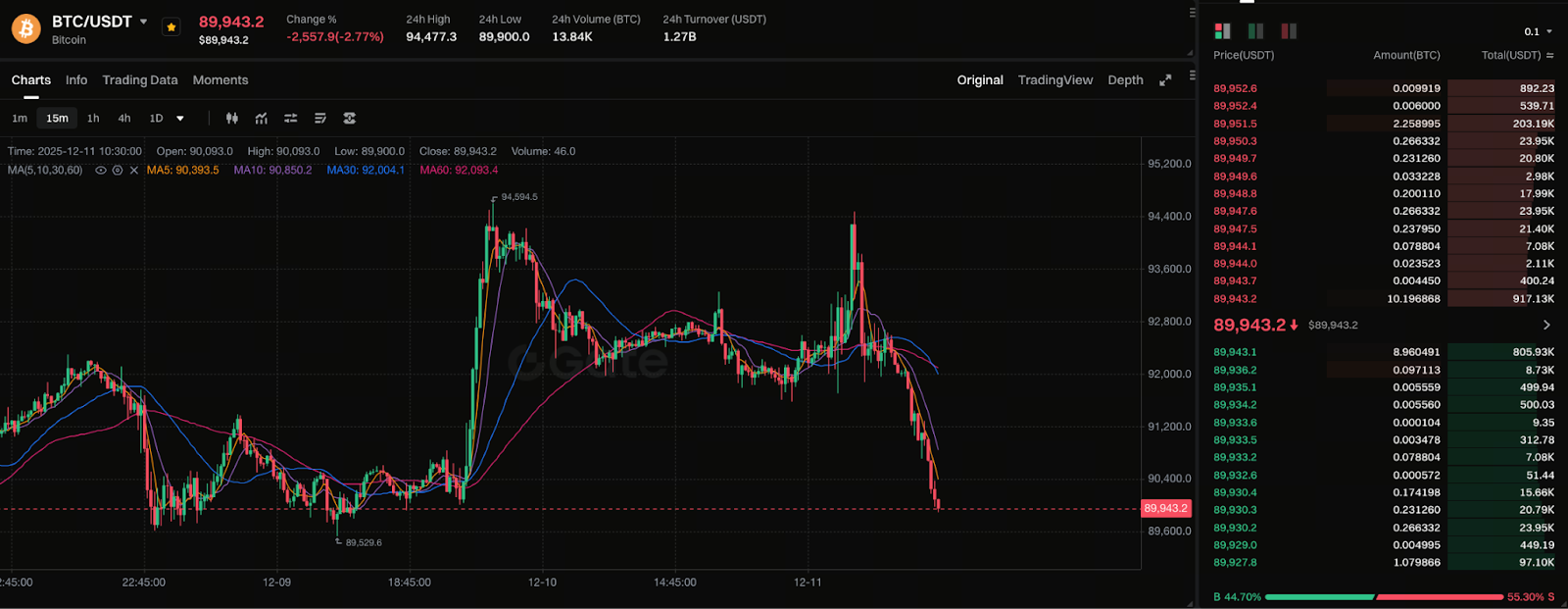

Chart: https://www.gate.com/trade/BTC_USDT

Recent data shows that Bitcoin’s price has been highly volatile over the past several days. It briefly surpassed $94,000 before retreating to around $92,500.

Specifically, one report highlighted that Bitcoin rebounded sharply from a late November low near $83,800. Daily-level technical indicators improved, pointing to a potential recovery in bullish sentiment. However, some analysts note that Bitcoin is oscillating between $92,800 and $88,100, suggesting the market may be entering a consolidation phase.

Why Do Rate Cut Expectations Lift Crypto Assets?

First, lower interest rates mean declining yields on traditional bonds, reducing the opportunity cost of holding non-yielding assets such as Bitcoin and gold. This makes crypto assets more attractive compared to cash or low-yield bonds.

Second, an accommodative monetary policy usually signals future economic stimulus and increased liquidity. In this environment, risk assets—including cryptocurrencies—tend to benefit. Several market research firms have indicated that if the Federal Reserve cuts rates, Bitcoin could become a key channel for capital inflows.

Finally, as institutional investors enter the market and retail attention grows, the volatility of crypto assets is increasingly correlated with traditional equities. For those seeking to hedge against inflation or currency depreciation, Bitcoin offers compelling appeal.

Risks and Uncertainties: Why Is BTC Struggling to Break Key Resistance?

Even with strong expectations for rate cuts, Bitcoin is not guaranteed to rally sharply. Some analysts point out that the market may have already priced in “rate cuts and easing.” If the Federal Reserve delivers a hawkish outlook, the price could face a “sell the news” reaction.

Additionally, crypto market research firms warn that Bitcoin is currently in a structurally “fragile zone.” This makes it difficult for the price to break above $100,000, while any selling pressure could trigger a swift pullback.

Furthermore, as institutional players increasingly drive price action, the correlation between traditional equities and cryptocurrencies is strengthening. Volatility in AI, technology stocks, and traditional assets can also move Bitcoin. If overall risk appetite declines, Bitcoin could be dragged lower as well.

How Should Investors Navigate Risks and Opportunities?

If you’re considering positioning in Bitcoin at this stage, maintain caution and flexibility. Consider these points:

  • Keep your position sizing reasonable; avoid overconcentration. Given the significant volatility, allocating all assets to Bitcoin carries high risk.
  • Monitor official Federal Reserve statements and key fundamentals such as inflation and employment data. Should the Fed signal a hawkish stance on future rate hikes, Bitcoin may retreat quickly.
  • Set clear take-profit and stop-loss thresholds. If the price breaks above $95,000 or falls below $88,000, have your exit plan ready in advance.
  • Consider a long-term holding strategy. If you are optimistic about the medium- to long-term outlook—such as greater institutional adoption and regulatory improvements in 2026 and beyond—short-term volatility may offer attractive entry points.

Conclusion

On the eve of the Federal Reserve’s rate decision, Bitcoin briefly surged to $92,500 on rate cut expectations, sparking strong market enthusiasm. However, uncertainties—including “priced-in expectations, policy divergence, and structural trading ranges”—have also intensified. For investors, rationality and patience may prove more valuable than aggressive moves. If you’re preparing for a potential rebound, remain vigilant about downside risks.

Author: Max
Disclaimer
* The information is not intended to be and does not constitute financial advice or any other recommendation of any sort offered or endorsed by Gate.
* This article may not be reproduced, transmitted or copied without referencing Gate. Contravention is an infringement of Copyright Act and may be subject to legal action.

Related Articles

AI-Native Settlement Layers: How United Stables Is Building the Next Financial Rail
Beginner

AI-Native Settlement Layers: How United Stables Is Building the Next Financial Rail

Stablecoins were originally designed as dollar substitutes within exchanges, primarily used for asset pricing and trade settlement. As on-chain financial ecosystems have matured, their role has expanded beyond simple payments to include collateral assets, cross-chain liquidity mediums, and unified settlement units. In particular, as AI systems and automated agents begin to participate directly in economic activity, demand has risen sharply for programmable value units capable of instant settlement. This shift is pushing stablecoins toward the role of foundational financial infrastructure.
2026-03-25 03:16:17
DePIN Identity Network and Real World Applications: How Humanity Protocol Brings on-chain Identity Into the Physical World
Beginner

DePIN Identity Network and Real World Applications: How Humanity Protocol Brings on-chain Identity Into the Physical World

Most Web3 identity systems remain confined to on-chain environments and struggle to achieve meaningful adoption in real world settings. Through a DePIN architecture and physical verification hardware, Humanity Protocol aims to bring decentralized identity into access control systems, hospitality, public services, and offline events, allowing on-chain identity to function not just as a digital credential, but as foundational infrastructure for real world access.
2026-03-25 07:40:53
The ve(3,3) Flywheel Explained: How AERO Tokenomics Powers Aerodrome’s DeFi Economy
Beginner

The ve(3,3) Flywheel Explained: How AERO Tokenomics Powers Aerodrome’s DeFi Economy

In the competition for DeFi liquidity, high-inflation mining alone is no longer enough to build lasting advantages. Aerodrome applies the ve(3,3) economic model to redesign token emissions, voting mechanisms, and revenue distribution, creating a liquidity flywheel centered on governance and cash flow. This article examines AERO tokenomics, the veAERO locking mechanism, and protocol revenue models to explain how Aerodrome builds a sustainable DeFi economic system.
2026-03-25 06:41:58
Aerodrome Tokenomics: How ve(3,3) Powers Base's Most Profitable DEX
Beginner

Aerodrome Tokenomics: How ve(3,3) Powers Base's Most Profitable DEX

AERO is the native token of Aerodrome Finance, a core decentralized exchange and liquidity protocol in the Base ecosystem. It is primarily used for liquidity incentives and ecosystem operations. veAERO is a governance NFT that users receive by locking AERO, representing both voting power and the right to share protocol revenue. Through a dual track structure of AERO as a utility token and veAERO as a governance credential, Aerodrome separates liquidity usage value from long term governance power, allowing participants to act as liquidity providers, governance decision makers, and revenue sharers within the same system.
2026-03-25 06:40:31
Aster vs Hyperliquid: Which Perp DEX Will Prevail?
Beginner

Aster vs Hyperliquid: Which Perp DEX Will Prevail?

Aster and Hyperliquid are the two representative protocols of the "purpose-built L1 path" within the current decentralized perpetual exchange (Perp DEX) sector. As a pioneer in the field, Hyperliquid has built a deep liquidity moat through its highly mature order book architecture and strong community consensus. Conversely, Aster, as a rising challenger, seeks to leapfrog the competition in high-performance trading through more aggressive multi-chain aggregation logic, private transaction modules, and an underlying execution environment optimized for 2026 market demands.
2026-03-24 11:58:33
Gold Price Forecast for the Next Five Years: 2026–2030 Trend Outlook and Investment Implications, Could It Reach $6,000?
Beginner

Gold Price Forecast for the Next Five Years: 2026–2030 Trend Outlook and Investment Implications, Could It Reach $6,000?

Analyze current gold price trends alongside authoritative five-year forecasts, integrating an evaluation of market risks and opportunities. This gives investors insight into the potential trajectory of gold prices and the main drivers expected to shape the market over the next five years.
2026-03-25 18:13:30





