As AI becomes deeply involved in data trading, compute scheduling, and automated service networks, traditional account based authorization systems are increasingly unable to support high frequency, low value, cross platform machine transactions. Kite introduces machine-native payments, on-chain identity through KitePass, Proof of AI attribution, and causal sequence consensus to ensure that AI contributions, behaviors, and rewards can be precisely recorded and settled. At the same time, token governance, staking security, and value recycling are designed as a closed loop, enabling AI to move from a tool into an on-chain economic actor with real asset value and financial attributes.
This article starts with an overview of the Kite project and the background of agent-native economies. It then explains how Kite redefines AI asset value, examines the governance and payment role of the KITE token, its token economic structure, and the logic behind key on-chain indicators. By contrasting Kite with centralized AI platforms, the article helps readers understand Kite’s position within decentralized AI infrastructure and its potential role in future machine economies.
Kite Project Overview

(Source: GoKiteAI)
As AI increasingly participates in data trading, compute orchestration, and automated service networks, systems that rely on centralized authorization and account models reveal growing efficiency and trust limitations. Kite is built as an EVM compatible Layer 1 blockchain that integrates on-chain identity, smart contracts, and peer to peer settlement directly into AI execution logic. This allows AI agents to authenticate, collaborate, and exchange value without intermediaries. Through multi layer identity design and agent-native payment architecture, Kite improves transparency and fund security, while enabling AI to participate in real economic activity within a verifiable framework.
Financializing the AI Agent Economy: How Kite Defines AI Asset Value
Kite does not define AI asset value by model size or raw compute power. Instead, value comes from whether an AI agent can perform real, verifiable economic actions. As AI evolves from a descriptive tool into an operational agent that can compare prices, place orders, pay, and settle transactions, human centered financial systems struggle to meet the demands of high frequency, low value, cross platform machine activity.
Kite builds a machine-native economic foundation by introducing causal sequence mechanisms at the consensus layer to ensure logical ordering and reliable execution in multi agent collaboration. At the protocol level, identity through KitePass, high speed micropayments, and Proof of AI attribution are natively integrated. This ensures that every data contribution, model call, and task execution can be precisely recorded, priced, and rewarded. Within this structure, AI is no longer a passive consumer of resources. It becomes an on-chain economic participant with identity, budget, accountability, and revenue rights. AI asset value is no longer abstract. It is expressed as settled contributions, auditable behavior, and sustainable income streams.
The Role of the KITE Token: Governance, Staking, and Payment Flow
KITE is the native token of the Kite network, and its core functions span three areas: network governance, security staking, and AI service value flow.
By design, KITE is not just a medium of exchange. It represents economic rights within the agent-native economy. Validators and delegators stake KITE to participate in consensus and secure the network, with rewards linked to the real performance of supported modules. Token holders participate in governance by voting on protocol upgrades, incentive policies, and module standards, ensuring that long term ecosystem development aligns with collective interests.
At the payment layer, stablecoin revenue generated by AI services is converted into KITE and redistributed to modules and the base network. This makes the token the core settlement and revenue sharing asset for AI value creation, establishing a use-driven reward cycle where contribution directly translates into economic return.
Kite AI Token Economic Model
Kite’s token economic model centers on value driven by real usage. The total supply is capped at ten billion tokens. Distribution and non inflationary design tightly link token value to the actual growth of the AI ecosystem.
In the initial allocation, 48% is reserved for ecosystem and community development, 20% for modules to incentivize high quality AI services, 20% for the team and early contributors, and 12% for investors. This structure prioritizes participants who create and sustain real value.
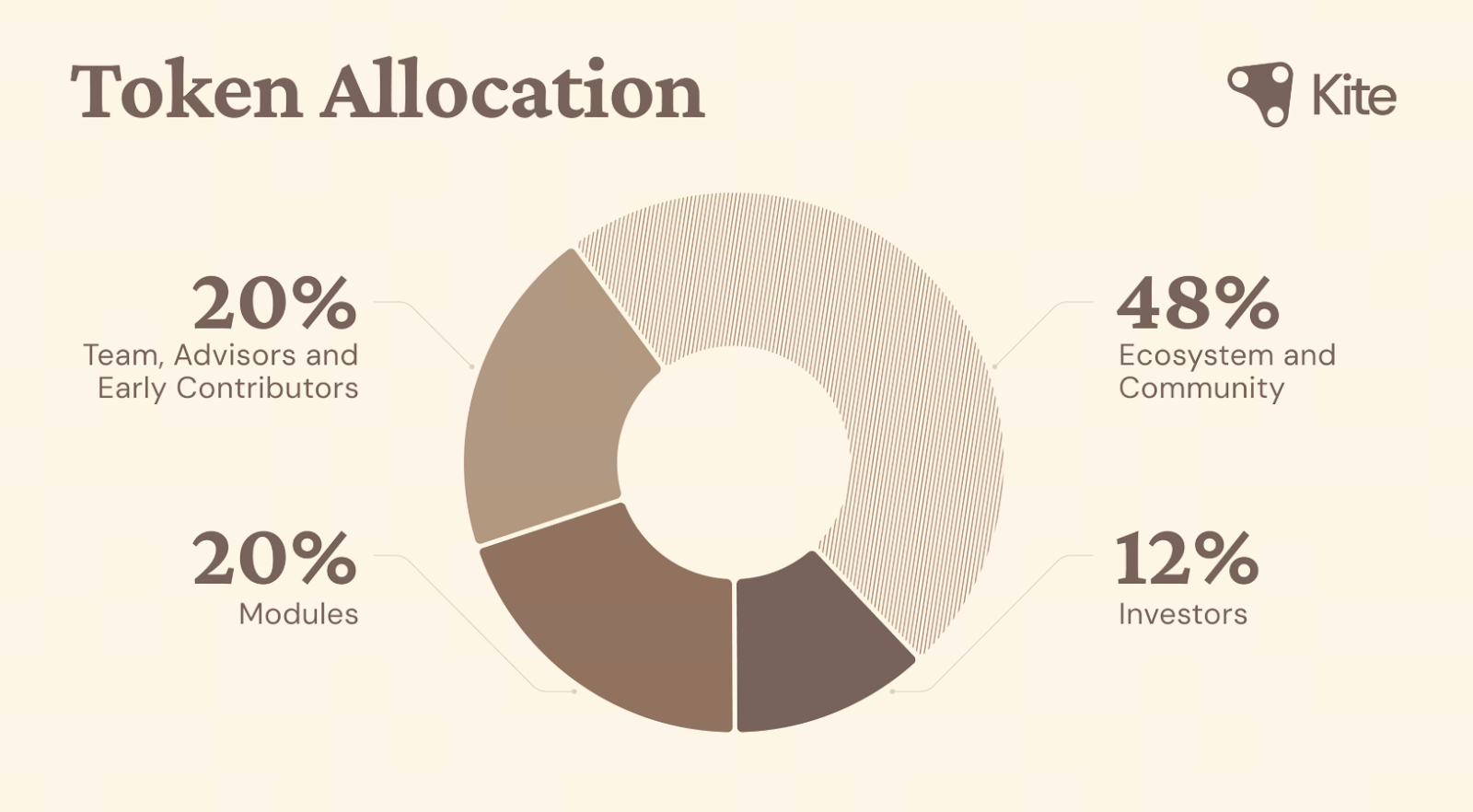
(Source: gokite whitepaper)
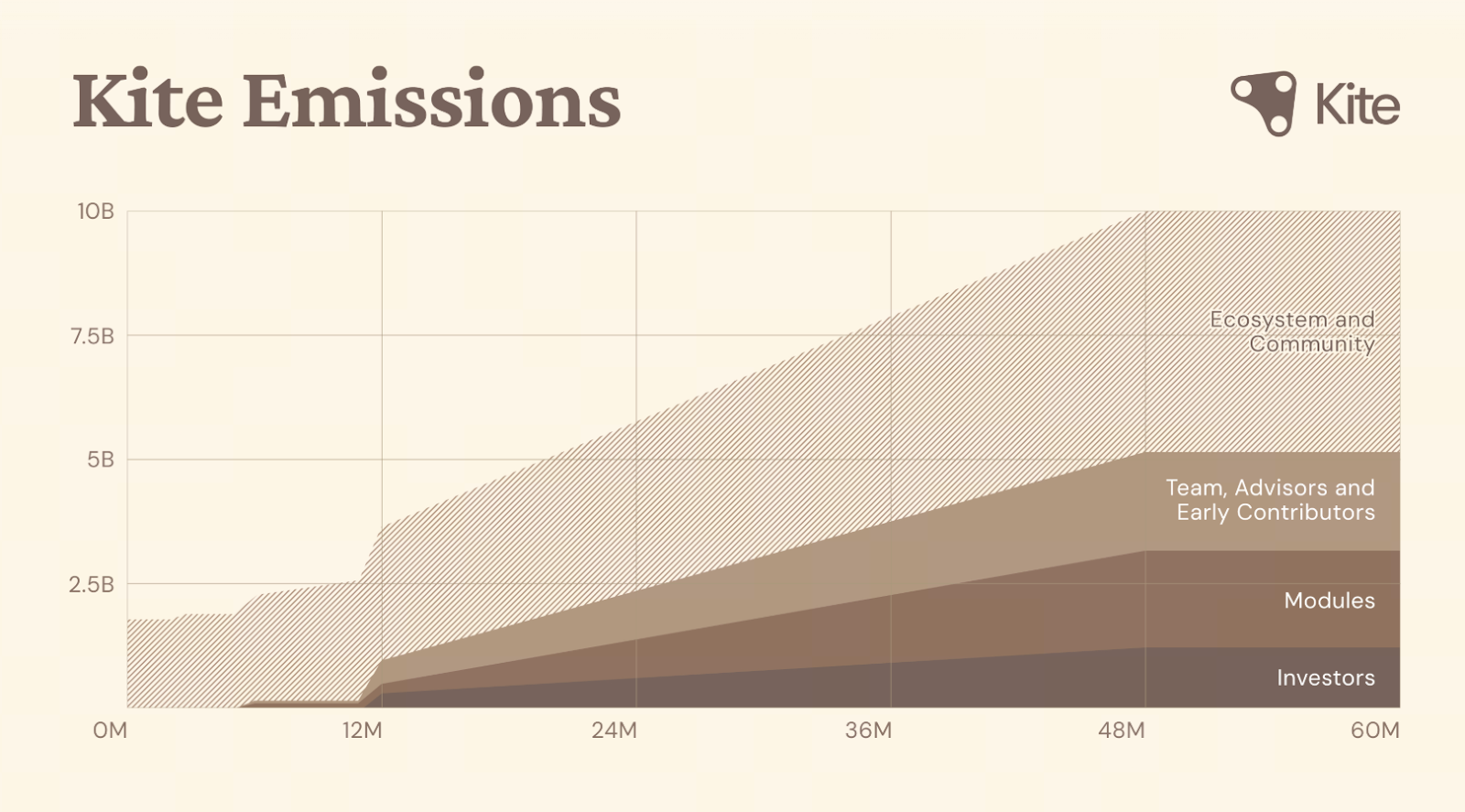
(Indicative KITE token issuance over time, Source: gokite whitepaper)
Operationally, Kite adopts a revenue oriented model. Fees generated by AI services flow back to the network, are converted into KITE, and distributed to modules and staking participants. This gradually replaces traditional PoS inflation as the primary reward mechanism. A delayed release design encourages participants to balance immediate liquidity with long term returns, transforming token recipients into aligned long term stakeholders. Over time, this creates a self reinforcing machine economy flywheel driven by real AI demand.
Key Metrics and Calculation Logic
In Kite’s model, token value is not driven by narrative expectations alone. It is grounded in quantifiable on-chain indicators. The core logic focuses on actual usage intensity and includes three main data categories.
The first is AI service transaction volume, measured by real invocation counts and settlement value, which reflects genuine network demand. The second is protocol revenue, derived from AI service fees and module commissions. This stablecoin revenue is continuously converted into KITE, creating long term buy pressure. The third is token lockup and staking ratios, including KITE locked in module liquidity pools and staked by validators and delegators. These metrics indicate market confidence in network security and long term development.
Together, these indicators form a closed loop model of usage leading to revenue, revenue converting into token demand, and token lockup reducing circulating supply.
Why These Metrics Matter to Traders
For traders, these metrics mean that KITE price dynamics can be directly linked to operational performance rather than sentiment alone. Rising AI service usage increases protocol revenue, which leads to more stablecoins being converted into KITE, creating structural demand. Higher module lockups and staking ratios reduce circulating supply and signal long term alignment among ecosystem participants.
These indicators function as Kite’s on-chain fundamentals, similar to revenue, cash flow, and user growth in traditional markets. Tracking their trends allows traders to assess whether KITE is entering a genuine growth phase or merely experiencing short term speculation.
How Kite’s Decentralized Structure Differs from Traditional AI Platforms
Compared with centralized AI leaders such as OpenAI, Google, or Anthropic, Kite’s differentiation lies not in model performance but in economic structure and power distribution. Traditional AI platforms operate as closed systems where data access, model usage, pricing rules, and revenue distribution are controlled unilaterally. Developers and users participate without ownership of data assets or value flows.
Kite adopts decentralized architecture that embeds identity, payment, settlement, and governance into the protocol layer. On-chain identity and programmable permissions allow AI agents to transact, settle, and collaborate without trusted intermediaries. Data providers, model developers, and compute nodes all receive verifiable on-chain rewards.
This structural shift transforms Kite from a platform based AI model into a protocol based AI economic infrastructure. Its advantage is not stronger models, but the ability to support a sustainable, participatory, and revenue sharing machine economy.
Conclusion
Kite aims to redefine the foundation of AI and blockchain integration. Through on-chain identity, machine-native payments, and a measurable token economic model, it builds an agent-native economy driven by real usage. In this system, AI becomes an on-chain economic actor with assets, accountability, and income rights. Token value evolves from narrative driven speculation into a dynamic reflection of service demand, protocol revenue, and network security.
As decentralized AI infrastructure matures, Kite’s long term potential depends on its ability to attract real applications and developers, and to anchor the machine economy flywheel in verifiable value flows. If successful, it represents a meaningful step toward a more open, collaborative, and sustainable future for AI driven economies.







