
Aptos Foundation released a comprehensive tokenomics update on April 14, using seven mechanisms to drive the protocol’s supply model transition from a “subsidy-driven” approach to a “performance-driven” approach. Key adjustments include lowering the staking annualized rate from 5.19% to 2.6%, increasing Gas fees by 10x, setting a hard cap of 2.1 billion tokens for the protocol layer, and permanently locking 210 million APT.
Seven Core Token Reform Measures
Staking annualized rate lowered to 2.6%: Reduced from the current 5.19%; at the same time, exploring differentiated designs that can offer higher reward rates for long-term staking commitments; validator operating costs will be significantly reduced according to AIP-139
Gas fees increased by 10x: After the increase, stablecoin transfers remain as low as about 0.00014 USD, maintaining their status among the world’s lowest fees; all Gas fees paid in APT are permanently burned
Set a hard cap of 2.1 billion tokens for total supply: The protocol layer’s total supply cap is established through governance; with the current circulating supply at 1.2B, there are still 904 million within the hard-cap space (about 43%)
Permanently lock 210 million APT: The Foundation permanently locks and stakes them, accounting for about 18% of the current circulating supply; these tokens are never sold or distributed, effectively equivalent to burning
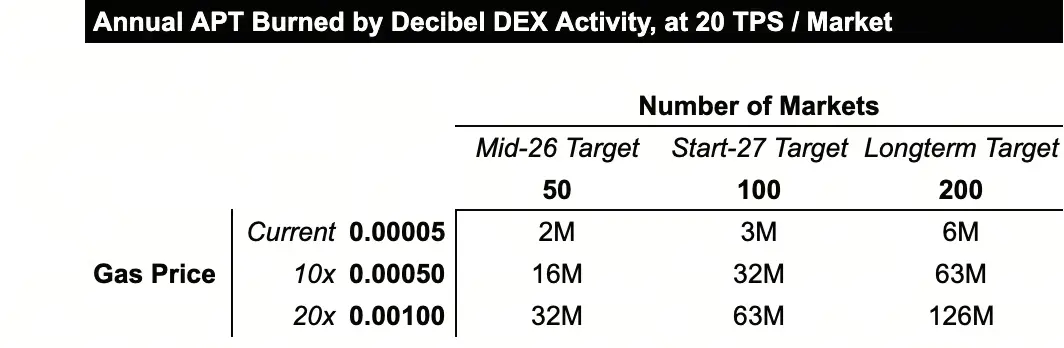
Decibel DEX burns over 32 million tokens annually: The first fully on-chain decentralized exchange, planned to cover 100+ markets; once each market reaches 10k TPS, the annual burn volume will further grow
Milestone-triggered incentives: In the future, subsidies and rewards will be tied to KPIs; if performance targets are not met, token allocations are delayed rather than canceled
Programmatic buyback plan: The Foundation explores using existing cash or future authorized income, along with ecosystem investment income, to programmatically buy back APT on the open market
Structural Background for a Deflationary Transition: 2026 Is a Critical Turning Point
This reform timing has structural support. The four-year unlock cycle for initial investors and key contributors will end in October 2026; at that time, the annual token supply unlock amount will naturally decrease by about 60%; the Foundation’s grant allocations will also reduce by over 50% year over year between 2026 and 2027. Aptos’s supply pressure was already at a natural turning point; with these seven mechanisms layered with structural constraints, the goal is for the annual APT removal amount to exceed the issuance amount after Decibel DEX scales up, achieving deflationary supply.
From the demand side, institutions such as BlackRock, Franklin Templeton, and Apollo have already deployed hundreds of millions of dollars on Aptos. Application revenue growth reached 1,552%, rising to $33.5 million, providing a sustained foundation for trading activity for the deflationary model.
Frequently Asked Questions
What is the real impact of Aptos lowering its staking annualized rate from 5.19% to 2.6% on stakers?
Staking rewards shrink by about half; returns for stakers whose purpose is purely passive holding yield will decrease. But the Foundation is also exploring differentiated mechanisms that offer higher reward rates for long-term commitments, encouraging long-term network participation; with validator hardware costs reduced significantly under AIP-139, it also offsets, to some extent, the impact of the reward reduction.
Does increasing Gas fees by 10x affect Aptos’s cost-competitiveness for usage?
The impact is extremely small. Even after the 10x increase, the stablecoin transfer cost is still about $0.00014, remaining among the world’s lowest fees across mainstream blockchains. The main purpose of raising Gas fees is to increase the amount of APT burned, not to change the cost-competitiveness landscape—so it has almost no effect on the real day-to-day usage costs for individual users and institutions.
How does Decibel DEX drive deflationary momentum for APT?
As a fully on-chain decentralized exchange that executes every trade on-chain, Decibel consumes APT as Gas fees for each order, matching, and cancellation, and burns all of it permanently. After it is expected to cover 100+ markets, it is projected to burn over 32 million APT per year. As TPS and market scale expand, the burn volume will continue to grow, forming a deflationary flywheel effect driven by trading activity.
Disclaimer: The information on this page may come from third parties and does not represent the views or opinions of Gate. The content displayed on this page is for reference only and does not constitute any financial, investment, or legal advice. Gate does not guarantee the accuracy or completeness of the information and shall not be liable for any losses arising from the use of this information. Virtual asset investments carry high risks and are subject to significant price volatility. You may lose all of your invested principal. Please fully understand the relevant risks and make prudent decisions based on your own financial situation and risk tolerance. For details, please refer to
Disclaimer.
Related Articles
Ripple Outlines Four-Phase Quantum-Safe Plan for XRP Ledger by 2028
Ripple has developed a four-phase roadmap to secure the XRP Ledger against quantum computing threats by 2028, addressing concerns over blockchain cryptography vulnerabilities. Key phases include researching quantum risks and implementing advanced security methods. XRP Ledger is currently better equipped than Bitcoin, with built-in key rotation enhancing safety.
GateNews1h ago
Hong Kong Launches 24/7 Trading Framework for Tokenized Funds, AUM Reaches $1.37B
Hong Kong's Securities and Futures Commission (SFC) has established a regulatory framework for round-the-clock trading of tokenized products on licensed platforms. With 13 tokenized products and approximately HK$10.7 billion in assets, this initiative aims to integrate traditional finance with Web3 through regulated stablecoins and tokenized deposits, enhancing liquidity.
GateNews3h ago
Japan launches the Canton network verification pilot and tests government bonds as digital collateral
JSCC, under the JPX Japan Exchange Group, partnered with Mizuho, Nomura, and Digital Asset to launch a concept proof-of-concept project based on the Canton network. The project will test the feasibility of Japanese government bonds as digital collateral, with the aim of improving liquidity and management efficiency in financial markets, and ensuring it does not conflict with existing regulations. The initiative also covers cross-border trading scenarios, signaling the application potential of Japanese government bonds in the digital asset space.
ChainNewsAbmedia4h ago
Vitalik Buterin Outlines Ethereum's 5-Year Roadmap Focused on Quantum Security and Scalability
Vitalik Buterin presented Ethereum's five-year roadmap, focusing on quantum security and scalability. Key goals include increasing gas limits, implementing Zero Knowledge Proofs, and enhancing transaction confirmation times by 2028, despite challenges with quantum-resistant signatures.
GateNews5h ago
Nexchain Smart Actions Brings AI to Autonomous Web3
Nexchain introduced Smart Actions, a suite of intelligent modules designed to transform blockchain networks from manual, reactive systems into autonomous and self-optimizing environments, according to an announcement on April 18, 2026. The product reflects the company's commitment to building
CryptoFrontier7h ago
Hong Kong SFC issues two tokenized offering circulars on the same day (26EC22 / 26EC23): Full breakdown of VATP secondary trading and primary subscription and redemption rules
The Hong Kong Securities and Futures Commission will issue two guidance circulars for tokenized products in 2026, covering primary-market subscription and redemption and secondary-market trading requirements, respectively. The circulars will clearly define the responsibilities of product providers, liquidity requirements, and fair pricing mechanisms. The new regulatory framework will affect how the industry operates and will create new business opportunities for compliance lawyers, forming a template for tokenized finance regulation in the Asia-Pacific region.
ChainNewsAbmedia8h ago


